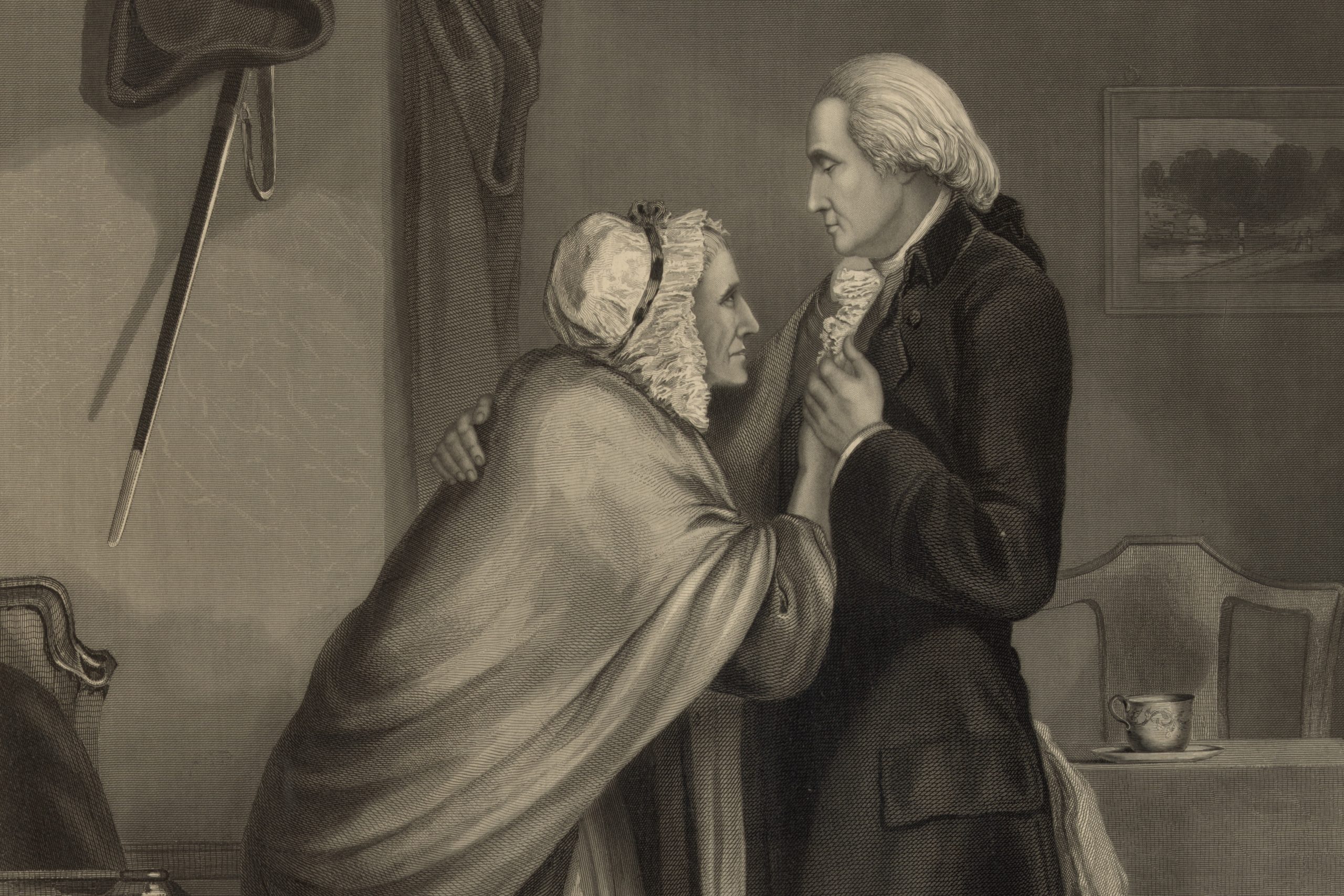
When George Washington’s father died in 1743 responsibility for the family fell to his young widow, Mary Ball Washington. George, then just eleven, was the eldest of Mary’s five children. Mary was about thirty-four. Few historical characters were more celebrated in the nineteenth century or more maligned in the twentieth. Nineteenth-century Americans celebrated her as the ideal mother for a modern republican hero — a Roman matron who gave her son for the republic and a Christian mother who raised her son to revere God and sacrificed him so that all Americans could be free. Twentieth-century historians condemned her as a selfish shrew avoided by her famous son. The truth is much more interesting.
When Augustine Washington died, the family was living at the modest plantation across the Rappahannock River from Fredericksburg known since at least the middle of the nineteenth century as Ferry Farm. The plantation was Augustine’s chief bequest to George, to be his when he reached his majority. Mary lived there for twenty-nine years after Augustine’s death, then moved into a house in town, where she died in 1789, shortly after her famous son was inaugurated as first president of the United States.
The monument over her grave in Fredericksburg, with its simple inscription — “Mary The Mother of Washington” — seems faintly sacrilegious now. It was completed in 1894, just as her reputation reached its greatest height. The dedication was attended by President Grover Cleveland, the vice president, chief justice, cabinet secretaries, the governor of Virginia, and other dignitaries. In his address to the assembled crowd, Senator John W. Daniel of Virginia celebrated Mary as “the good angel of the hearthstone, the special providence of tender hearts and helpless hands,” and traced Washington’s greatness to his mother’s training: “It was in his character, all-sufficient in every emergency, that was displayed the overtowering greatness of George Washington and it is doubted not that this character was toned and shaped by his mother’s hand. The principles which he applied to a Nation were those simple and elementary truths which she first imprinted upon his mind in the discipline of home.”1
Within a generation, professional historians, drawing on the surviving correspondence between mother and son, concluded that Mary Washington was less than a saint. She was “grasping, querulous, and vulgar,” Samuel Eliot Morison wrote in 1932, “a selfish and exacting mother, whom most of her children avoided as soon and as early as they could; to whom they did their duty, but rendered little love. It was this sainted mother of Washington who opposed almost everything that he did for the public good, who wished his sense of duty to end with his duty to her, who pestered him in his campaigns by complaining letters, and who at a dark moment of the Revolutionary War increased his anxieties by strident complaints of neglect and starvation.”2
Washington’s most important biographer, Douglas Southall Freeman, was almost as uncompromising. According to Freeman, Mary Washington was complaining, overprotective, and a “poor manager,” who concerned herself with “a thousand trifles . . . to the neglect of larger interests.” More recent biographers have followed the interpretation developed by Morison and Freeman. James T. Flexner described Mary Washington as a selfish woman who presided over a loveless, unhappy home her eldest son escaped at his first opportunity. Nearly all of Washington’s modern biographers seem to have concluded that Mary Washington had no constructive influence over the development of her famous son.3
Neither the pious interpretation of the nineteenth century nor the revisionist interpretation of the twentieth is well-grounded in documentary evidence. Mary Washington’s nineteenth-century admirers based their interpretation largely on undocumented traditions. Her twentieth-century detractors were more scholarly, but their interpretation is not justified by the very limited documentation that survives from the years after Augustine Washington’s death. Their view of Mary as a selfish, demanding woman is based largely on the later correspondence between mother and son — letters peppered with testy barbs and barely disguised anger that demonstrate that the relationship between them grew increasingly strained. But projecting this evidence back into the 1740s is neither warranted nor wise.

Residence of Washington’s Mother at Fredericksburg, Virginia, John Gadsby Chapman, 1833, Mount Vernon Ladies Association
When Washington moved permanently to Mount Vernon in 1754 he left his mother in possession of Ferry Farm, the Rappahannock River plantation bequeathed to him by his father. That circumstance belies any suggestion of estrangement between mother and son. In 1771 Washington surveyed the plantation, labeling the survey the “fields where my mother lives,” without making reference to his ownership. She lived there until 1772, when he moved her into a house in Fredericksburg that he had bought for her. Whenever he came to Fredericksburg he visited his mother, and he often stayed with her rather than his sister Betty, who was married to Fielding Lewis, one of the leading merchants in town.4
On these visits he often gave Mary money, but there were apparently disputes about these gifts, because Washington began making notes in his account book about who was present when he made them. Since we know little about Mary’s financial needs, it is not easy to say whether he was giving her less than she needed or just less than she wanted. None of his gifts were extravagant, and he may have considered most of them loans. Most were for such modest sums — £10 or so — that his practice of recording witnesses seems a bit excessive. But without more insight into the private dramas than these notes offer, we cannot say whether he was less than generous or she was too demanding. Perhaps it was a little of both.
Disputes about money grew more serious as Mary grew older. When she moved into Fredericksburg in 1772, George rented her 400-acre tract on Little Falls Run (a short distance down river from Ferry Farm) along with most of her slaves. In return for £122 annually (which included the lease of her slaves), he was to receive all the profits from the property. The rent was paid each year but Washington complained that he never received any of the profits from the place. She charged that the overseer was dishonest. Washington seems to have suspected that she was keeping at least some of the money for her own use, but during the war he could do little to correct the problem. In 1783 he asked his brother John Augustine to find a new overseer and attend to the proper management of the plantation, but it never seems to have returned anything.5
Washington’s frustration with this arrangement was compounded during the war when he learned (“from very good authority,” he assured John Augustine) that she was “upon all occasions, and in all Companies complaining of the hardness of the times,” and “of her wants and distresses.” He suspected that these complaints were the source of a proposal discussed by members of the Virginia legislature to grant her a pension, which he headed off, assuring Benjamin Harrison that his mother “has an ample income of her own.”6
Mary did not think so. To John Augustine, she lamented a few years after the war that “I never lived soe pore in my life.”7
Washington resented the implication that he was an “unjust and undutiful son.” He contended that her sense of distress was an illusion. If she were “so disposed,” he advised her, she might be “perfectly happy—for happiness depends more upon the internal frame of a persons own mind—than on the externals in the world.” True happiness, he insisted, “depends wholy upon your self, for the riches of the Indies cannot purchase it.”8
When Washington offered this advice, his mother was nearing eighty, in poor health, and she undoubtedly felt increasingly isolated and lonely. She was probably already suffering from the breast cancer that apparently caused her death two years later. Whether he was too distracted by public concerns to appreciate her situation, or whether she had become irrationally concerned about money or simply depressed by the burdens of age and infirmity, is impossible to know. But it seems imprudent to assess her role in his early life on the basis of these final, unhappy episodes.
Mary Washington was probably not the sainted mother of nineteenth-century tradition, but neither does she seem to have been the selfish incompetent portrayed by modern critics. Her relationship with her eldest son may not have always been warm or happy, but her constructive influence over him seems to have been considerable. Washington suggested as much himself in 1784, when he publicly acknowledged his debt to the woman, he said, “by whose Maternal hand (early deprived of a Father) I was led to Manhood.”9
Mary Washington was thirty-four when her husband died, but she never remarried. She apparently did not lack suitors. While George and his brothers remained minors, she had possession of a valuable estate that a new husband would be entitled to cultivate for his own benefit until the heirs reached their majority. Remarriage offered widows in Mary’s situation security but posed the risk that their children’s estates might be mismanaged (and in rare cases even despoiled) by their second husbands. Most widows accepted this risk; remarriage, usually within a year or two, was almost universal for women in Mary’s circumstances. Mary’s own father had died when she was small, and Mary’s mother had experienced considerable difficulty in establishing her property rights and those of Mary under his will. Her decision not to remarry was apparently a conscious one and may have been prompted by a determination to protect her children’s inheritance and pass it on intact, which she succeeded in doing. This determination suggest the kind of independent spirit and strong will that would be among her eldest son’s most prominent characteristics.10
As the oldest male in the household after his father’s death, George undoubtedly helped his mother manage the plantation he was destined to inherit. Under her guidance he first learned to give orders and to have them obeyed. The recollections of George’s cousin, a frequent visitor to Ferry Farm, suggest that she was a strict disciplinarian and a demanding taskmaster:
I was often there with George, his playmate, schoolmate, and young man’s companion. Of the mother I was ten times more afraid than I ever was of my own parents. She awed me in the midst of her kindness, for she was, indeed, truly kind. I have often been present with her sons, proper tall fellows too, and we were all as mute as mice; and even now, when time has whitened my locks, and I am the grand-parent of a second generation, I could not behold that remarkable woman without feelings it is impossible to describe. Whoever has seen that awe-inspiring air and manner so ‘characteristic in the Father of his Country, will remember the matron as she appeared when the presiding genius of her well-ordered household, commanding and being obeyed.11
Her eldest son would become an exacting taskmaster, determined to wrest the maximum labor from his workers. The farm reports Washington demanded from his managers, which calculate the number of man-days devoted to specified tasks, are among the most detailed plantation records known to survive from the eighteenth century. They suggest a mind obsessed with discipline and order.
Underscoring his formative experiences in plantation management at Ferry Farm must have been the need to use the resources left to the family after the dispersal of Augustine’s estate to maximize the family’s income, which must have diminished dramatically after Lawrence and Austin took possession of most of their father’s productive property. The importance of efficiency, and the need to conserve scarce resources and to use them for maximum effect were lessons George Washington carried with him throughout life, and influenced his conduct in war and statecraft as well as in the management of his private affairs.
Mother and son may not have gotten along all very well because they were much alike. Finding herself in unexpectedly difficult circumstances after Augustine’s death, Mary needed to be tough-minded, strict with subordinates, and extremely careful with her money. The old-age confession of one of George’s cousins that he was ten times more afraid of Mary than he was of his own parents has the ring of truth. Her eldest son grew to be a tough-minded adult, a strict disciplinarian, careful with his money. His anger, when aroused, terrified his subordinates. It is not hard to see George Washington as a reflection of his mother.
Notes
- For an example of the encomiums to Mary, see Jared Sparks, The Writings of George Washington, vol. 1 (Boston: American Stationer’s Company, 1837), 4-5; Rufus Griswold wrote that “there is no fame in the world more pure than that of the mother of Washington, and no woman since the Mother of Christ has left a better claim to the affectionate reverence of mankind”; see Rufus W. Griswold, The Republican Court, or, American Society in the Days of Washington (New York. D. Appleton and Company, 1855), 125. Nineteenth-century efforts to memorialize her are amply documented in Susan R. Hetzel, The Building of a Monument: A History of the Mary Washington Associations and their Work (Lancaster, Pennsylvania: Press of Wickersham Company, 1903). For Daniel’s speech at the dedication, see pp. 153-57. [↩]
- Samuel Eliot Morison, The Young Man Washington (Cambridge: Harvard University Press 1932), 10; This work was given as an address at Harvard University in commemoration of the 200th anniversary of GW’s birth. It was published separately as a pamphlet, and reprinted (without source notes) in Morison’s collection, By Land and By Sea: Essays and Addresses by Samuel Eliot Morison (New York: Alfred A. Knopf, 1953), 161-80. [↩]
- Douglas Southall Freeman, George Washington: A Biography (7 vols., New York: Charles Scribner’s Sons, 1948-1954), 1: 193. The documentation of the long paragraph in which Freeman offers this assessment is uncharacteristically light. For Freeman’s reflections on the problem of interpreting GW’s relationship with his mother, see Freeman, Washington, 1: xix-xx; James Flexner’s contention that Mary Washington “lived into George’s second term as President” but “never budged from home to take part in any triumphant moment of his career” displays a gross ignorance of her circumstances and even of indisputable fact. Mary Ball Washington died in 1789, shortly after her son’s first inauguration. James T. Flexner, George Washington: The Forge of Experience (Little, Brown and Company, 1965), 19. In his biography of Washington, John Ferling describes Mary Washington as a “tough, opinionated, selfish, overly protective, and possessive woman.” John Ferling, The First of Men: A Life of George Washington (Knoxville: The University of Tennessee Press, 1988), 6. The Morison-Freeman interpretation is echoed in Paul K. Longmore, The Invention of George Washington (Berkeley: University of California Press, 1988), 1, and in more recent biographical works. In Washington: A Life (New York: The Penguin Press, 2010), Ron Chernow describes Mary as “crude,” “slovenly” and “illiterate,” a woman who “leveled a steady stream of criticism” at her son. [↩]
- These visits are documented in Donald Jackson and Dorothy Twohig, eds., The Diaries of George Washington (6 vols., Charlottesville: University Press of Virginia, 1976-79); see, e.g., 2: 132 (March 6, 1769), 193 (Nov. 1, 1769), 204 (Dec. 26, 1769), 236 (May 19, 1770); in light of such visits, Freeman’s contention that “he did not wish to be with her” has no merit. (Freeman, Washington, 1: xix). Washington sometimes dined with his mother and spent the night with his sister; on other occasions he dined with his sister and spent the night with his mother. But whatever the arrangement he did not fail to spend time with her when he visited the town. [↩]
- GW to John Augustine Washington, January 16, 1783, John C. Fitzpatrick, ed., The Writings of George Washington (39 vols., Washington: Government Printing Office, 1931-44), 26: 41-45. [↩]
- ibid. [↩]
- Mary Washington to John Augustine Washington [no date, but written before John Augustine’s death in January 1787], Mount Vernon Ladies Association. [↩]
- GW to Mary Washington, February 15, 1787, W.W. Abbot, ed., The Papers of George Washington, Confederation Series (6 vols., Charlottesville: University Press of Virginia, 1992-1997), 5: 33-37. [↩]
- This public tribute to his mother might be regarded as formulaic, but Washington seems to have given the passage some thought. In the draft of his remarks, Washington wrote “led from childhood,” but subsequently changed this to the stronger, more emphatic phrase, “led to Manhood.” GW to the Citizens of Fredericksburg, February 14, 1784, W. W. Abbot, ed., Papers of George Washington, Confederation Series 1: 122-23. [↩]
- On the remarriage of widows in colonial Virginia, see Darrett and Anita Rutman, A Place in Time: Middlesex County, Virginia, 1650-1750 (New York: W. W. Norton & Company, 1984), 114; for a more detailed examination of the same matter, see Darrett and Anita Rutman, “‘Now-Wives and Sons-in-Law’: Parental Death in a Seventeenth-Century Virginia County,” in Thad W. Tate and David L. Ammerman, eds., The Chesapeake in the Seventeenth Century: Essay on Anglo-American Society (Chapel Hill: University of North Carolina Press, 1979), 153-82; on the legal disputes over the estate of Joseph Ball I, see Freeman, Washington, 1: 44. [↩]
- The cousin was Lawrence Washington of Chotank. His recollections are quoted in George Washington Parke Custis, Recollections and Private Memoirs of Washington (New York: Derby & Jackson, 1860), 131. [↩]