On the night of April 21, 1775, twenty-one-year-old Ebenezer Huntington left Yale College and rode thirty miles to Wethersfield, Connecticut. He was scheduled to graduate in September — in those days Yale seniors were examined in July and commencement was in September — but a college degree was probably far from his mind that night. News had just reached New Haven that British regulars had fired on Massachusetts militia at Lexington and that the regulars had been driven back to Boston in a running fight from Concord all the way to Boston Neck. Massachusetts militia, joined by men from New Hampshire, Rhode Island, and Connecticut were assembling at Cambridge to surround Boston and perhaps even drive the British out.
Ebenezer left Yale without securing permission from his college president, Reverend Naphtali Daggett. This was a breach of Yale’s rules that jeopardized his graduation. He might have hoped for Daggett’s indulgence. The president was an outspoken patriot (he would die in 1780 from wounds inflicted by British troops) but the faculty refused to grant Ebenezer’s request to leave several weeks early. Yale suspended the traditional September commencement in 1775 and awarded degrees to its seniors — including the absent Ebenezer — on July 25.1
On April 22 Ebenezer joined the Wethersfield alarm company commanded by his brother-in-law John Chester. The company promptly marched for Cambridge, a hundred miles away. A resort to arms might have seemed inevitable to Ebenezer and many other men his age. Political tensions between colonists and British authorities had been mounting since he was a boy. Resistance to the Stamp Act had swept through the colonies when he was ten. British troops had killed colonists in the Boston Massacre when he was sixteen. The British army occupying Boston had engaged in increasingly aggressive provocations while Ebenezer was at Yale.
Born in 1754, Ebenezer had grown up in a patriot household in Norwich, Connecticut. His father, Jabez, an important merchant and community leader, joined the Sons of Liberty and became a leader of the patriot resistance when Ebenezer was a boy. Jabez taught his sons Andrew, Joshua, Zachariah, and Ebenezer to cherish the liberties the colonists had long enjoyed — liberties threatened by increasingly authoritarian imperial regulations and military occupation.
Private Ebenezer Huntington’s first weeks in the barely organized provisional army may have seemed like a great adventure, but he soon learned the grim reality of military life. Spared fighting at Bunker Hill, he witnessed the wounded return from the battlefield. He watched the spread of smallpox in the army, and learned that death from disease — often brought on by unsanitary conditions in camp, exposure and inadequate food and clean water — killed more men than the British. And he saw how unprepared the colonists were for war. They lacked sufficient artillery, muskets, ammunition and gunpowder. The army seemed deficient in everything needed to carry on a war.
But Ebenezer saw that the men had spirit. He was pleased to report that the soldiers with him did not fear enemy artillery fire. “Our men in General did not regard their firing one half so much as they do a Shower of hail,” he wrote home:
Those men belonging to the Train of Artillery from Rhode Island Espyed a Sheel falling ran up to it knocked out the Phiz and brought it up to the General with almost two Pounds of Powder in it, it is Strange that our People regard their firing no more than they do but ‘tis Certainly true they do not Pay any Attention to it.2
George Washington arrived to take command of what was known thereafter as the Continental Army at the end of June 1775. Discipline and order soon improved. In September, Ebenezer was promoted to lieutenant in John Chester’s company. As summer faded to winter and the army settled in for the siege, Ebenezer shared his observations on the war with his father and brothers back in Norwich — the beginning of a remarkable series of letters documenting his service, his frustrations, and his idealism. The United States prevailed in its war for independence because of the commitment of Ebenezer Huntington and young men like him.
On March 4, 1776, he wrote that his regiment had received orders to take “Dorchester Hill” and that a battle seemed imminent. Ebenezer arranged to have his belongings sent home if he should perish. That night he was one of thousands of Continental soldiers who occupied Dorchester Heights along with the heavy artillery to command Boston Harbor and force a showdown with British. Like many others, Ebenezer expected a British attack and a second, desperate battle like Bunker Hill. Instead the British decided to evacuate Boston. Ebenezer expressed his disappointment to his father: “I believe it would have Put an End to the War in the N England Colonies, Had an Action taken Place.”3
Ebenezer decided to resign after the British evacuated Boston. He may have been discouraged by the condition of the army or thought he could better serve the cause by working with his brother Andrew in Norwich, securing supplies and fitting out privateers. He also seems to have chafed, as many officers did during the war, at seeing another man advanced in rank ahead of him. I “am determin’d for myself never to act as a Subaltern Officer again & Joel Hyde to have a Captaincy,” he grumbled. He went to General Washington to submit his resignation, but found Washington “not a little Surprized that I should wait on him with such a request & Gave me a very severe Reprimand.” Ebenezer’s brother Jedediah intervened and secured a furlough for Ebenezer.4
Ebenezer’s temper may have been cooled by his promotion to captain in May 1776, about the time the army moved to defend New York City. He had been under artillery fire at Roxbury during the Siege of Boston, but Ebenezer’s first experience of battle came on August 27, 1776, at the Battle of Brooklyn. The regiment sustained heavy casualties and was forced to retreat along with the rest of Washington’s army. Captured men, including young men Ebenezer had known from childhood, were confined in empty sugar warehouses and later in rotting hulks moored off Brooklyn — crammed together below decks, denied adequate food and water, and forced to live in filth. Many never returned home.5
Defeat at Brooklyn did no diminish his enthusiasm nor his hope for victory. Ten days after the battle he wrote from Manhattan that “we Expect an attack Soon I hope & Trust under the Smiles of Heaven we Shall Be able to Defeat our Cruel & unnatural Enemys.” The disasters of the following weeks changed his mood. Washington’s army lost New York City and then all of Manhattan, including Fort Washington, with much of the army’s remaining artillery and stores. “The present appearance is very Gloomy,” he wrote in late November, “the British troops making head whereever they attempt, our people instead of behaving like brave men, behave like Rascalls.”6
Like a seasoned regular, Ebenezer reserved his worst scorn for the unreliable militia. “The Militia Who have been sent for our Assistance,” he complained, “leave us the minute their times are out & would not stay tho’ their eternal Salvation was to be forfeited it they went home: The Persuasion of a Cisero would not any more Effect their tarry; than the Niagara falls would the Kindling of a Fire.”7
Late November and December 1776 was the army’s lowest point. Ebenezer can be forgiven for being pessimistic. His enthusiasm returned in January, when news reached him of Washington’s victory at Princeton. “The Enemy are Pounded & Harrested & I think that by the latter end of this week I may inform you that they are drove to the Extremity if not entirely from the state of N Jersey,” he wrote joyfully to his brother Andrew, “our army in great good Spirits & the Enemy retreating before them the bigger part of which have agree’d to tarry Six weeks longer the Enemy retreating in a great Precipatition.”8
Ebenezer and his regiment could only cheer the victory from afar. They had been assigned the critical task of defending the Hudson Highlands from a British attack up the river. This was a critical role. Much of the supplies for Washington’s army came from Connecticut and had to be ferried across the Hudson River north of West Point to reach the army in New Jersey. If the British had been able to take control of the Hudson Valley, they would have cut Washington’s lifeline. Ebenezer was promoted to major in January 1777.
Essential though it was, service in the Hudson Highlands was frustrating — far from the active theater of the war. News was scarce, he complained. Ebenezer’s time was consumed with the problems of supply and other logistical matters. In November 1777 he was again on verge of resignation. “I expect to leave this Regiment & the Army, before the opening of Another years Campaign,” he wrote to his Andrew. Yet he was concerned about his men, and asked Andrew to send him supplies for his command. That winter he secured leave to visit his brother Joshua and help him harvest the winter pumpkin crop.9
Ebenezer’s winter discontent dissolved with the return of spring and the opportunity for more active service. In the summer of 1778 his regiment was sent to reinforce John Sullivan’s campaign to retake Newport. The British mounted an attack on Sullivan’s position at the north end of Rhode Island. Sullivan’s army was forced to abandon the island, but the defeat did not dim Ebenezer’s enthusiasm. He wrote with pride to Andrew:
Command of the Reg’t during & Just before the Action, Devolved on me . . . as Col’ Livingston had left the Reg’t and rode over to the left to see how the Actions went on & in his Absents, received a slight Wound, by which Means he did not join the Reg’t till the Actions was over which lasted very heavy about Nine Minute, at about fifteen Rods Distance; the rest of the time was rather Long Shot.10
In October 1778 Ebenezer was promoted to lieutenant colonel. The responsibilities of command, and especially of caring for his men, weighed on him. He begged his father to persuade the Connecticut legislature to provide adequate pay and provisions for its soldiers. “Not a Day Passes,” he wrote his father,
but some Soldier with Tears in his Eyes, hands me a letter to read from his Wife Painting forth the Distresses of his Family in such strains as these ‘I am without bread, & Cannot get any, the Committee will not Supply me, my Children will Starve, or if they do not, they must freeze, we have no wood, neither Can we get any — Pray Come Home’ — These Applications Affect me. My Ears are not, neither shall they be shutt to such Complaints, they are Injurious they wound my feeling, & while I have Tongue or Pen I will busy myself to stir up my Countrymen to act like men who have all at Stake, & not think to enriched themselves, by the Distresses of their brave Countrymen, in the Field.11
The twenty-four year-old lieutenant colonel worried that his men would go home at the end of their enlistment, and promised to advocate for these ragged soldiers so long as he possessed a “Tongue or Pen.”
Huntington’s regiment remained in Rhode Island through the winter of 1778 and most of 1779, then marched, threadbare and hungry, for Washington’s winter camp at Morristown, New Jersey. It was already December when they marched. “It will be extreme Cold in tents which we shall make use of Every Night,” Ebenezer wrote, and it would take several weeks to complete huts to house his men once they reached Morristown. In the meantime they had to endure the most ferocious winter in memory. “The oldest people now living in this country” General Washington wrote, “do not remember so hard a Winter.”12
Ebenezer thought once more about leaving the army. Regiments were much reduced, he wrote to Andrew, and there were too many officers for too few men. Perhaps, he speculated, he would be deranged — rendered a supernumerary in a reorganization of the army and sent home. “It would be very agreeable,” he confessed, “to live at Ease & Quietness once more (free from the Noise & Din of Arms) & restore an Injured Constitution, too much worn in the Service of an Ungrateful Country.”13
Instead he was drawn again into active campaigning. In June 1780 the British marched on Washington’s camp at Morristown. Washington’s army repulsed them at near Springfield, New Jersey, on June 23. Weeks later Huntington and his men were still maneuvering through the burned over countryside of northern New Jersey, parrying British threats, with barely anything to eat and almost no supplies. For want of tents & teams to Carry them,” he wrote to Andrew, “we have lain in the Woods without any Covering but what the Almighty gives the Brute Creation to which State we verge fast.” It was too much. He finally exploded in a torrent of anger:
The Rascally Stupidity which now prevails in the Country at large, is beyond all descriptions. They Patiently see our Illustrious Commander at the Head of 2,500 or 3,000 Ragged tho Virtous & good Men & be oblig’d to put up with what no troops ever did before. Why dont you Reinforce your Army, feed them Clothe and pay them, why do you Suffer the Enemy to have a foot hold on the Continent? You Can prevent it, send your Men to the field, believe you are Americans Not suffer yourselves to be dup’d into the thought that the french will relieve you & fight your Battles, it is your own Supineness that induc’d Congress to ask foreign Aid, it is a Reflection too much for a Soldier, You dont deserve to be freemen unless you can believe it yourselves, when they arrive they will not put up with such treatment as your Army have done they will not serve Week after Week without Meat without Cloathing, & paid in filthy Rags. I despise My Countrymen. I wish I could say I was not born in America, I once gloried in it but am now ashamed of it — If you do your duty, tho’ late, you may finish the War this Campaign, you must Immediately fill your Regiments, & pay your troops in Hard Monies they can not exist as Soldiers otherwise — The Insults & Neglects which the Army have met with from the Country, Beggers all description, it must Go no farther they can endure it no longer, I have wrote in a Passion, indeed I am scarce ever free from it — I am in Rags, have lain in the Rain on the Ground for 40 hours past, & only a Junk of fresh Beef & that without Salt to dine on this day, rec’d no pay since last December Constituents complaining, & all this for my Cowardly Countrymen who flinch at the very time when their Exertions are wanted, & hold their Purse Strings as tho they would Damn the World, rather than part with a Dollar to their Army.14
Ebenezer’s undisguised wish to be sent home went unfulfilled. As angry and frustrated as he was, he had become a remarkably effective officer who had the loyalty and confidence of his men. His superiors recognized it. “I find that I am Arranged on the New Establishment,” he told Andrew in late November 1780, “which is by no means pleasing.” But he would not resign. Whether he was prepared to admit it or not — whether he truly understood himself or not — he was too deeply committed to the American cause to quit.15
Instead of being sent home, he was detached from his regiment and given command of light infantry — elite troops in the armies of the eighteenth century. When summer came the army maneuvered around the British lines outside New York City, probing for an opening. Ebenezer found himself operating for the first time beside French troops, whose “officers dine in luxury,” he noted, while Americans went hungry and were clothed in rags. No people, he reflected, “deserve freedom . . . who are neither willing to Contend for Freedom Personally or for those who will defend their Cowardly Souls.” Yet he continued to fight for the freedom of his ungrateful countrymen.16
The drama of a strenuous campaign distracted Ebenezer from his discontents. At the end of August, the combined armies of Washington and Rochambeau marched south, headed for Yorktown, where a British army under Cornwallis had entrenched and was waiting for support from British land and naval forces in New York. The allies invested Yorktown at the end of September and began to bombard the British line on October 9. Ebenezer wrote to Andrew the next day: “At present we have about 30 heavy pieces open’d on the town, but in 6 days more unless his Lordship Complains of our fire, we shall have upward of Ninety including Mortars to teaze him with, which must Inevitably from his Situation oblige him to Surrender.” As Ebenezer predicted, Cornwallis surrendered on October 19. The young lieutenant colonel formed up with the senior officers of the allied army to watch the surrender.17
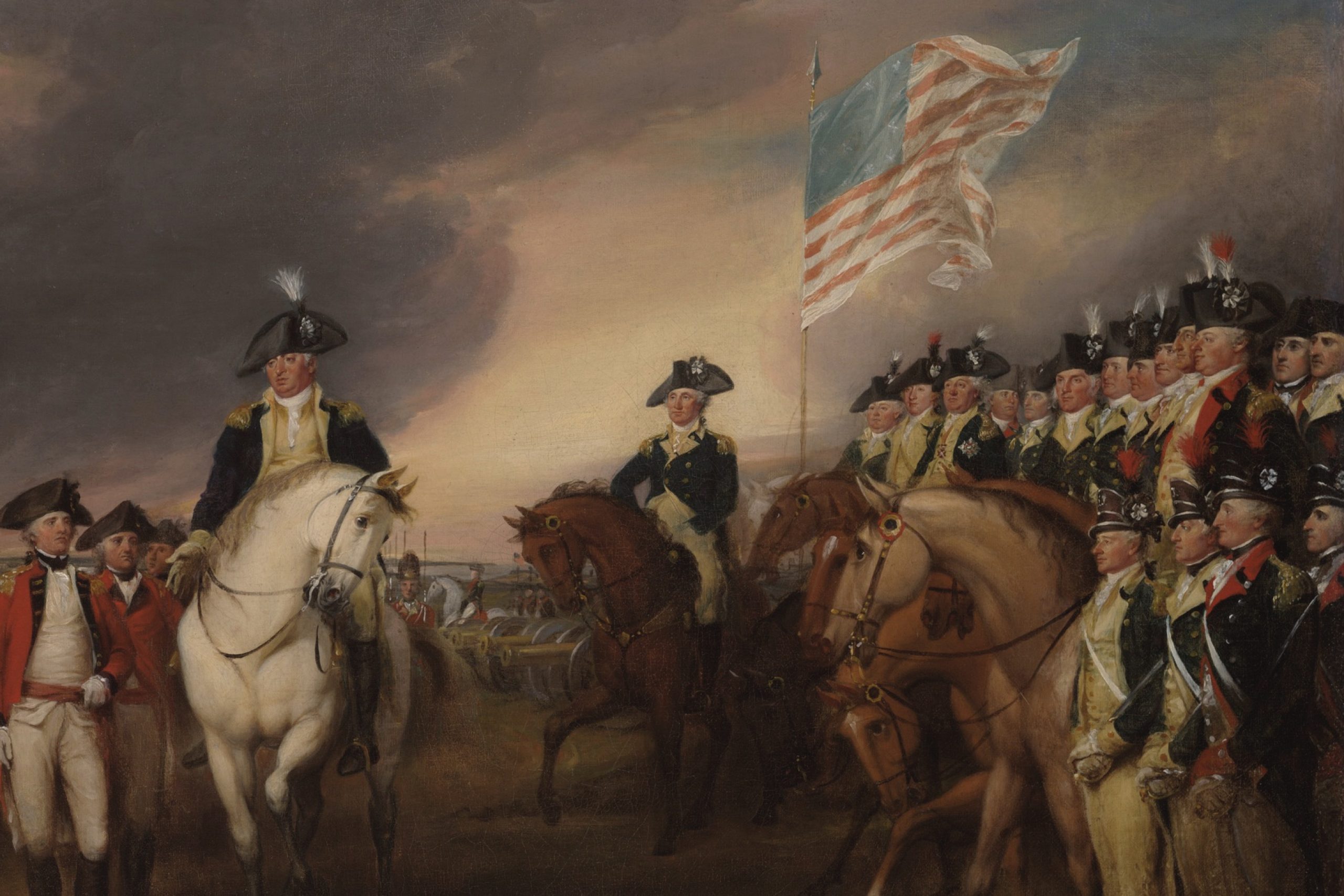
John Trumbull portrayed Ebenezer Huntington in his heroic painting of The Surrender of Lord Cornwallis at Yorktown. Huntington is at upper right behind the row of mounted officers, one in from the right side of the canvas. Yale University Art Gallery
The joy of victory was short lived. Washington’s army marched back to the Hudson to contain the army of Sir Henry Clinton, which still occupied New York City. The Continental Army — still poorly supplied and often unfed — watched and waited, while peace negotiations in Europe dragged on through 1782. Finally, in the spring of 1783, Ebenezer was able to report that news of a treaty of peace had reached America. “The Commander in Chief has announced it to us,” he wrote home, and “very soon we shall be disolved as a Military body, & Join with our Countrymen in the Walks of Private Life.”18
Ebenezer Huntington — who had threatened to leave the Continental Army repeatedly — was one of the last officers of the Continental Army to surrender his commission and return home. He finally left the army on November 3, 1783. Since the night he rode from New Haven, he had fought in some of the war’s greatest battles, marched thousands of miles, and risen through the ranks to become one of the most respected line officers in the Continental Army. He was a few weeks short of twenty-nine years old.
On other Americans committed to the cause, see Margaret Corbin, Revolutionary, The Elusive Peter Hunter, and Joseph Plumb Martin, Everyman, all in The American Crisis.
Notes
- The president and faculty of Harvard College, impressed with Ebenezer’s commitment to the cause, awarded him a diploma on August 8. [Samuel Gladding Huntington, Richard Thomas Huntington, and Samuel Huntington], The Huntington Family in America (Hartford, Connecticut: privately printed for the Huntington Family Association, 1915), 518-21; see also Franklin B. Dexter, Biographical Sketches of the Graduates of Yale College, vol. 3: May 1763-July 1778 (New York: Henry Holt and Company, 1903), 565-67. [↩]
- EH to Jabez Huntington [hereafter JH], June 25, 1775, [Charles Frederick Heartman] Letters Written by Ebenezer Huntington during the American Revolution (New York: privately printed, 1914), 16-17. [↩]
- EH to JH, March 4, 1776, Heartman, Letters Written by Ebenezer Huntington, 30. [↩]
- EH to JH, March 24, 1776, Heartman, Letters Written by Ebenezer Huntington, 34. [↩]
- For a first-hand account of the treatment of prisoners taken at the Battle of Brooklyn, see the manuscript account of Lieutenant Jabez Fitch for August 22, 1776-December 15, 1777 now in the New York Public Library. A facsimile was published, apparently under the auspices of the Prison Ship Martyrs’ Monument Association, in or shortly after 1897 (presumably in New York), when the manuscript was still in private hands. The facsimile was titled Diary of Captain Jabez Fitch. The document is not a diary, but the title stuck; it is described as a diary in the New York Public Library catalogue. William Henry Waldo Sabine later transcribed and published the manuscript as The New-York Diary of Lieutenant Jabez Fitch of the 17th (Connecticut) Regiment from August 22, 1776 to December 15, 1777 (New York: Colburn & Tegg, 1954). Fitch composed it in or about April 1777 as a personal narrative of the experience of American prisoners in New York from the Battle of Brooklyn until the spring of 1777, which he sent with an explanatory cover letter to his brother. The narrative was apparently based on a diary Fitch kept during that time. [↩]
- EH to JH, September 7 and November 25, 1777, Heartman, Letters Written by Ebenezer Huntington, 43, 53. [↩]
- EH to JH, November 25, 1777, Heartman, Letters Written by Ebenezer Huntington, 53. [↩]
- EH to Andrew Huntington [hereafter AH], January 5, 1777, Heartman, Letters Written by Ebenezer Huntington, 57. [↩]
- EH to AH, November 9, 1777, Heartman, Letters Written by Ebenezer Huntington, 64-65. [↩]
- EH to AH, September 21, 1778, Heartman, Letters Written by Ebenezer Huntington, 73-75. [↩]
- EH to JH, December 21, 1778, Heartman, Letters Written by Ebenezer Huntington, 77-78. [↩]
- EH to AH, December 3, 1779, Heartman, Letters Written by Ebenezer Huntington, 82; George Washington to the marquis de Lafayette, March 18, 1780, John C. Fitzpatrick, ed., The Writings of George Washington, vol. 18: February 10-June 11, 1780 (Washington: Government Printing Office, 1937), 122-25. [↩]
- EH to AH, February 8, 1780, Heartman, Letters Written by Ebenezer Huntington, 83-84. [↩]
- EH to AH, July 7, 1780, Heartman, Letters Written by Ebenezer Huntington, 86-89. [↩]
- EH to AH, November 27, 1780, Heartman, Letters Written by Ebenezer Huntington, 90. [↩]
- EH to AH, August 2, 1781, Heartman, Letters Written by Ebenezer Huntington, 93-95. [↩]
- EH to AH, October 10, 1781, Heartman, Letters Written by Ebenezer Huntington, 96. [↩]
- EH to AH, March 29, 1783, Heartman, Letters Written by Ebenezer Huntington, 104. [↩]