The American Revolution was an unusually cerebral revolution. Its heroes included philosophers as well as soldiers. Its political leaders combined sophisticated political thought with political action in a way not seen in this country since. Their ideas — and their stubborn determination to make those ideas the foundation of effective government — still shape our world. Few have had more lasting influence than George Mason, a retiring Virginia planter who cherished personal liberty and virtuous citizenship.
“Steadfast, able, and zealous,” Thomas Jefferson wrote, Mason was
a man of the first order of wisdom among those who acted on the theatre of the revolution, of expansive mind, profound judgment, cogent in argument, learned in the lore of our former constitution, and earnest for the republican change on democratic principles. His elocution was neither flowing nor smooth; but his language was strong, his manner most impressive, and strengthened by a dash of biting cynicism, when provocation made it seasonable.1
Mason is not well known today. He did not pursue fame like Washington, Jefferson, and some of their contemporaries. But he deserves immortality as much as any of them. He was one of the most important champions of liberty in history, a philosopher-politician who demanded effective safeguards for individual rights.2
An Unlikely Revolutionary
Mason was the son and grandson of gentlemen-planters. He was born on his father’s plantation on Dogue Neck (now Mason’s Neck) in 1725. His father drowned in a ferry accident when George was nine. Thereafter his education was overseen by his mother’s brother, John Mercer, a scholarly planter and lawyer who owned one of the largest libraries on the Northern Neck of Virginia. Mason never attended college, but he learned to read Latin and familiarized himself with much of the classical literature so widely favored by cultivated gentlemen in the eighteenth century. He also read deeply in philosophy and became one of the most cerebral revolutionaries of his time.
Unlike Thomas Jefferson, John Adams and other intellectual leaders of the revolutionary generation, Mason was not a lawyer and never seems to have made a systematic study of the law, at least of the kind that prepared a man to practice it. In this regard he was something like James Madison, the young intellectual who was, for a time, Mason’s protégé in the Virginia legislature. Yet Madison had a sophisticated formal education at Princeton, and stayed on after graduation to engage in post-graduate studies under the guidance of John Witherspoon. He was used to contrary views and schooled in give and take. Mason spent most of life studying alone. He reached his own conclusions, free of challenge and without the exchanges that sharpen rhetorical skills and prepare a man to compromise.

George Mason was only seventeen when he wrote his name on the title page of this copy of John Locke’s Essay Concerning Human Understanding, one of the foundations of Enlightenment thought. Locke’s contention that the mind is a blank slate at birth and that all knowledge is based on subsequent sensory experience is the intellectual basis for the revolutionary assertion of universal equality. Courtesy Merrill’s Auctioneers, Williston, Vermont
This experience made Mason an honest and forthright scholar, but also prickly, blunt and uncompromising. He was learned but grumpy, a hard man to be close to and perhaps a hard man to like. He found the posturing of polite society boring. “I begin to grow heartily tired of the etiquette and nonsense so fashionable in this city,” he wrote from Philadelphia in the summer of 1787. “It would take me some months to make myself master of them, and that it should require months to learn what is not worth remembering as many minutes, is to me so discouraging a circumstance as determines me to give myself no manner of trouble about them.”3
He had a short temper which seems to have worsened with age. He had little patience with legislative maneuvering. He wrote to Richard Henry Lee in 1779, in a typically irascible way, about some legislation they both supported: “I understand both Bills are to be warmly opposed, & before they get thro’ our Butcher’s Shambles, the Committee of the Whole House, they will probably be mutilated mangled & chop’d to Peices.”4
He was perfectly able to turn his temperamental judgments against himself. He was the chief advocate for requiring federal congressmen to be at least twenty-five. In his notes on the debates in the Federal Convention, James Madison recorded that Mason had said that “he would if interrogated be obliged to declare that his political opinions at the age of twenty-one were too crude and erroneous to merit an influence on public measures,” adding that “it had been said that Congress had proved a good school for our young men. It might be so for any thing he knew but if it were, he chose that they should bear the expense of their own education.”5
Mason was a most unlikely revolutionary. He was older than most of the revolutionary leaders — seven years older than his neighbor George Washington, seventeen years older than Jefferson. His health was not strong; he suffered from gout through most of his adult life, which must have compounded his natural irritability. He was known as “Colonel” Mason, but the militia title was a really a courtesy. A less martial character is hard to imagine.
Nor did Mason enjoy being a legislator. He regarded public office as a burden, and he could never bring himself to sit in public assemblies and listen to the endless harangues of little men about little problems. Though he served several term in the Virginia legislature, he never relished it, and once described an effort to secure his reelection “as an oppressive & unjust Invasion of my personal Liberty.”6
He much preferred to remain at Gunston Hall, his elegant Fairfax County home, and manage his own affairs. No important figure in American history is more intimately tied to a single place. But on two great occasions Mason left his home, his large family, and his books, and rendered services to his country that earned him a place among the immortal heroes of our history.
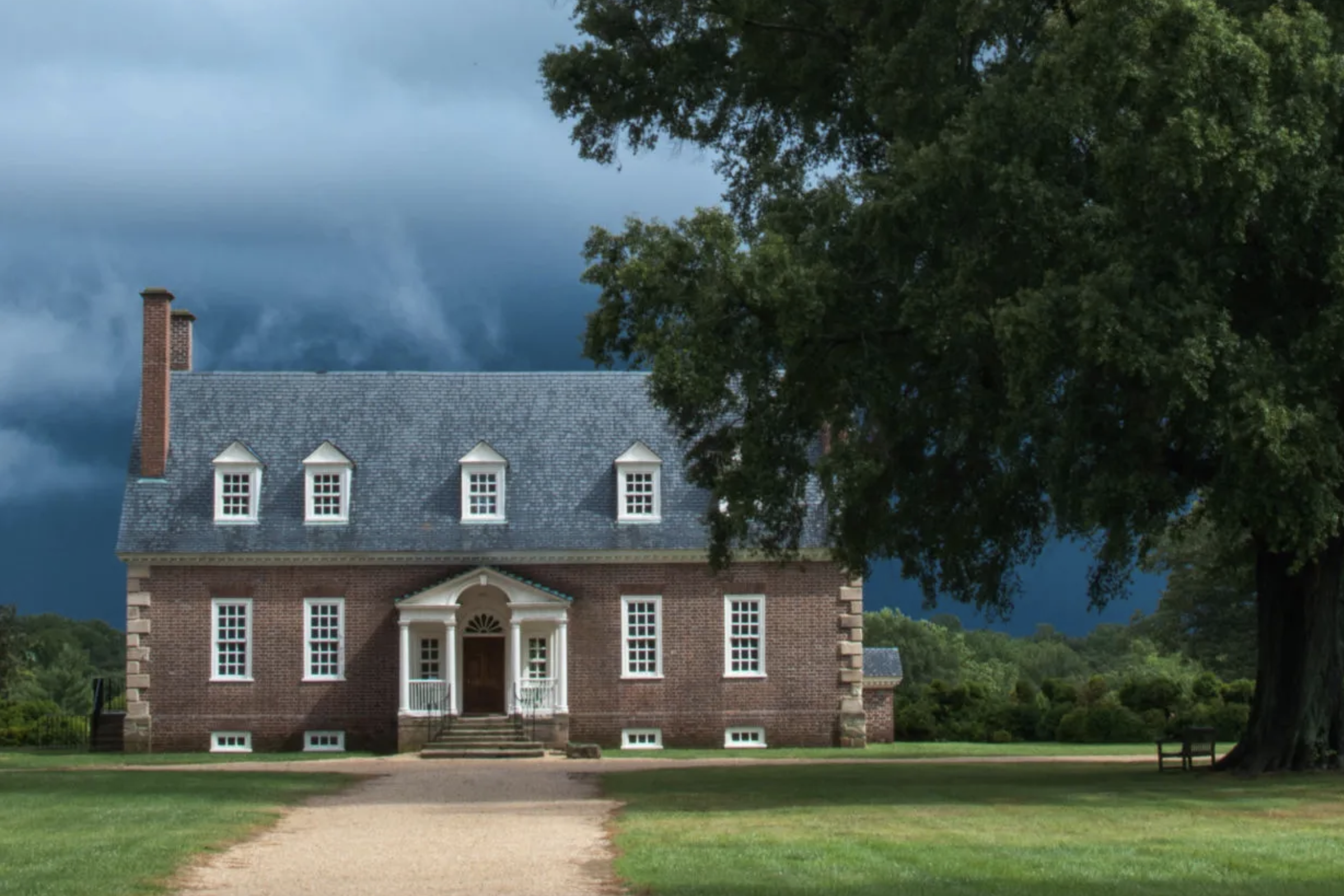
For George Mason, personal independence was more precious than acclaim. He built Gunston Hall between 1755 and 1759 and preferred private life there to public office. Courtesy George Mason’s Gunston Hall
Equally Free
In the spring of 1776 Mason represented Fairfax County in the Virginia Convention which had taken the place of the colonial House of Burgesses and was preparing a constitution for the new commonwealth. Assigned to a committee to draft a bill of rights, he grumbled about parliamentary procedures and “useless” committee men and wrote the Virginia Declaration of Rights more or less on his own. It became, and remains, one of the most influential and widely-imitated assertions of natural and civil rights.
“All men are born equally free and independent,” Mason began, “and have certain inherent natural rights, of which they can not by any compact, deprive or divest their posterity; among which are the enjoyment of life and liberty, with the means of acquiring and possessing property, and pursuing and obtaining happiness and safety.”7
Aristocrats, cautious go-slow men, and closet tories blanched at the opening words, certain that Mason was inviting a slave insurrection. The “monsters,” Mason’s ally Thomas Ludwell Lee wrote, “kept us at bay on the first line, which declares all men to be equally free and independent.” But Mason’s words survived to become the first official act that led, through gradual, halting, and painful steps, to the abolition of slavery and the acknowledgment of human rights for all.8
Mason’s Declaration went on to assert that the power of government “is derived from the People,” who retain “an indubitable, inalienable, and indefeasible Right” to “reform, alter or abolish” any government at will. Mason also outlined the most basic civil rights, including the rights to a speedy trial by jury, and against self-incrimination, unlawful seizure of property, and unjustified imprisonment. Mason asserted that “the freedom of the press” is “one of the great bulwarks of liberty, and can never be restrained but by despotic governments.” Mason’s Declaration also provides for religious toleration, asserting that “all men are equally entitled to the free exercise of religion” and that all should practice “Christian forbearance, love, and charity toward each other.” It also provided that “a well-regulated militia, composed of the body of the people, trained to arms, is the proper, natural, and safe defense of a free state; that standing armies, in time of peace, should be avoided as dangerous to liberty; and that in all cases the military should be under strict subordination to, and governed by, the civil power.”
Each provision was debated and many were contested. Patrick Henry convinced the convention to drop Mason’s ban on ex post facto laws. A quiet young delegate from Orange County — twenty-five year-old James Madison — unsuccessfully urged the convention to broaden the article on religious toleration. The Declaration that emerged from this debate was a triumph in applied political theory. It influenced declarations adopted in Pennsylvania, North Carolina, Maryland, Delaware, Massachusetts, and Vermont. Mason’s Declaration — one of the greatest achievements of the American Revolution — shaped the Bill of Rights attached to the Federal Constitution and similar declarations adopted in other countries. Its author, the French philosopher Condorcet wrote, had earned “the eternal gratitude of mankind.”9
Obtaining Happiness
Mason’s Declaration of Rights sounds much like the Declaration of Independence. Thomas Jefferson, in fact, may have derived the famous assertion of the inalienable rights to “life, liberty, and the pursuit of happiness” from Mason’s formulation. But there are subtle and important differences between the two documents, as there were between Mason and Jefferson as political thinkers.10
Mason tells us that people have the right to the “means of . . . pursuing and obtaining happiness.” Jefferson mentioned only a right to the pursuit, which seems empty by comparison.7
For neither man was pursuit synonymous with mere seeking. Pursuit involved following. Even today one pursues a fleeing criminal or a course of study. In the eighteenth century pursuit implied even more strongly a correct path toward a goal. So when Mason and Jefferson tell us that people have a right to pursue happiness, they do not mean that people have a right to seek happiness however they like. They mean for us to pursue happiness by cultivating virtue.
Nor was happiness as vague a goal as it now seems. Happiness did not mean pleasure, though eighteenth-century thinkers held that happiness ought to be pleasant. For thinkers like Mason, a person achieved happiness when his condition fit his character, talents, and abilities. Mason believed that people have a fundamental right to the “means” to reach this happy condition.
But what did Mason mean by “means”? Means is now treated as a synonym for assets; we describe a poor person as having limited means. In the modern idiom, Mason seems to be asserting that a person has a right to the assets he needs to obtain happiness. The Virginia Declaration can thus be read as a prescription mandating a whole range of public entitlements. But this is a misreading of Mason. In the early modern world, means usually meant methods. Remember the classic Machiavellian formula: the ends justify the means.
Mason’s means include the whole range of legal protections that allow a free society to flourish. And they include, mostly explicitly, the “means of acquiring and possessing property,” which Jefferson left out of the Declaration but which Mason understood was one of the most fundamental rights of all.
Rights and Responsibilities
Mason’s Declaration differs from Jefferson’s in another important respect. Jefferson asserts the inalienable rights of mankind, but does not mention our responsibilities. Mason makes it clear that our natural rights have corollary responsibilities. “No free government,” Mason wrote, “or the Blessings of Liberty can be preserved to any People, but by a firm adherence to Justice, Moderation, Temperance, Frugality, and Virtue and by frequent Recurrence to fundamental Principles.”
Of these characteristics, Mason regarded virtue — by which he meant a willingness to subordinate private desires for the good of the community — as paramount. Pursuit of self interest in opposition to the public good, Mason wrote before the Revolution, is “not only mean & sordid, but extremely short-sighted and foolish.” Wise men, he argued, understood that they “can no other way so effectually consult the permanent Welfare of his own Family & posterity, as by securing the Just Rights and Privileges of that Society to which they belong.” He wished all men to be free, but he insisted that we must use of freedom wisely.11
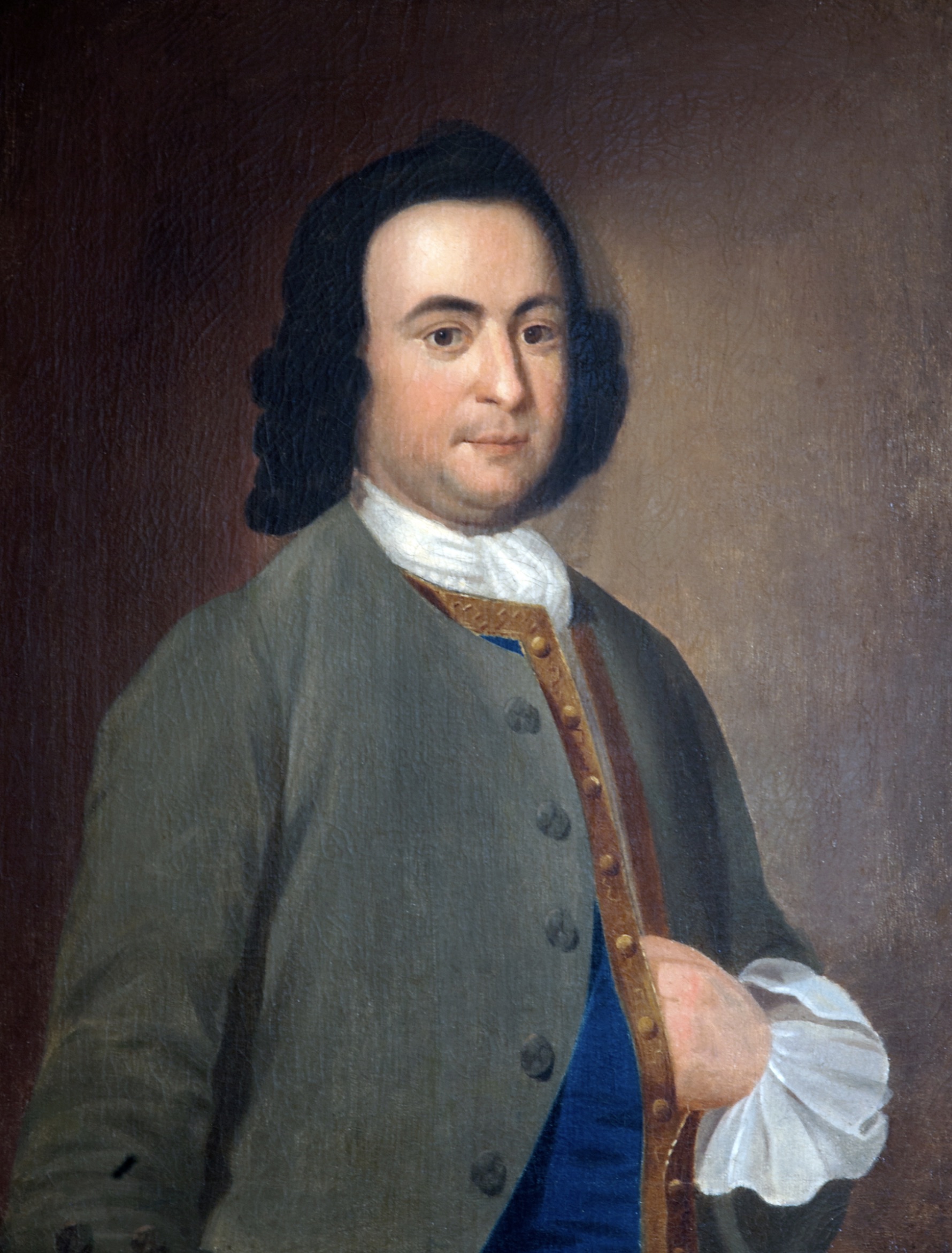
“How he learned his indifference for distinction,” Edmund Randolph wrote of Mason, “can be solved only from that philosophical spirit which despised the adulterated means of cultivating happiness.” Devoted to his family, Mason preferred their company to public life. He was not yet twenty-five when he married Ann Eilbeck and had wedding portraits painted by John Hesselius. The original Hesselius portrait of Mason had apparently decayed or been damaged by 1811, when Mason’s son John had three copies painted by Dominic W. Boudet. This one is on display at Gunston Hall. The Hesselius original does not seem to have survived.12
The key to the difference between Mason and Jefferson lies in their different visions of republican society. Jefferson’s drew his inspiration from the liberal tradition associated with John Locke and the social thought of the Scottish Enlightenment, which stressed the innate moral sense of individuals. Mason’s vision drew more inspiration from Locke but also from the republicanism of ancient Rome — an austere martial spirit that idealized voluntary attachment to the good of the state.13
Mason’s revolutionary idealism substituted civic responsibility for obedience to kings and lords as the basis for an ordered society. More than two hundred years later, his challenge remains vital to freedom: do we have enough virtue — enough willingness to sacrifice our private desires — to protect our liberty? Can our republic survive our selfishness?
Slow Poison
Mason, like Washington, Madison, and Jefferson, helped lead a great revolution in favor of human liberty while holding men, women, and children in bondage. The irony was not lost on him. Mason described slavery as a “slow Poison . . . daily contaminating the Minds & Morals of our People.”14
He realized that slavery and freedom could not survive together for long. “Every Gentlemen here,” he complained,
is born a petty Tyrant. Practiced in Acts of Despotism & Cruelty, we become callous to the Dictates of Humanity, & all the finer feelings of the Soul. Taught to regard a part of our own Species in the most abject & contemptible Degree below us, we lose that Idea of the dignity of Man which the Hand of Nature had implanted in us, for great & useful purposes. Habituated from our Infancy to trample upon the Rights of Human Nature, every generous, every liberal Sentiment, if not extinguished, is enfeebled in our Minds.15
Mason wrote these words shortly before the Revolutionary War at a time when he seems to have imagined a Virginia without slaves. Behind the closed doors of the convention that produced the Federal Constitution in 1787, Mason warned that slavery would “bring the judgment of heaven” on the new nation. “As nations cannot be rewarded or punished in the next world,” he said, “they must be in this. By an inevitable chain of causes and effects providence punishes national sins, by national calamities.” But tragically, Mason never conceived a way for the Southern economy, or his own, to function without slaves. Mason would have been the first to confess the inconsistency between his ideals and the reality of enslavement.16
For many modern Americans, the failure of our revolutionary leaders to secure the abolition of slavery compromises their achievement. But their assertion of fundamental rights, however incomplete it was in application, remains the foundation upon which freedom has grown.
The Bill of Rights
Mason served in the Virginia House of Delegates through much of the Revolutionary War, but finally withdrew from office in 1781 and refused to be lured out again until 1787, when he joined Washington, Madison, and other Virginians at the convention that drafted the Federal Constitution.
Mason was one of the most active member of the convention, joining Madison and James Wilson in advocating for a government with the broadest base of popular support. Seconding Wilson’s proposal for a House of Representatives that would be “the most exact transcript of the whole Society,” Mason argued that representatives “should sympathize with their constituents” and “think as they think, and feel as they feel.”17
At the last moment Mason refused to sign the Constitution because it contained no bill of rights. Madison and other delegates assured him that a bill of rights was entirely unnecessary — that the Constitution delegated only specified powers to the federal government, and that it thus possessed no power to encroach on personal liberty.
Mason knew better. He placed liberty before the Union, and he knew that the federal government would wield enough power to deprive Americans of natural and civil rights. Without a bill of rights, he warned the convention, the government outlined in the Constitution “would end either in monarchy, or a tyrannical aristocracy.”18
In the Virginia ratification convention Mason made the case for a federal bill of rights with clarity: “We wish only our rights to be secured. We must have such amendments as will secure the liberties and happiness of the people, on a plain simple construction, not on a doubtful ground. We wish to give the government sufficient energy, on real republican principles, but we wish to withhold such powers as are not absolutely necessary in themselves, but are extremely dangerous.”19

George Mason’s objections to the Federal Constitution reached readers in every part of the county. His demand for a bill of rights was taken up by Antifederalists in every state, including Massachusetts, where printer Isaiah Thomas republished George Mason’s objections in December 1787. Courtesy Seth Kaller, Inc.
Virginia ratified the Constitution over Mason’s objections by a narrow majority. But Mason’s objections to the Constitution were published all over the nation and excited demand for a bill of rights. When the First Congress convened in New York in 1789, Congressman James Madison — converted at last to Mason’s point of view — introduced a series of amendments to the Constitution that formed the Bill of Rights. It was the crowning achievement of Mason’s public life.
Mason Remembered
Condorcet and the other European admirers of the American Revolution praised the author of the Virginia Declaration of Rights, but few of them knew his name. Even in America, Mason’s contributions to the revolutionary achievement were not fully appreciated in his lifetime. Other revolutionaries — Washington, Jefferson, and Madison among them — were deeply conscious of themselves as historical actors, and bequeathed themselves to us along with their achievements. Mason does not seem to have devoted much attention to his historical memory. He was content to leave us his accomplishments.
Although George Mason preferred not to leave his Fairfax County plantation, his influence has been felt around the world for more than two hundred years, by millions of people who never heard his name. Mason’s ideals are invoked wherever oppressed people assert their inalienable rights. In Birmingham and Selma, in Castro’s prisons and Tiananmen Square —Mason’s legacy lives wherever people raise their voices to insist on the fundamental truth that all people “are by nature equally free and independent, and have certain inherent rights.” Friends of liberty are all his disciples.
Notes
- Thomas Jefferson Randolph, ed., Memoir, Correspondence and Miscellanies from the Papers of Thomas Jefferson, vol. 1 (Charlottesville: F. Carr, 1829), 33. [↩]
- Mason’s role in the Revolution was not widely appreciated for most of the nineteenth century. His reputation began to grow after the publication of Kate Mason Rowland, The Life of George Mason, 1725-1792 (2 vols., New York: G. P. Putnam’s Sons, 1892). Ms. Rowland was the great-grandniece of George Mason and an energetic promoter of his memory. Her two volumes included transcripts of many of Mason’s letters and papers. Interest in Mason was also stimulated by the publication of Max Farrand, ed., The Records of the Federal Convention of 1787 (3 vols., New Haven: Yale University Press, 1911), which provided scholars with a readily accessible record of Mason’s role in the debates that produced the Federal Constitution. Since 1949, when the last private owners of Gunston Hall deeded Mason’s home to the Colonial Dames, that organization and the Board of Regents of Gunston Hall it formed have encouraged scholarly understanding and public appreciation of George Mason. The Regents of Gunston Hall were instrumental in the publication of the most important source on Mason: Robert A. Rutland, ed., The Papers of George Mason (3 vols., Chapel Hill: University of North Carolina Press, 1970). [↩]
- George Mason to George Mason, Jr., Robert Rutland, ed., Papers of George Mason, 3: 884-85. [↩]
- George Mason to Richard Henry Lee, June 4, 1779, Rutland, ed., Papers of George Mason, 2: 506-9. [↩]
- Farrand, ed., Records of the Federal Convention, 1: 375 [June 22, 1787]. [↩]
- George Mason to Martin Cockburn, April 18, 1784, Rutland, ed., Papers of George Mason, 2: 799-800. [↩]
- The Virginia Declaration of Rights, ca. May 20-June 12, 1776, Rutland, ed., Papers of George Mason, 1: 274-91. [↩] [↩]
- Thomas Ludwell Lee to Richard Henry Lee, June 1, 1776, Kate Mason Rowland, Life of George Mason, 1: 240. [↩]
- Jean-Antoine-Nicolas de Caritat, marquis de Condorcet, “Ideas on Despotism: For the Benefit of Those Who Pronounce This Word Without Understanding It” (1789), in Guillaume Ansart, ed., Condorcet: Writings on the United States (University Park, Pennsylvania: Pennsylvania State University Press, 2012), 63-78; the quoted passage is on pp. 75-76. Ansart translates the final word as “humankind.” [↩]
- On the Declaration of Independence, see “Getting Right with the Declaration of Independence.” [↩]
- George Mason, Extracts from Virginia Charters, ca. July 1773, Rutland, ed., Papers of George Mason, 1: 163-85; the passage quoted is on p. 173 in Mason’s note 7. Mason’s annotation of these extracts is easily overlooked but is among the most important documentation of Mason’s constitutional and political thought before the Revolution. [↩]
- Edmund Randolph, History of Virginia, edited by Arthur H. Shaffer (Charlottesville: University Press of Virginia, 1970). [↩]
- On Jefferson’s vision of republican society, see Jack Warren, “A Constitution for a Sovereign People” and C. Bradley Thompson, “Thomas Jefferson and the Meaning of Self-Government.” [↩]
- George Mason, Extracts from Virginia Charters, ca. July 1773, Rutland, ed., Papers of George Mason, 1: 163-85; the passage quoted is on p. 173 in Mason’s note 7. [↩]
- ibid. [↩]
- Farrand, ed., Records of the Federal Convention, 2: 370 [August 22, 1787]. [↩]
- Farrand, ed., Records of the Federal Convention, 1: 133-134 [June 6, 1787]. [↩]
- Farrand, ed., Records of the Federal Convention, 2: 632-633 [September 15, 1787]. Mason wrote his objections on a copy of the version of the Constitution distribute to delegates on September 12; for those objections, see Farrand, ed., Records of the Federal Convention, 2: 637-640. [↩]
- John P. Kaminski et al., eds., The Documentary History of the Ratification of the Constitution, vol. 9: Ratification of the Constitution by the States: Virginia [vol. 2 of 3] (Madison: State Historical Society of Wisconsin, 1990), 1162. [↩]