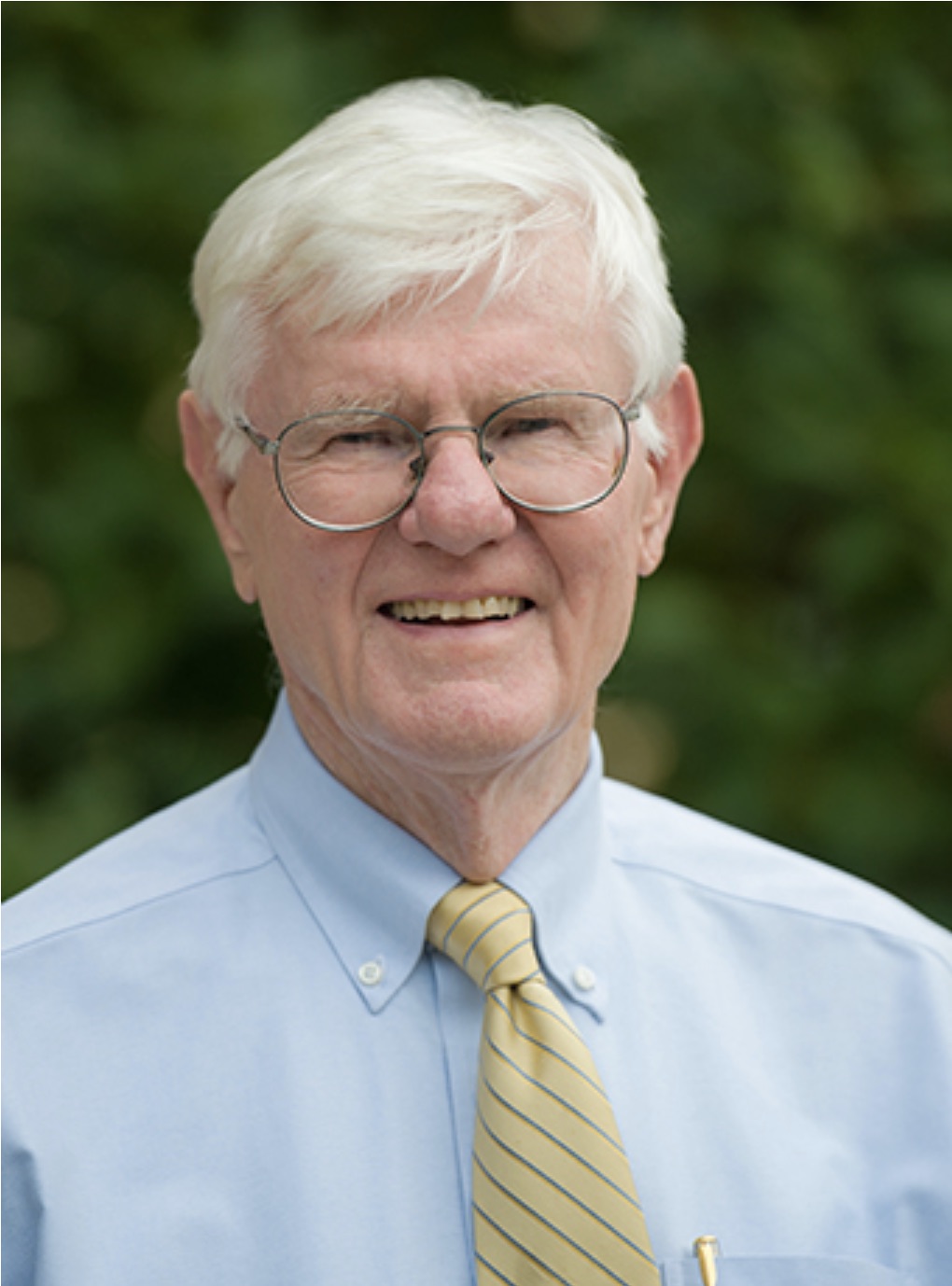
Gordon Wood, who died on Sunday after being struck by a car, was as committed to the life of the mind as anyone I have known. I studied with him in the 1980s, served as his teaching assistant, and had the opportunity to share the stage with him in 1987. He was a remarkable and inspiring scholar who shaped our understanding of the American Revolution more fully than anyone of the last century.
He seemed to me to be an old-school New Englander all the way through — courteous, formal, and very private. He referred to students by their first and last names, or as Mr. This or Miss That. Those who assumed from his manner or from his sophisticated work about ideas in the American Revolution that he was a Brahmin like Samuel Eliot Morison were wrong. He was a self-made man. What intrigued him most about the thought of the Revolutionary leaders was that it led, inexorably, to a democratic society that displaced men like them.
When I knew him he nearly always seemed to be focused, quite happily, on whatever he was thinking and writing about. He was then working on what became Empire of Liberty in the Oxford History of the United States (long looked for — not least because Wood had written a particularly critical review of Robert Middlekauff’s The Glorious Cause, the volume in that series dealing with the Revolution) and what became The Radicalism of the American Revolution. Both books were a very long time coming (working on more than one book at a time will do that). His reputation then rested on The Creation of the American Republic, his imposing first book, and a series of insightful essays about the nature of ideas in American history, the most important of which was (and remains) “Rhetoric and Reality in the American Revolution.”
When he returned to Brown in 1983 after a year in England as a visiting professor, his colleagues made him chairman of the history department — a task he would have preferred to avoid and that he apparently did, for the most part, avoid. Several months later he told me that he had found that if he ignored an administrative issue it usually resolved itself with no need for any action from him. I’m not sure that was good for the department but it spared him from distractions.
He had no interest I could ever detect in academic politics, which is a sinkhole of time — and never discussed contemporary politics, at least with students. Historical understanding was his aim and he pursued it relentlessly. He seemed happiest reading and writing. It was said, in hushed tones among graduate students, that he owned a set of Evans cards — the remarkable boxed set of microcards with nearly every known book, pamphlet, and broadside printed in what became the United States through 1800. It was a set, with few exceptions, only good academic libraries owned. We imagined him in front of a glowing microcard reader, happy consuming the published work of the Revolutionary generation.
His command of printed sources was remarkable and he was intimately familiar with the published papers of the leading Revolutionaries — the papers of Jefferson, Madison, Washington, Adams, and others in their magisterial modern editions. These inform his work. Unpublished manuscript sources occupy a much smaller place among his sources. Here and there that deficiency shows through. A really full understanding of the political ideas of secondary figures requires slow research in what are usually low-yield manuscript collections. He might have pointed graduate students in that direction, helped shape their work and then made judicious use of their findings, but he was content to let graduate students follow their inclinations without much guidance. He had many students, some of them quite accomplished, but he was not at the head of a cultivated school of thought. There are Wood students but there is no Wood school. His influence is considerable but diffuse.
He was one of the best academic lecturers I have known. In his upper division courses every lecture was a little gem. His lecture on changing ideas about the nature of the American continent was insightful and unexpectedly comic — he had a dry wit but in this case the material (including Jefferson’s determination to prove to the French naturalist Buffon that the moose was proof of the superiority of American nature) was hilarious and he knew it. The concluding lecture in his American Revolution course — dealing with the enduring importance of the Revolution and the worldwide influence of our Revolutionary ideals — was deeply moving.
I always sat front and center and remember his classes as a highlight of my life. I scowled just once — when he passed over the Revolutionary War in less than ten minutes, during which he said little more than “the Americans won.” Afterwards he asked me why I frowned. When I explained he graciously invited me to lecture to the next class on the war. I made the argument that Revolution was shaped in vital ways by the realities of a long war for national liberation that engaged thousands of plain Americans in every part of the country and left them all with a personal stake in the republic — none of which would have happened if the Revolution had ended quickly. He liked it. It became, in time, one of the central arguments of my own book Freedom: The Enduring Importance of the American Revolution.
He was a fine public speaker of an academic sort — not a storyteller by disposition but superb at refining intellectual insights and conveying them in concise and memorable ways. He was comfortable behind a lectern because he was always speaking about things that mattered to him. On the road he was friendly to his hosts and affable during and after question time, but most of the time he seemed to me a fundamentally shy man.
The sparkling character of his work came not just from its intellectual value but from what always seemed to me to be a degree of personal amazement about the American Revolution. He came to the Revolution as the subject of his life’s work in a roundabout way and a bit later than others. He had graduated from Tufts and served in the Air Force before enrolling in graduate school at Harvard, intending to study modern United States history. He was drawn to the Revolution by Bernard Bailyn’s graduate seminar.
Wood was inspired by Bailyn’s conviction that the Revolution was the central, transforming event in American history — the watershed between the American ancien regime and the rollicking, unprecedented democratic culture of the nineteenth century — and spent his entire career studying and writing about it, never losing his sense of astonishment at what happened in the Revolutionary generation. That spirit is woven through his work and makes it whole.
There was gain and loss in his focus. He was dragooned to give a lecture on Lincoln at a commemorative event at Brown when I was there, and though he began by apologizing to the audience that Lincoln was far afield from his specialty, in the thirty or forty minutes that followed he explained Lincoln’s thought and his place in American ideas more clearly than anything I had read before or that I’ve read or heard since. Often I have wondered what he might have said or written about the Populists or the New Deal. His greatest gift, perhaps, was understanding how ideas change under the “pressure of events,” a phrase that recurs in his work. What others might see as inconsistency or even evidence of hypocrisy, he recognized as a consequence of the inevitable interplay between changing practical realities and the way historical characters understand and accommodate those changes.
He was an intellectual of the first order, but he was not an intellectual historian in the way his generation understood that discipline. He attracted some graduate students interested chiefly in political ideas, but he was a preeminent contextualist. He didn’t conceive of the history of ideas as a dialogue between thinkers across generations and centuries. Ideas were, for him, how people make sense of the circumstances in which they find themselves, and evolve under the pressure of events, adapting to accommodate conditions that are always changing. His way of understanding the evolution of ideas in the Revolutionary generation — the basis of the central insights of The Creation of the American Republic, which first established his reputation — owed as much to Perry Miller’s From Colony to Province — about the evolution of New England Puritanism under the pressure of changing circumstances in the Old World and the New — as to Bailyn’s landmark Ideological Origins of the American Revolution.
In 1987 he invited me to join him at a conference at Purdue at which he was to be a featured speaker and to give a lecture there myself. Having a weakness for colorful characters and great stories, I gave a talk about convergence of circumstances that made Patrick Henry the central political figure in Revolutionary Virginia and shaped his ideas. Wood spoke last, and in forty minutes sketched the central insights of The Radicalism of the American Revolution. It was one of the most remarkable lectures I have heard.
On our way home he commented that Bailyn had sought to establish the American Revolution at the center of our history, but for all of his insight Wood feared that Bailyn, who had moved on to other things, had not succeeded. Wood hoped that he would succeed. That was almost forty years ago, and in those decade he pursued his goal with unwavering dedication. He leaves us with an extraordinary body of work that deserves to be read and re-read and that merits reflection and reconsideration, discussion and debate. No one, I suspect, will every argue the case for the American Revolution more effectively.