The Revolutionary War was shaped by ideas of honor and glory. No one pursued them more aggressively than John Paul Jones, a young Scotsman who arrived in America only months before the war began. With an naval officer’s commission bestowed by the Continental Congress, which had neither a fleet nor the faintest hope of waging a successful war at sea against the world’s greatest naval power, he set out in pursuit of fame. He was relentless.
The French alliance opened French ports to American privateers and warships of the Continental Navy, making it possible for Americans to carry their war for independence to British waters. In early 1779, the French government presented Captain John Paul Jones with an old French merchant ship that had been converted to a forty-two-gun man of war.
The witty proverbs Benjamin Franklin had published decades before in Poor Richard’s Almanac were making the rounds in France as Les Maximes du Bonhomme Richard (“Early to bed, and early to rise, makes a man healthy, wealthy and wise” and “There are no gains, without pains” are two of the many still repeated today). Jones named the ship Bonhomme Richard in Franklin’s honor. Jones may have also meant it as a friendly jab at the elderly Franklin. The old ship was well past its prime — rotten, leaky, and armed with cast-off French guns of poor quality.
Determined to cover himself in glory, Jones sailed Bonhomme Richard around the British Isles in the summer of 1779, capturing sixteen ships. On September 23, while sailing near the English coast, Jones sighted a convoy of cargo ships homeward bound from the Baltic Sea, loaded with timber and naval stores — tar, hemp for rope, and other goods the Royal Navy consumed in prodigious amounts. These goods came from Britain’s American colonies before the war forced the Royal Navy to turn to the Baltic nations for them. Sinking or capturing ships in the convoy would have been a major accomplishment, but they were guarded by a new fifty-gun warship, HMS Serapis, commanded by Capt. Richard Pearson, which broke off from the convoy to engage the Richard.
The battle began as night fell. The two ships opened fire almost simultaneously. Two of the old cannons on the Richard blew up, and careful fire from Serapis quickly put most of the other American guns out of service. Jones concluded that close action was his only hope of victory over Serapis, which was superior to Bonhomme Richard in every respect. Jones grappled with the enemy, while sweeping the British deck clear with musket fire and grenades. Below decks, cannon fire from Serapis blasted Bonhomme Richard’s hull to splinters and the ship began to take on water. The British attempted to board Bonhomme Richard, but small arms fire from Americans in the rigging and a counterattack drove them back below. An explosion—perhaps caused by a grenade—set off a series of explosions on the lower gun deck of Serapis and sealed its fate. With both vessels on fire, Pearson surrendered. Hundreds of spectators watched the battle from nearby cliffs. The ships moved off together, and the next morning, Bonhomme Richard sank. Jones sailed the crippled Serapis into a Dutch harbor, where he became an instant celebrity.
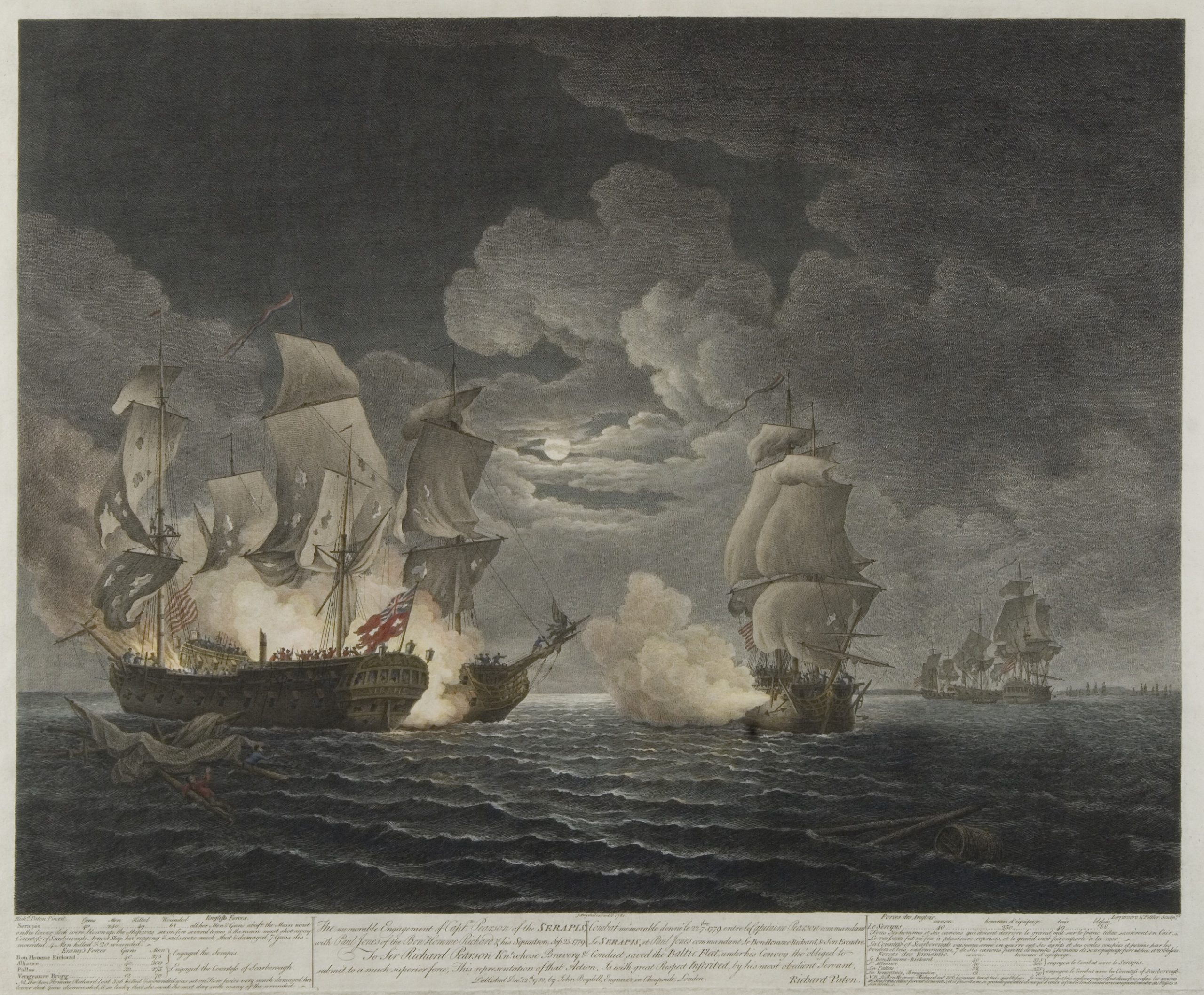
Bonhomme Richard and Serapis exchanged broadsides at close range as the Baltic convoy, at far right, sailed on to safely. (The Society of the Cincinnati)
Early in the action, as the two ships drew close, Pearson called out to Jones, asking whether he surrendered. Jones is said to have responded “I have not yet begun to fight!” This response has echoed down the centuries, but how do we know Jones said it?
The source of this famous reply is a book published in New York in 1825 — Henry Sherburne’s Life and Character of Chevalier John Paul Jones, a captain in the navy of the United States during their Revolutionary War. The book consists mainly of letters and documents from the war, to which Sherburne added an account of the battle secured from Richard Dale, titled “Particulars of the engagement between the Bon homme Richard and the Serapis, furnished by First Lieutenant Richard Dale, of the Richard, for this work.” In it, Dale explained that early in the battle, Captain Pearson of Serapis sought to pass Richard and then turn to cross in front of her bow, raking Richard with a broadside as he passed. As soon as Pearson put over, he realized that he did not have sufficient clearance and that Richard would collide with Serapis amidships. Pearson promptly turned Serapis on to the same line as Richard, but Serapis slowed in turning and Richard’s bow ran into the stern of Serapis. “We had remained in this situation but a few minutes when we were again hailed by the Serapis, ‘Has your ship struck?’ To which Captain Jones answered, “I have not yet begun to fight!”1
A slightly different account is recorded in the autobiography of Benjamin Rush, a Philadelphia physician, who described a postwar dinner party at which Jones told the story of the battle: “It was delivered with great apparent modesty and commanded the most respectful attention. Towards the close of the battle, while his deck was swimming in blood, that captain of the Seraphis [sic] called him to strike. ‘No, Sir,’ said he, “I will not, we have had but a small fight as yet.”2
“I have not yet begun to fight” and “We have had but a small fight as yet” are similar sentiments. Which version is more reliable? Or should we trust either of them? Dale placed the exchange early in the battle, while in Rush’s version the exchange took place near the end, with the deck of Richard awash in blood. They may have both been accurate — just describing exchanges at different moments.
Rush wrote his account of the dinner party years after the event and can be forgiven if he paraphrased Jones or got the moment in the battle wrong. Dale was a participant, on the deck of the Richard with Jones, and even though he wrote his account for Sherburne more than forty years after the battle, he seems like a much more reliable source than Rush. Of course it is entirely plausible that Dale did not hear what Jones said over the noise of battle. What Rush’s account suggests is that “I have not yet begun to fight,” or some version of it was part of the story of the battle as Jones told and retold it. Whether or not Dale actually heard Jones say it in battle he had abundant opportunities afterwards to hear Jones tell his version of the story.
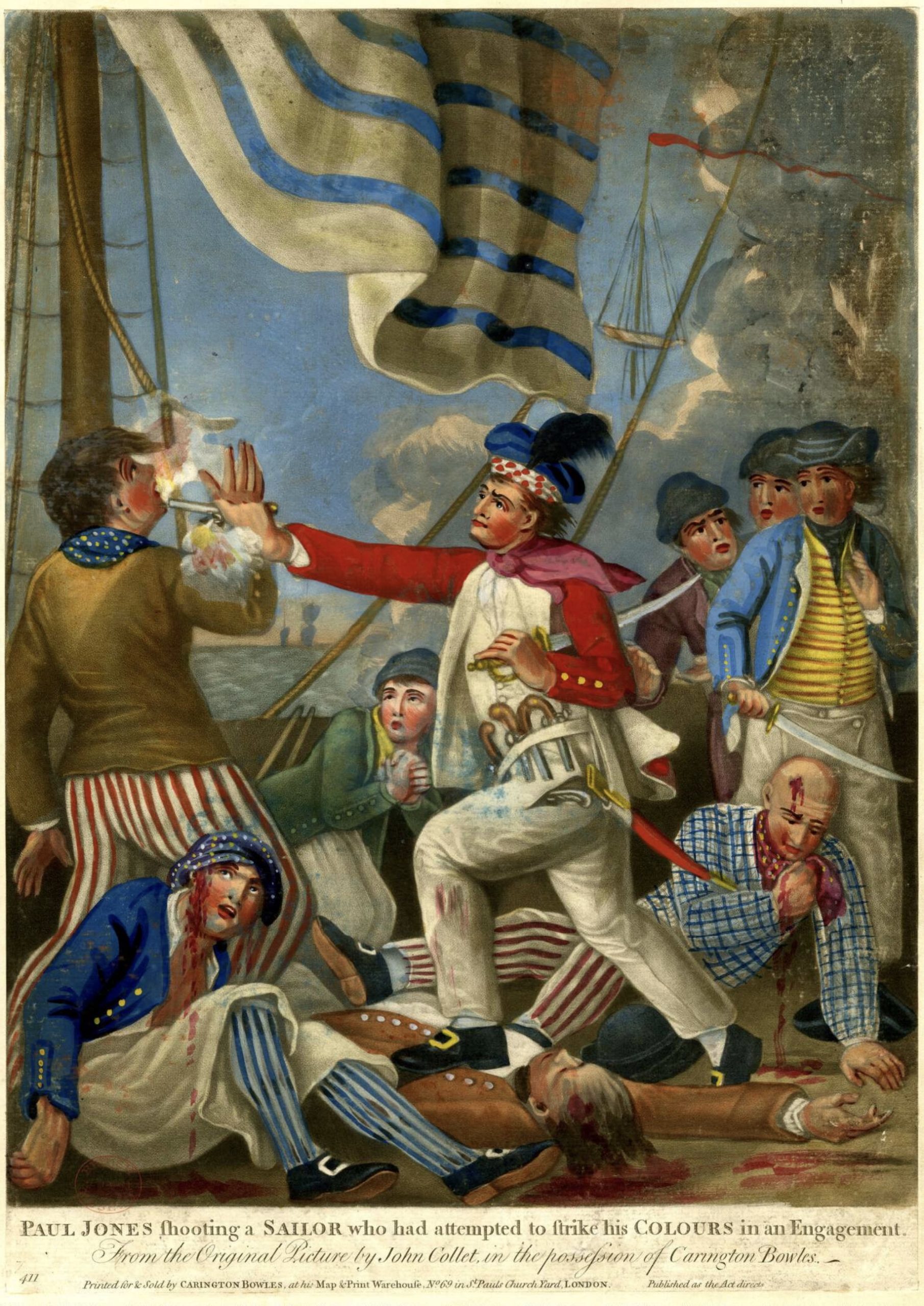
Paul Jones shooting a Sailor who had attempted to strike his Colours is one of several contemporary British prints portraying Jones as a vicious criminal, wholly lacking in honor. (Courtesy of the Trustees of the British Museum)
Like many good stories this one probably grew in the retelling. We have abundant evidence that Jones had an outsized ego and cultivated his own celebrity. The battle alone proves that. It was of no military importance. As Jones and Pearson joined in battle the convoy escaped. Pearson might have detached and saved his ship, but rational calculations of that kind did not govern. The contest, though fought with cannons, muskets, pistols, and grenades, was much more like duel between knights in armor than a battle between modern warships. Honor was the prize.
Jones won the duel and became the toast of Amsterdam and Paris. He was decorated by Louis XVI. Jean-Antoine Houdon, the greatest sculptor of the age, carved a marble bust of Jones, whose portrait, like that of Franklin, was suddenly everywhere. Jones had terra cotta replicas made and sent them to George Washington, Benjamin Franklin, Thomas Jefferson, James Madison, John Jay, Lafayette, and Admiral d’Estaing. What became of most of these busts isn’t clear, but Washington and Jefferson — who must have been surprised by these gifts — put them on display in their homes, where they can be seen today, incongruous and faintly amusing memorials to Jones’ vanity.
Pearson, released in Holland, returned to Britain where he was showered with praise for saving the convoy. Despite losing a valuable warship, he was knighted by George III. If I fight him again, Jones said when he heard, “I will make him a Lord!” British writers extolled Pearson’s virtues and condemned Jones as a criminal. He was a Scotsman with no legitimate ties to the rebellious American colonies, they told the public, commanding a worthless French ship and a mercenary crew he subjected to ferocious discipline and violent abuse, motivated by nothing more than profit. He was, in short, a pirate.
If “I have not yet begun to fight” was the punchline in John Paul Jones’ dinner table version of the battle between the Richard and the Serapis, as it seems to have been, it suggests a bit more than the obvious fact that Jones wanted to be known as a man of extraordinary courage. He wanted to be remembered as a man of honor, too — a naval officer who would fight to the limit of his endurance to defeat a warship of the Royal Navy even after his prize had sailed beyond the horizon.
The story of Jones and Pearson is a reminder that the Revolutionary War, though it was fought with explosives and spanned the globe, was a premodern conflict, shaped by ideas about personal and national honor and fought by people who idolized courage. To win their independence, Americans needed a great deal of the kind of courage Jones displayed. Such courage made Jones an enduring symbol of daring and determination.
Notes
- Henry Sherburne, Life and Character of Chevalier John Paul Jones, a captain in the navy of the United States during their Revolutionary War (New York: Vanderpool & Cole, Printers, 1825), 126-29. [↩]
- George W. Corner, The Autobiography of Benjamin Rush: His “Travels Through Life” together with his Commonplace Book for 1789-1813 (Princeton: Published for the American Philosophical Society by Princeton University Press, 1948), 157. [↩]