A prosperous craftsman whose trade serves the very wealthy is an unlikely sort of revolutionary. He has too much invested in stability to welcome economic upheaval and too much invested in relationships with customers, suppliers, and peers to welcome revolutionary change — or so it would seem. Yet such craftsmen were among the active supporters of American resistance to British policies in the 1760s and political revolution in the 1770s. Paul Revere is the best known, but he was one of many, including the curiously named Plunket Fleeson, the most successful upholsterer in eighteenth-century Philadelphia.1
Why did they do it? They weren’t simply following their wealthy patrons. In most cases their customers were divided about resistance and revolution and ultimately between patriots and loyalists.
No single or simple answer will suffice. Great movements are rarely shaped by simple motives and single causes. Revolutions occur when the aspirations and anxieties of a wide variety of people collide and find common expression in a movement larger than any of them. People had many and varied reasons for embracing the cause of resistance to the impositions of the British government in the 1760s and early 1770s, and those who followed the logic of their resistance into revolution, as many did, had their own reasons for doing so.
We can only understand the Revolution by exploring those reasons rather than assuming participants all fit into neat patterns aligned with occupation, wealth, ethnicity, religion, or region. Such patterns are suggestive, but they often do not explain the positions historical actors adopted or the actions they took, which were often contingent on circumstances that are not apparent at the broad level of social identity.
Discerning why Plunket Fleeson embraced the Revolution and what it meant to him is hampered by the fact that he did not leave us many letters and papers recording his thoughts or justifying his actions. We have the records of what he did, spread out in fugitive invoices, newspaper advertisements, and entries in the surviving ledgers and correspondence of the people with whom he did business. We also have the material remains of the work he did and contemporary descriptions of that work. Fleeson’s craft and the business he built around it consumed most of his life. If we are to understand why he became a revolutionary and what the American Revolution meant to him we must begin with upholstery, however remote that may seem from the business of revolution.
II
Plunket Fleeson lived most of his long and successful life as a colonial subject of the British crown. He spent nearly all of it in Philadelphia, where he was born in 1712. The town was then thirty years old, and had a population of around three thousand people. It was an unsophisticated place, with muddy, unpaved streets joining a cluster of low, inelegant little houses, barely more than a settlement on the edge of Britain’s Atlantic empire — a place of little consequence and no pretense, culturally dominated by Quakers who expressed a preference for the plain and simple. Philadelphia offered little else.
The upholsterer was a luxury craftsman largely unknown in seventeenth century America. The first craftsman identified as an upholsterer, or “upholder,” was John Budd, whose name and occupation appeared in tax records in the 1690s. Between 1700 and 1760, some eleven upholsterers worked in Philadelphia. By mid-century, the successful upholsterer was much more than specialized craftsman in the furniture trade. He was part craftsman and part entrepreneur whose chief stock in trade — fine fabrics — was the most expensive part of fitting out a stylish house. The most successful upholsterer was an interior designer and arbiter of taste, upon whom the wealthy relied to help decorate their homes in the best English manner.2
When Plunket Fleeson opened his own upholstery shop in 1739, Philadelphia was just beginning to lift itself out of the mud and had become a town of modest consequence. Dr. Alexander Hamilton, a Scotsman on a tour of the colonies in 1744, wrote that “the majority of the houses mean and low, and much decayed; the streets in general not paved, very dirty and obstructed with rubbish and lumber.”3
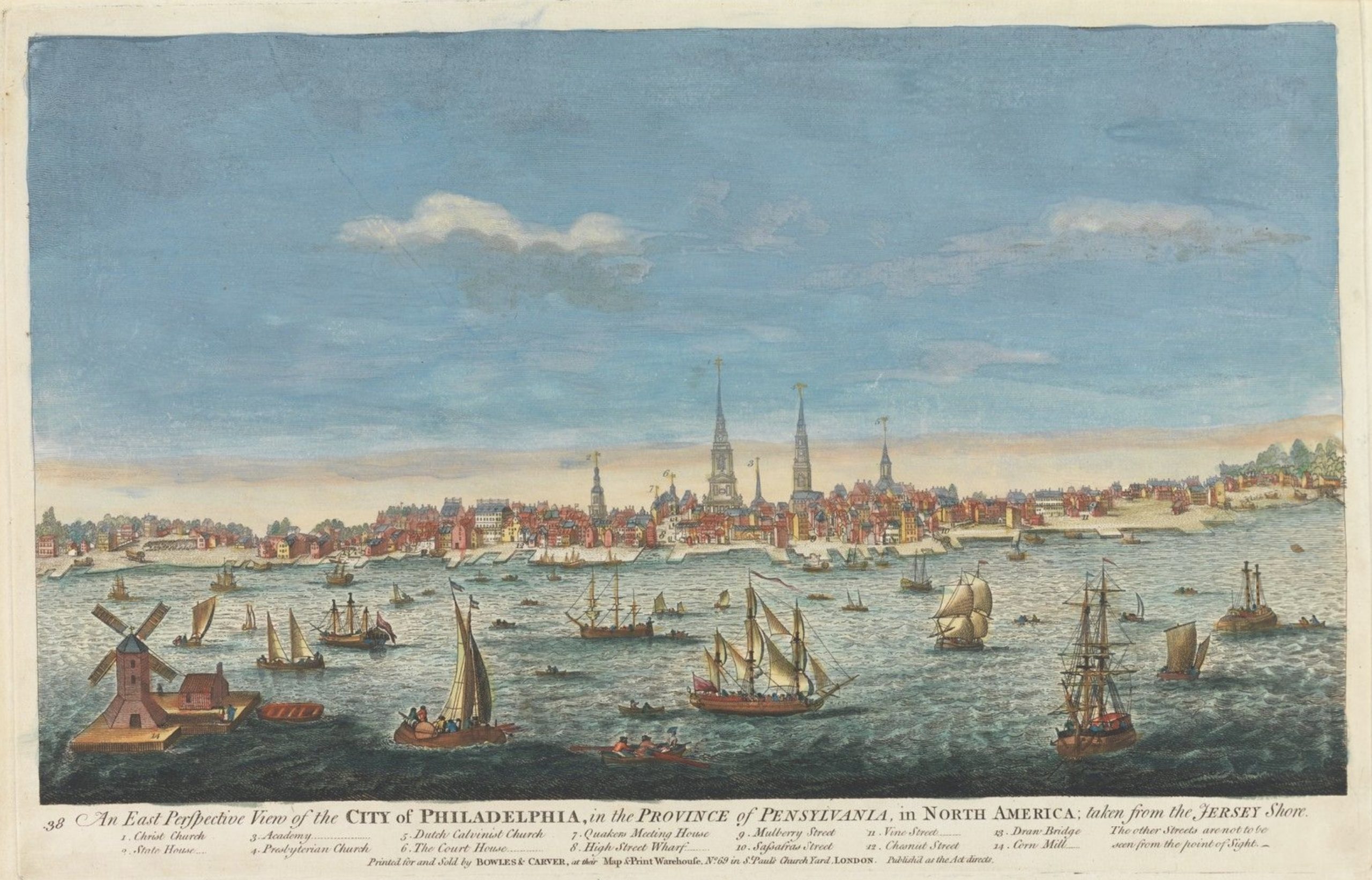
George Heap drew this view of Philadelphia a few years before Plunket Fleeson opened his upholstery shop. An active port serving a rich farming country, Philadelphia was beginning to prosper and its wealthy residents were developing a taste for fine furnishings. Paul Mellon Collection, Yale Center for British Art
Unimpressive as it was, Philadelphia was the market town for a rural hinterland that stretched for many miles in all directions, with a port that conducted a lively trade, shipping foodstuffs, lumber, and other raw materials up and down the Atlantic coast and with Britain’s colonies in the Caribbean as well as with Britain itself. Philadelphia’s merchants were growing wealthy and developing a taste for better things, including upholstered furniture, curtains, and mattresses tightly packed with hair and feathers rather than loosely filled with wool.
Fleeson satisfied their wishes and prospered with them, earning enough to acquire a good house at 113 Chestnut Street. Next door lived Anthony Benezet, a Quaker schoolmaster who became the first great antislavery spokesman in the Atlantic world. Benjamin Franklin, who was about Fleeson’s age, owned the lot in back. Fleeson benefitted from a growing network of connections in commerce and public life, and was rewarded with highly visible public business. When the new State House (which we know as Independence Hall) was completed, Plunket Fleeson supplied the curtains.4
Fleeson was deeply attached to his city. When the pacifist Quaker leaders of Pennsylvania refused to raise a militia to defend the city in time of war, he was among the first to join the Philadelphia Associators, a private militia organized in 1747. He was made an ensign.5 As his business prospered he contributed generously to public improvements. In 1752 he was among the founders of the Hibernia Engine Company and an early contributor to the Pennsylvania Hospital, of which he served as a director. He was also proud to serve the public as a craftsman. In 1753 he reupholstered the chair used by the speaker of the Pennsylvania Assembly, and in 1754-56 he furnished new window curtains for the State House.
By then he was successful enough to acquire the large lot at the corner of Fourth and Chestnut, where he conducted his business at “the Sign of the Easy Chair.” Unlike many craftsmen and tradesmen, Plunket Fleeson did not live over his shop. From the 1750s onward, he was among the richest taxpayers in the city’s prosperous Middle Ward. He generally ranked from the eighty-sixth to the ninety-fifth percentile in wealth.6
By the late 1750s, Fleeson was more a businessman than a craftsman, employing seamstresses, painters, and other craftspeople as well as upholsterers, commissioning work from cabinetmakers and joiners, and always buying and selling, his frequent advertisements offering “ready money for Horse hair and Cow tails” and “maple chairs as cheap as from Boston.” His reputation rested on his elaborately upholstered easy chairs, which were a symbol of refinement and elegant living only the wealthy could afford.7

Fleeson’s wealthy patrons preferred furnishings in the latest style like these chairs designed by Thomas Chippendale, who prepared this drawing for the first edition of his Gentleman and Cabinet Maker’s Director (1754). Chippendale prescribed the carvings in detail but left the upholstery to the imagination of the craftsman. Metropolitan Museum of Art
Fleeson succeeded in selling the trappings of eighteenth-century opulence in a city shaped by Quaker injunctions to live simply and plainly — injunctions that wealthy Quakers seemed to have honored in the breach. William Penn had railed against the folly of excessive ornamentation. “How many pieces of Ribbond, Feathers, Lace-Bands, and the like, had Adam in Paradise, or out of it?” Penn asked. “What rich Embroyders, Silks, Points, &c. had Abel, Enoch, Noah, and good old Abraham?” Quaker teachings in the second half of the eighteenth century continued to discourage “vain and needless things and fashions, in Apparel, Buildings, and furniture of Houses, some of which are immodest, indecent, and unbecoming,” calling them “a Clog and hindrance” to living a Godly life.8
These were prescriptions, and Philadelphia’s mid-century Quakers did not adhere closely to them. Prohibitions often reflect what people do — otherwise why bother making rules? In fact, surviving decorative arts owned by eighteenth-century Philadelphia Quakers testify to their taste for the finer things. They were a temptation to which successful Philadelphians easily succumbed, and Plunket Fleeson, an Anglican, was there to help them do it. A 1761 advertisement signaled his role as a tastemaker, offering a second hand “Sett of yellow and a Sett of green Worsted Bed an Window Curtains, fitted in the best Taste by Mr. Fleeson.”9
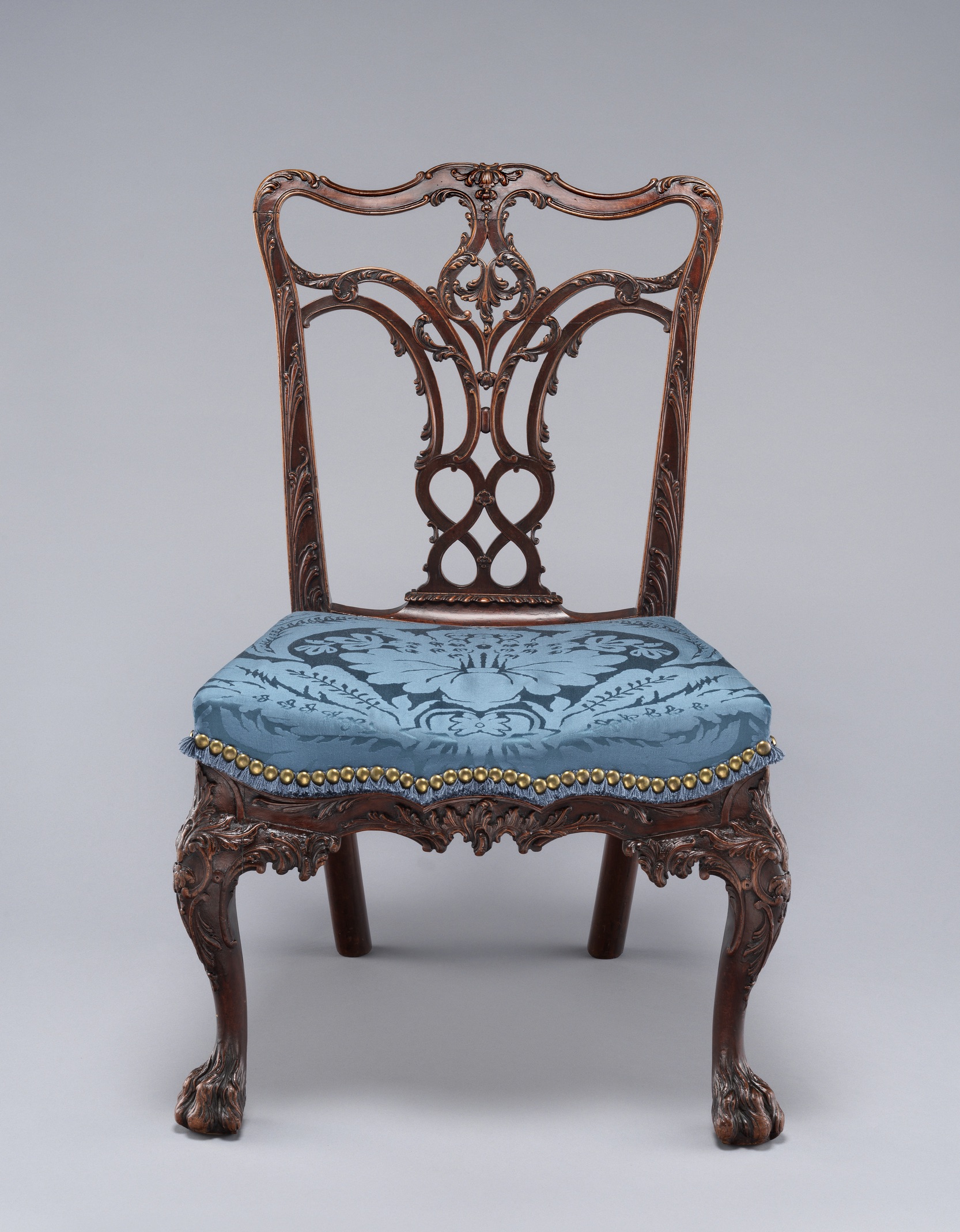
Philadelphia craftsmen adapted and reimagined Chippendale’s designs to suit their clients. The original upholstery on this chair was designed by Plunket Fleeson. Metropolitan Museum of Art
By then Philadelphia had become the place in British America to buy fancy goods, especially upholstered furniture. Philadelphia craftsmen set the style for the colonies: sophisticated, urbane, and refined. The wealthy merchant John Brown of Providence could have ordered his furniture from craftsmen in Providence, Newport, or Boston. In 1761 turned to Fleeson to order “a Compleat Black Walnut Easy Chair with Casters to run on … with Eagles claws” upholstered in “Red Hereteen,” specifying that it “be done well … by a neet workman, and finished as soon as may be.” Fleeson charged Brown nine pounds, eighteen shillings, three pence half penny for the chair — around two thousand dollars in our money. In 1764 Fleeson charged Nicholas Brown of Providence eleven pounds, thirteen shillings and eleven pence for a similar chair.10
In 1765 Fleeson offered his customers “crimson, green, blue and yellow Harrateens and Cheneys” — wool fabrics often used for bed hangings — “best Cotton Chints, Bed Patterns, with suitable Trimmings, silk Bed lace, Furniture Check, Flanders and other Bed Ticks,” as well as “a Variety of the best English Tossels.”11 Beds with elaborate and ingenious curtains, cornices, rods, and ruffles were among the most expensive furnishings in stylish homes. Fleeson charged William Armstrong forty-five pounds, fourteen shillings, nine pence for a “full trim’d Bed” in 1762. Only two pounds eleven shillings of that was for the wooden bedstead. The rest was for a chintz, linen, and silk confection including a variety of Venetian curtains, tassels, cords, and pulleys, which seems likely to have been the most expensive thing in Armstrong’s home.12
Plunket Fleeson was an impresario of this cultural transformation, in which American colonists succumbed to the same consumer impulses that were reshaping British cities and towns and the country houses of the wealthy — a taste for Staffordshire creamware and brass buttons and printed fabrics, and to the lure British commercial amusements, including traveling theater companies and ultimately, resident ones, offering up plays a season or two after their London premiers. Colonial high culture was deliberately, and proudly, imitative — identifying the colonial gentry and the more prosperous middling class of craftsmen and shopkeepers who served them with Britain.
Philadelphia was no longer the muddy town of Fleeson’s youth. It was, a Scottish peer, Lord Adam Gordon, opined in 1765, “one of the wonders of the world, if you consider its Size, the number of Inhabitants, the regularity of its Streets, their great breadth and length . . . one will not hesitate to call it the first Town in America, but one that bids fair to rival almost any in Europe.” Plunket Fleeson, through his civic-minded philanthropy but most of all with his draperies and cushioned chairs and fancy wallpaper, had helped to make it so.13
III
Fleeson was fifty-one years old at the end of the French & Indian War, and like many colonists he probably expected victory and peace to signal the beginning of a new era of prosperity — a time of increasing wealth that would be reflected in his ledgers by expansive order for fine fabrics, elaborate imported wallpaper, fancy furnishings, and other material manifestations of the good life in a triumphant empire of which the North American colonies were an increasingly important and valued part.
He could not have imagined that the British government would institute a program of imperial reorganization that would include imposing unprecedented taxes on the American colonies without their consent. In 1765 Fleeson’s name stood out among those of tradesman who signed a remonstrance against the Stamp Act. It was not that the tax would impose an unacceptable burden. Fleeson was prosperous, and the tax was small. The king’s subjects in Britain had paid stamp duties for several decades without protest — but they were represented in Parliament, the colonists insisted, while the colonists were not.
The tradesmen did not ground their case on this argument. They complained instead of the consequences of the act for the highly profitable trade between Britain and the colonies. The law, they complained, “if carried into execution in this Province, will further tend to prevent our making those Remittances to Great Britain, for payment of old Debts, or purchase of more Goods, which the Faith subsisting between the Individuals trading with each other requires.” The signers sought repeal of the act, “in justice to ourselves to the Traders of Great Britain who usually give us Credit, and to the Consumers of British Manufactures in this Province.”14
The British responses to the colonial protests were startling. Some government spokesman argued that the colonists were represented in Parliament — that every member represented all of the king’s subjects. This theory of virtual representation struck many colonists as absurd. Their spokesmen replied that the right to consent to taxes was a fundamental right of all Englishmen to which they were as much entitled as the king’s subjects in Britain.
Government spokesmen and other commentators replied that the colonists did not enjoy the same rights as Englishmen living in the British Isles — that by leaving Britain the colonists had sacrificed many of those traditional rights. Some writers went further, and argued that the colonists were not like Englishmen at all — that they were royal subjects living on the barbarous frontier of the king’s domain. The most severe of these critics wrote that the colonists were coarse, unrefined, and lived like the woodland savages that surrounded them, and that such people had no claim on the rights of Englishmen. As the imperial controversy degenerated in an endless series of intemperate polemics, this argument was repeated over and over.15
The imperial crisis of the 1760s led from protest to resistance to rebellion because it touched the lives of colonists from many different walks of life. Each had his or her own perspective on the crisis. To a settler in the backcountry, for whom a larger or better farm held out the prospect of a better life, the royal proclamation of 1763 forbidding settlement beyond the mountains loomed large, as it did for many speculators who hoped to grow rich. For learned men, constitutional and legal arguments about parliamentary authority loomed large.
For luxury craftsmen who had prospered by bringing the most refined English tastes to Philadelphia, the British argument that they were not entitled to the same rights as other British subjects challenged the results of a lifetime of work. Colonial urban centers were provincial and their high style culture imitated London tastes, but by the 1760s the latest London fashions reached Philadelphia nearly as fast as they reached provincial centers in Britain. Fleeson and other high style craftsmen thought of themselves as an integral part of the British cultural world and were dismayed to learn that the British government regarded them as socially and culturally inferior — as less than the full participants in British cultural life that they had worked so hard to become.
The Townshend Duties hit hard at the luxury market. Taxing paint, paper, lead, tea, and glass, the duties were aimed at the wealthy — Fleeson’s customers sitting in their fashionable parlors sipping tea, surrounded by walls adorned with imported paint and wallpaper, the room illuminated by natural light streaming through large, elaborate windows with glass panes fixed in place with lead. The colonial response — non-importation — was especially hard on the upholstery business. Upholsterers depended heavily on imported English luxury goods, including fancy fabrics and all manner of other refined goods for which no substitutes were produced in the colonies. One of Fleeson’s competitors, John Mason, ran a plaintive advertisement that “the Stagnation of Business, and Scarcity of Cash” had forced him to cut his prices by one third.16
Fleeson’s financial success insulated him from the business setbacks non-importation imposed on less established merchants and tradesmen. Fleeson probably had a substantial inventory of imported fabrics accumulated in his workshop at Fourth and Chestnut — enough indeed to give the “Sign of the Easy Chair” an enormous advantage over his younger, aspiring competitors. In the 1760s and 1770s Fleeson’s competitors included Mason, Blanch White, Charles Allen, George Haughton, Thomas Harper, Thomas Lawrence, William Martin, and others — some of them craftsmen trained in London shops who advertised their sophisticated credentials in the newspapers.
Philadelphia-born Plunket Fleeson nonetheless remained the leader, the gold standard in the trade. As the imperial controversy disrupted trade, Fleeson had considerable competitive advantages: a rich network of clients, a reputation as a craftsman of impeccable standards, and the assets to weather adversity. He had a substantial inventory of imported materials to work with and the means to deal with interruptions in business. With few of these advantages, his competitors found resistance and revolution potentially devastating.
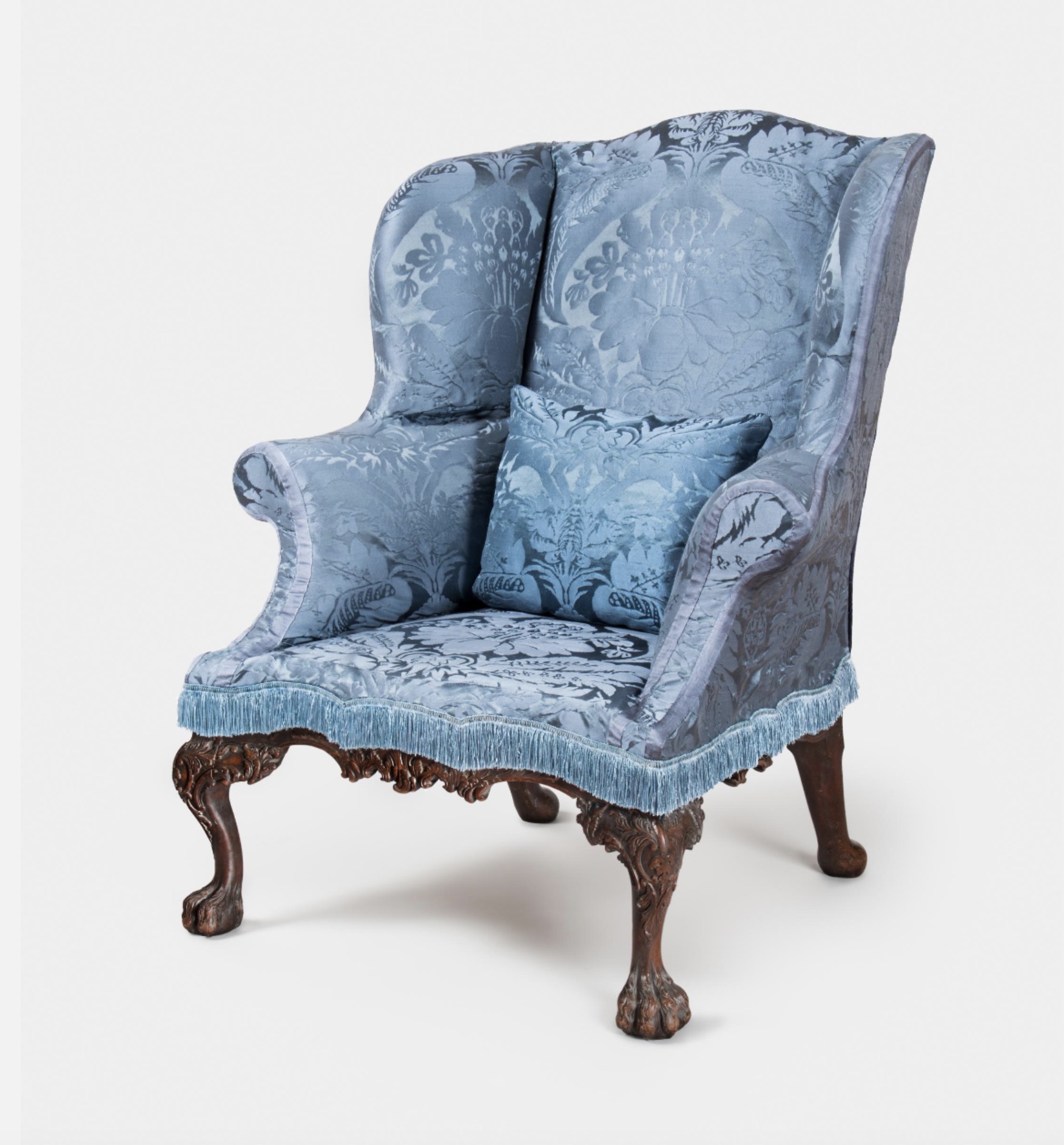
In 1770 Fleeson upholstered this easy chair for John Cadwalader, whose Philadelphia townhouse was furnished in the finest manner. Fleeson’s original upholstery does not survive. Textile conservators followed the original tack lines to replicate Fleeson’s style and covered the chair in a blue silk damask of the kind Fleeson used to cover the chair. Metropolitan Museum of Art
Fleeson did not. In 1769 he offered his customers “American Paper Hangings, manufactured in Philadelphia of all kinds and colours, and not inferior to those imported,” explaining that “there is considerable duty imposed on paper hangings imported here, and it cannot be doubted but that every one among us, who wishes prosperity to America, will give a preference to our own manufactures, especially on the above proposition, of equally good and cheap.” For Fleeson, this advertisement was a kind of declaration of independence.17
Plunket Fleeson took advantage of the new business opportunities the crisis offered. When George Washington was in Philadelphia for the First Continental Congress, he sought out Fleeson to supply the Fairfax County militia with drums and flags — and the revolutionary upholsterer was ready to oblige him. On November 29, 1774, Washington’s Philadelphia agent William Milnor reported to Washington that “Mr Fleecen assures me the Drums Coulers &c. shall be ready to come with the first Vessels & you may be assured I shall forward them with the Utmost speed.” Fleeson also provided Washington with a silk sash to go with his Virginia regimental uniform. When Washington at the next spring at the Second Continental Congress in full military uniform, the sash he wore was probably the one supplied by Plunket Fleeson.18
When war finally broke out, Fleeson embraced the business opportunities it presented. In 1775 he advertised “DRUMS and COLOURS, and other Military Instruments of the most approved kinds, and will endeavour to execute any distant orders with the utmost dispatch.” At least one of Fleeson’s “colours” survives — the regimental standard of the First Pennsylvania Battalion. On February 29, 1776, the Pennsylvania Committee of Safety authorized payment of twenty-four pounds for “Drums, &c” supplied to the First Pennsylvania Battalion. Fleeson charged charged Anthony Wayne eight pounds, five shillings for supplying “a Battan Taffaty Colour, Staff, Spear, Tassels” and four pounds, seven shillings for “a Division Colour Compleat.” In the spring of 1776, Fleeson manufactured three campaign tents for George Washington — a large marquee for dining, a smaller baggage tent, and a second large marquee with spaces for sleeping and office work.19
IV
Plunket Fleeson was sixty-four years old in the summer of 1776 — far too old for the military service — but he was widely regarded as a civic leader and embraced public service with enthusiasm. In June 1777 he was appointed a judge of the Philadelphia City Court. He continued to do business, but the war disrupted both the supply of imports and the demand for luxury furnishings. Fleeson found the cost of “every material” he used “raised in its price from its scarcity and the prevailing Exorbitance of the shopkeepers.” He turned to manufacturing mattresses and military goods.20

John Cadwalader was serving as colonel of a battalion of Philadelphia Associators in the defense of New York when Fleeson invoiced him for a camp bed and curtains, camp chest, mattress, flag, six walnut camp stools, a packing case, and “a large pillow.” Cadwalader Family Papers, Historical Society of Pennsylvania
Like many active patriots, Fleeson left the city when the British army approached in the fall of 1777, and did not return until the British evacuated in June 1778. He kept busy that summer and into the fall administering oaths of allegiance and serving on the grand jury investigating the conduct of citizens accused of collaborating with the British during the occupation. The grand jury returned several indictments for treason — a capital offense — but ultimately only two of the convicted were executed. In 1780, “Squire Fleeson,” as he was affectionately known, was promoted to presiding judge of the city court.
In December 1783, Fleeson had the pleasure of addressing George Washington on behalf of the city government when Washington passed through Philadelphia on his way to Annapolis to resign his commission as commander-in-chief. In his address, Fleeson praised “the infinite Goodness of the Supreme Ruler of the Universe,” for “raising up among us an illustrious Personage, with the most shining Abilities and conspicuous Virtues to lead, direct and animate by His Conduct and Example. Who this great Character is, shall be a Blank in our Page; being confident that every grateful Heart and generous Hand will be ready to fill it up.”21
It was an apt tribute from a man who had spent much of his life filling up the blank walls and empty rooms of Philadelphia’s finest homes, for whom resistance and revolution was a declaration of cultural equality as much as political independence. Plunket Fleeson died August 21, 1791. His body was interred in the churchyard of St. Paul’s, the elegant Anglican church completed in 1762, when he was on the vestry. The legend on his gravestone has worn to nothing, but his story survives to remind us of the complex motives that shaped the American Revolution.
Notes
- Fleeson’s first name is rendered either “Plunket” or “Plunkett” in contemporary sources. He typically signed his name “Plunt Fleeson” with a superscript t, but in his newspaper advertisements his name is generally spelled Plunket. [↩]
- On the role of the upholsterer as an interior designer and arbiter of taste, see Robert Campbell, The London Tradesman (London: T. Gardner, 1747), 169-70. [↩]
- When he advertised his new shop in the Pennsylvania Gazette on August 2, 1739, he promised “all Kinds of Upholsterers Work after the best Manner . . . at the most reasonable Rates.” He described himself as “lately from London and Dublin” although no evidence has been found that he had traveled to either city; Carl Bridenbaugh, ed., Gentleman’s Progress: The Itinerarium of Dr. Alexander Hamilton, 1744 (Chapel Hill: University of North Carolina Press for the Institute of Early American History and Culture, 1948), 18. [↩]
- Fleeson frequently advertised in the Pennsylvania Gazette. Much of what we know about his business comes from advertisements like this one published September 23, 1742:
Made and to be sold by Plunket Fleeson, at the easy Chair, in Chestnut-Street. Several Sorts of good Chair-frames, black and red leather Chairs, finished cheaper than any made here, or imported from Boston, and in Case of any defects, the Byer shall have them made good; an Advantage not to be had in the buying Boston Chairs, besides the Damage they receive by the Sea; Good live Geese Feathers, Sea beds, bed-bottoms of good Duck at 20s, and all kinds of Upholsterers Work done after the best manner. N.B. He has a neat japan’d Chest of Drawers to be sold Cheap.
In this one of June 14, 1744, in which Fleeson assured potential customers that he has a stock of the best walnut chair frames ready for the upholstery of their choice:
Knowing that People have been often disappointed and impos’d upon by Master Chair Makers in this City, to the Prejudice of his Part of that Business, by Encouraging the Importation of Boston Chairs, Has ingaged, and for many Months, employed several the best Chair makers in the Province, to the End he might have a Sortment of Choice Walnut Chair Frames; Gives Notice that he now has a great Variety of the newest and best Fashions, ready made, whereby all Persons who want, may be suppl’d without Danger of Disappointment or Imposition, at the most reasonable Rates; and Maple Chairs as cheap as from Boston. [↩]
- Pennsylvania Gazette, January 5, 1748. [↩]
- Marla R. Miller, Betsy Ross and the Marking of America (New York: Henry Holt & Co., 2010), 57, 233. Betsy Ross, famously associated with the American flag, worked in the Philadelphia upholstery trade. [↩]
- Pennsylvania Gazette, June 14, 1744. [↩]
- William Penn, No Cross, No Crown, or, Several sober reasons against hat-honour, titular-respects, you to a single person, with the apparel and recreations of the times being inconsistant with Scripture, reason, and practice . . . (London, s.n.), 1669). 44-45; Rules of Discipline and Christian advices of the Yearly Meeting of Friends for Pennsylvania and New Jersey . . . (Philadelphia: Printed by Samuel Sansom, Jun., 1797), 102, 35. [↩]
- Pennsylvania Gazette, July 9, 1761. [↩]
- John Brown to Plunket Fleeson, July 13, 1761, Sarah Brown Letter Book, Brown Family Papers, privately owned; February 1762 invoice, Brown Family Papers (Box 6, Folder 12), John Carter Brown Library; April 13, 1764 invoice from Plunket Fleeson to John Relfe, Brown Family Papers (Box 7, Folder 2), John Carter Brown Library. For a more detailed discussion of the work Fleeson did for the Browns, see Jennifer N. Johnson, The Upholstery and Chairmaking Trades in Eighteenth-Century Newport, 1730-1790,” M.A. Thesis, Cooper-Hewitt, National Design Museum, Smithsonian Institution and Parsons The New School for Design, 2012, 13-23. [↩]
- Pennsylvania Gazette, June 13, 1765. [↩]
- Fleerson’s invoice for Armstrong’s bed is transcribed in Florence M. Armstrong, Printed Textiles: English and American Cottons and Linens, 1700-1850 (New York: Viking Press, 1970), 56. [↩]
- Adam Gordon, Journal of an Officer Who Travelled in America and the West Indies in 1764 and 1765, in Newton Dennison Mereness, ed., Travels in the American Colonies (New York: The MacMillan Company, 1916), 365-453; the passage quoted is on p. 411. [↩]
- Pennsylvania Gazette, June 27, 1765. [↩]
- For a prominent example of this kind of anti-American polemic, see Samuel Johnson, Taxation no Tyranny; An Answer to the Resolutions and Address of the American Congress (London, Printed for T. Cadell, 1775), 50. [↩]
- Pennsylvania Gazette, July 9, 1767. [↩]
- Pennsylvania Gazette, October 19, 1769. [↩]
- William Milnor to George Washington, November 29, 1774, W. W. Abbot, ed., The Papers of George Washington, Colonial Series, vol. 10: March 21, 1774-June 15, 1775 (Charlottesville: University Press of Virginia, 1995), 189-91; on the Fairfax colors made by “One fleeson an Upholster,” see also William Bradford to James Madison, January 4, 1775, William T. Hutchinson and William M. E. Rachal, eds., The Papers of James Madison, vol. 1: March 16, 1751 - 16 December 16, 1779 (Chicago: The University of Chicago Press, 1962), 131-34. [↩]
- Pennsylvania Gazette, February 22, 1775 (Fleeson ran substantially the same advertisement in the Pennsylvania Packet, March 27, 1775); Pennsylvania Committee of Safety minutes, February 29, 1776, Peter Force, comp., American Archives: consisting of a collection of authentick records, state papers, debates, and letter and other notices of publick affairs, the whole forming a documentary history of the origin and progress of the North American colonies; of the causes and accomplishments of the American Revolution; and of the constitution of government for the United States, to the final ratification thereof, Series 4, Vol. 4 (Washington, D.C.: M. St. Clair Clarke and Peter Force, 1843), 1578; Plunket Fleeson, Account with “Col. Waine” [Anthony Wayne], August 26, 1776, Sol Feinstone Collection, American Philosophical Society; Fleeson’s invoice for Washington’s tents, May 4, 1776, is in the George Washington Papers, Library of Congress; the staff of the Museum of the American Revolution, where the marquee Washington used to sleep and work is on display, has prepared a transcript of the invoice. [↩]
- Edward Shippen to Jasper Yeates, January 19, 1776, Shippen Family Papers, Historical Society of Pennsylvania, in which Shippen explained why Fleeson charged more than expected for upholstering a chair and settee for Yeates, who lived in Lancaster. [↩]
- Plunket Fleeson to George Washington, December 13, 1783, George Washington Papers, Library of Congress. [↩]