The new Center for American Institutions at Arizona State University has issued a report on general U.S. History survey courses offered at more than three dozen American universities. Published online November 6, The Study of American History in Our Universities summarizes the findings of a year-long study. The report concludes that these courses, which once focused on the development of democratic institutions and the expansion of freedom and prosperity, are now devoted to persuading undergraduates that American history is a grim story of racism, oppression, violence, greed, exploitation, failure, and national decline.
The study was led by Professor Donald Critchlow, founding director of the center and a distinguished historian of modern American politics. It was sponsored by the National Commission on the Teaching of American History in Our Universities — a three-member panel including former Wisconsin governor Scott Walker, former Oklahoma governor Mary Fallin, and former speaker of the U.S. House of Representatives Newt Gingrich.
The report finds that basic American history courses offered by public and private universities overemphasize race, ethnicity, and sexuality, distorting American history and “stoking the flames of personal grievance and identity politics.” The result, the study concludes, is that basic American history courses at the university level are “speeding up the erosion of our civic culture.”
The research team examined seventy-five syllabi used in introductory courses in American history — thirty-six from courses covering American history through 1877 and thirty-nine from courses covering 1877 to the present. The team restricted its work to documents available to the public online. The thirty-six syllabi for the first course were the only ones they could find online despite reaching back as far as 2010, itself evidence that more transparency is needed in higher education.
Using a syllabus as evidence of course content has some limits. A syllabus is a prescriptive document, indicating the topics the instructor intends to cover in readings, lecture, and discussion and upon which assessments are based. It provides only a partial view of the content of a course as it is taught, but probably the best one available in the absence of lecture transcripts or recordings. By examining as many as it could acquire in public sources, the research team identified broad and disturbing patterns.
The study reveals what its authors call a “contrast between the topics most civically involved Americans would expect in an introductory survey course on American history and what many professors have decided to teach instead.” Those decisions, in most cases, are “driven by a present-day political agenda.”
The courses the study examined focus on conquest, imperialism, inequality, exclusion, “gender and masculine toxicity,” violence as “endemic to white European culture,” and, in the last century, national decline. Race, ethnicity, sexuality, social class, the exploitation of workers, and the persistence of inequality dominate most courses. These courses devote little or no attention to religious, economic, and political history and generally ignore or dismiss the benefits of the free market and the growth of American prosperity.
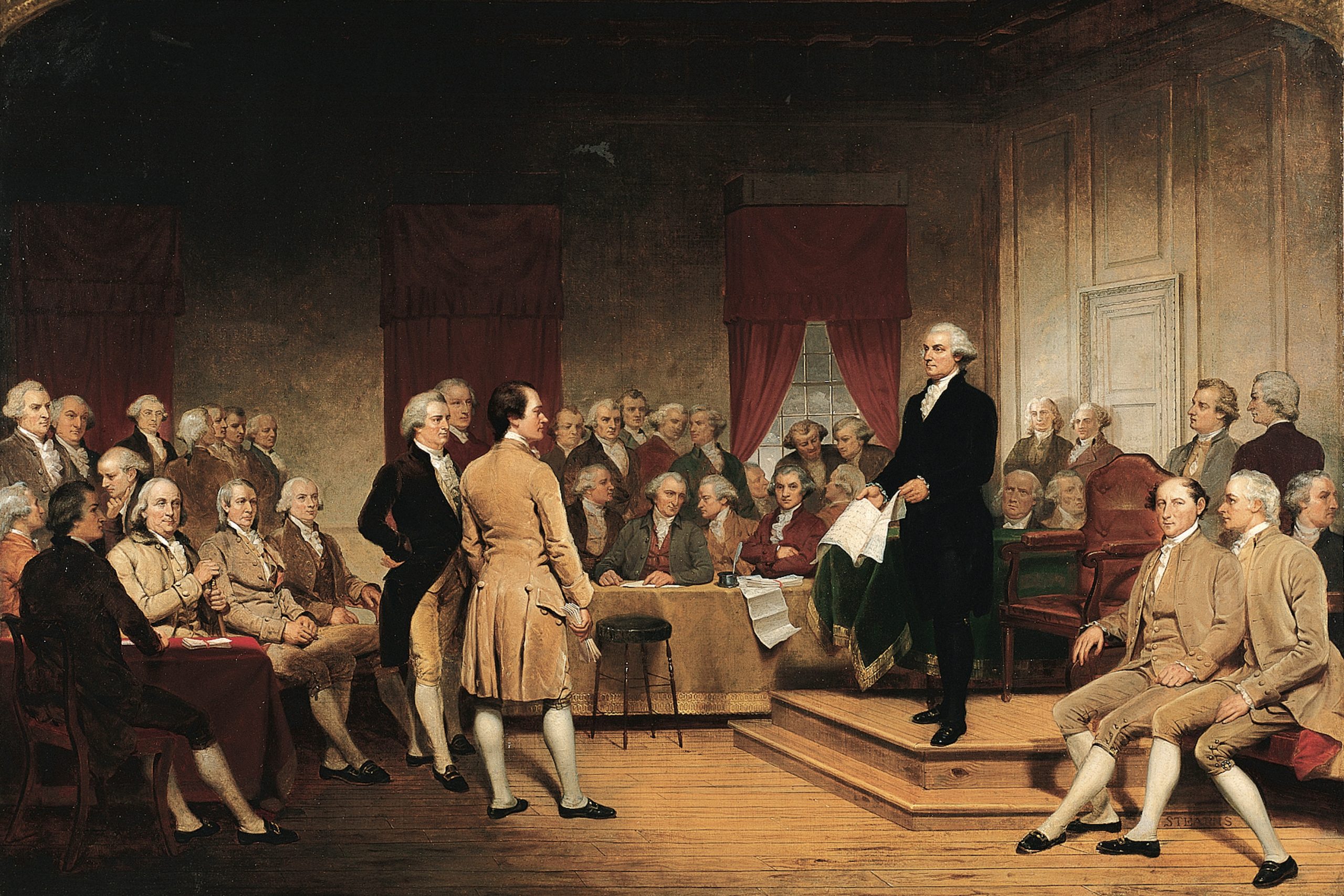
The report finds that instructors pay scant attention to “traditional and foundational topics,” including the basic principles and creation of the Federal Constitution, the Industrial Revolution, the development of American democracy, and the role of religion in American reform movements. In the first half of the survey the focus is on imperialism, colonial dispossession of native peoples, social inequalities, and racism — the syllabus for the course at a major state university in the Midwest announces that the purpose of the class is to lead students to “grasp how inequality was woven into the nation’s very constitution.” Missing is effective treatment of the American Revolution, the establishment of republican governments, and the principles, drafting, and ratification of the Federal Constitution and the Bill of Rights.
In the second half of the survey, more than sixty percent of syllabi used politically charged terms drawn from identity politics, including “white supremacy” and “toxic masculinity.” Many instructors teaching this period emphasize gender roles, homosexuality, queer theory, militant social protest, and various forms of victimization. Political history is largely absent and military history is entirely absent from nearly every syllabus the team reviewed. Most courses do not address military operations in World War I or World War II. They focus on the home front, racism in civilian and military life, and the suppression of civil liberties in wartime. Diplomatic history is likewise neglected, as is invention and the growth of business and industry. Readings assigned in these courses emphasize black nationalism, militant feminism, and gay activism.
These survey courses now reflect the view, which the American Historical Association describes as pervasive among university faculty members, that “the primary mission of the study of history is the correction of today’s social problems.” Yet fewer and fewer students are paying attention. Over the last twenty years the number of students graduating with a major in history has dropped by fifty percent.
During the same period many universities removed the history surveys — Western or World History and U.S. History — from their general education requirements for a bachelor of arts degree. Courses that were once the cornerstone of a liberal education have degenerated into platforms for politically-motivated instructors to parade partisan grievances. Enrollments have shriveled and the history of our nation and the principles that have shaped that history go unlearned.
What can be done about any of this?
The report makes a series of recommendations to reform basic American history education at the university level — a much broader aim than addressing the content of the basic survey courses. Given the claim that their findings document “a crisis in civic education,” the recommendations are modest — perhaps too modest.
The first is an appeal for “educational transparency,” including the online publication of course syllabi, enrollment figures, faculty meeting minutes and announcements involving curriculum content, and biennial reports on educational outcomes for students.
Their second recommendation is that university administrators require faculty hiring searches to cast a wider net, seeking new faculty members “with broad areas of expertise not restricted to candidates focused solely on racial, ethnic, sexual orientation, or gender identity.” Since hiring is generally dominated by committees of current faculty eager to find new colleagues who share their academic and political preferences, the idea that faculties can be reformed from within is a mirage.
Third, the report calls for the establishment of new interdisciplinary departments and degree programs creating “the possibility of greater opportunities for civic education” and “a climate more welcoming to intellectual diversity.” The study does not explain why this would be so — why new interdisciplinary programs would circumvent the dominant position of grievance politics and hostility to American institutions found in history departments. Given the declining number of undergraduates majoring in history few institutions seem likely to invest in new departments and programs staffed by historians with a more balanced approach to American history. New programs staffed by existing faculty would simply perpetuate, and probably amplify, their vision of the American past as a sordid story of oppression and exploitation, devoid of constructive accomplishments and high ideals.
The commissioners and the research team insist that they are committed to academic freedom, including the freedom of instructors to “teach their courses in ways they consider appropriate.” Legislatures and academic governing bodies, they contend, should not dictate specific curricula. But it is clear that the authors of the report don’t trust the current generation of instructors to do a competent job. They contend that teachers “should be obligated to provide students a fuller understanding of the entirety of American history” but don’t say what authority should compel them to meet that obligation. Until we resolve that question real reform will remain out of reach.
__________
The Study of American History in Our Universities is available to the public on the website of the Center for American Institutions.