Raphaël Glucksmann, a French member of the European Parliament from the Progressive Alliance of Socialists and Democrats, recently suggested we return the Statue of Liberty to France: “We gave it to you as a gift, but apparently you despise it. So it will be just fine here at home.” M. Glucksmann has since said he wasn’t serious — this was just a “wake up call” reflecting his frustration with American policies. He adds that “the statue is yours. But what it embodies belongs to everyone. And if the free world no longer interests your government, then we will take up the torch, here in Europe.”1
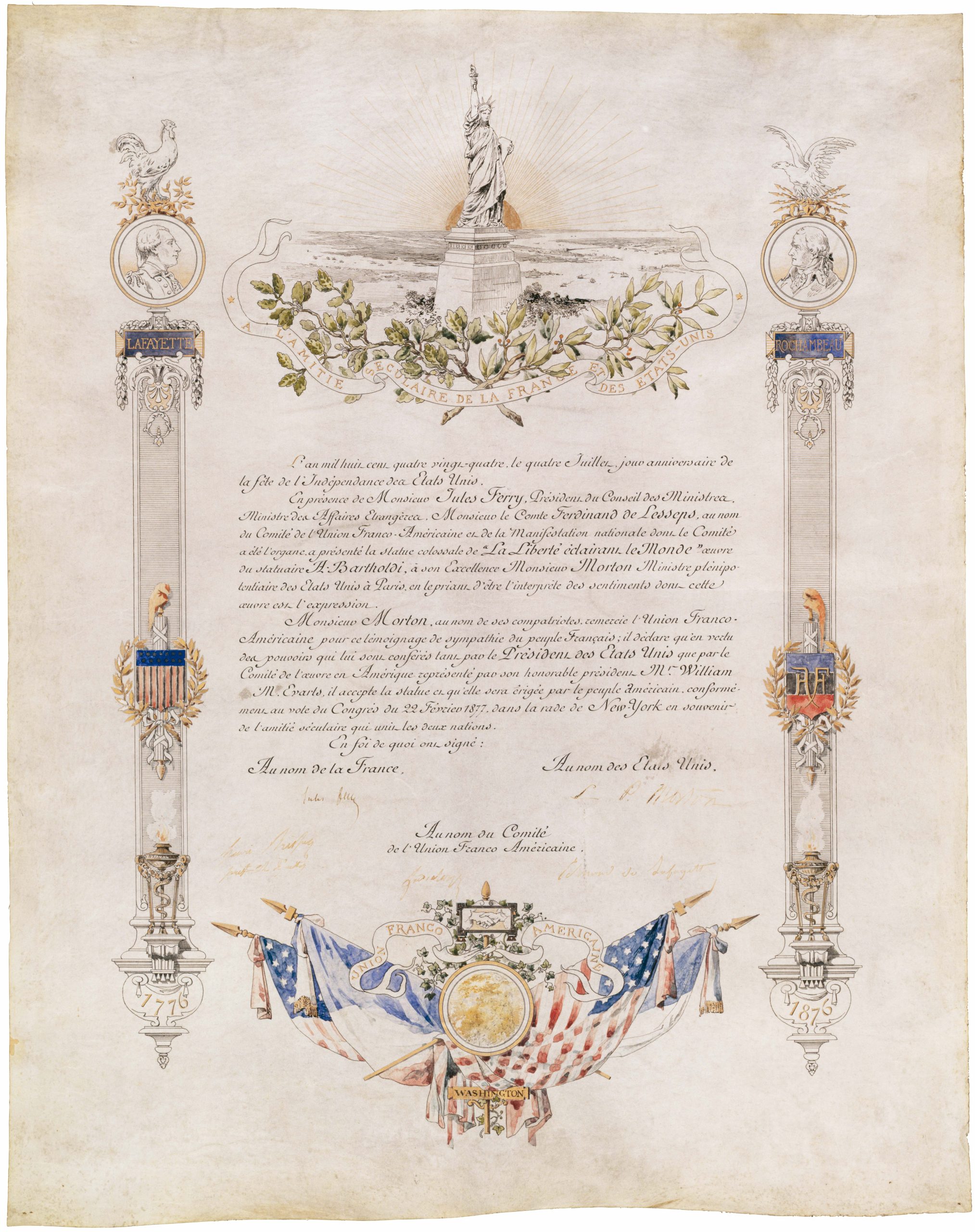
The Statue of Liberty — its formal name is Liberty Enlightening the World — was officially presented on behalf of the French people by Jules Ferry, president of the council of ministers, and accepted on behalf of the American people by Ambassador Levi P. Morton. This deed of gift is dated July 4, 1884, two years before the statue was dedicated in New York Harbor. National Archives
Actually the Frenchman who conceived the statue, raised the money to build it, and saw that it was presented to the people of the United States in 1886 hoped that Europeans, and ultimately everyone in the world, would “take up the torch.”
The statue was first imagined by Édouard-René Laboulaye, a college professor, enemy of slavery, advocate for religious freedom and women’s rights, and one of the most prominent liberal republicans in France. His aim was to aid his countrymen in establishing and maintaining a liberal constitution adapted from the American model, with a bicameral legislature and separation of powers. In the decades since the American Revolution, he explained in 1849, the United States had been governed by one constitution, while in the same years France had been governed by ten. “Give us time,” he wrote, “and we will become a democracy.”2
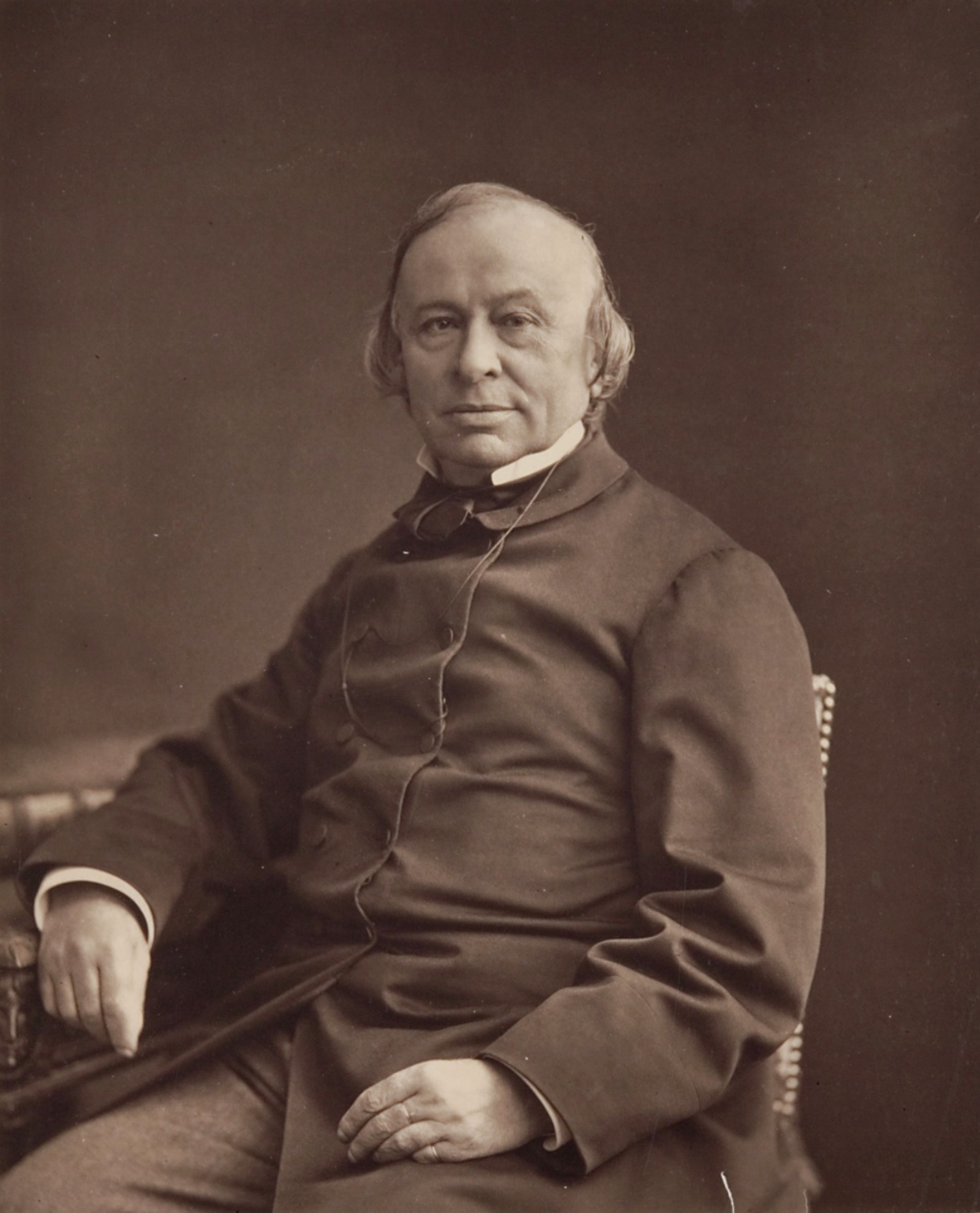
Éduoard Laboulaye, photograph by “Nadar” (Gaspard-Félix Tournachon), c. 18753
Laboulaye was infatuated with the idea of America. He never visited the United States, but Mary Booth, a gifted translator and editor, wrote that he knew more about the United States than anyone in Europe. He was known, she said, as “le plus Américain de tous le Français” — the most American of all the French.4 He was the first academic to offer a course of lectures on American history. He dressed plainly, as he imagined all true Americans did. He translated Benjamin Franklin’s autobiography and other works. He also wrote a three-volume history of the United States, in which he argued that the creation of the American republic was the beginning of a new order of things in which American liberty would ultimately enlighten the world.5
In the spring of 1865 Laboulaye hosted a dinner party at which he suggested a monument, designed in France and “built in America as a memorial to their independence.”6 Among his guests was Frédéric Bartholdi, an ambitious young sculptor. Bartholdi had been to Egypt and was deeply impressed by its monuments, especially the colossal statues of Ramses II at Abu Simbel. He volunteered to design the memorial Laboulaye had in mind, but the project was impractical during the reign of Napoleon III, who was hostile to republican ideas.
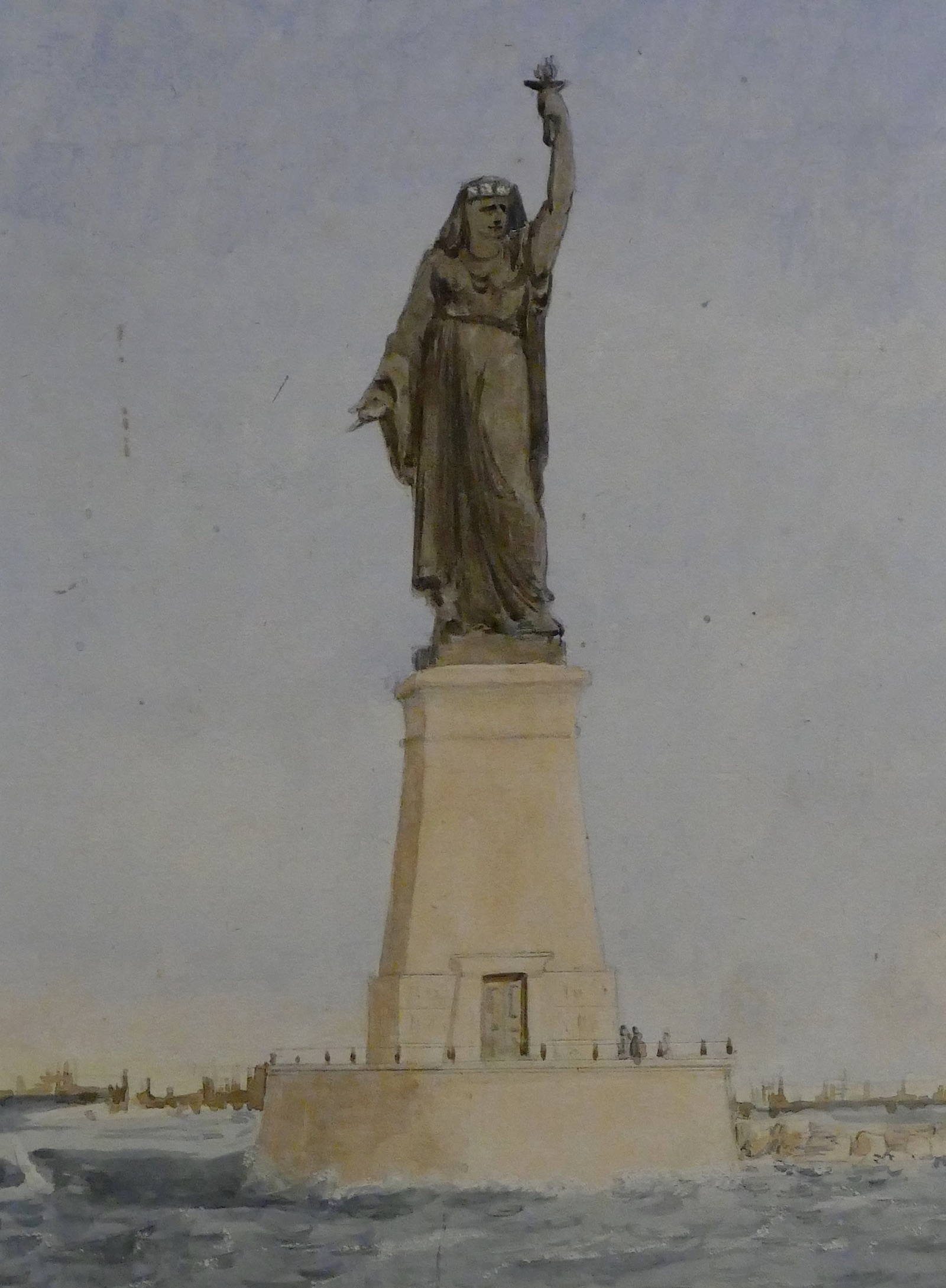
In Bartholdi’s plan for Egypt Carrying the Light to Asia, a steel structure supported a copper figure of a woman holding aloft a torch. He incorporated these features on a much larger scale in Liberty Enlightening the World. Musée Bartholdi de Colmar
In the meantime Bartholdi proposed a colossal statue for the northern end of the new Suez Canal — a statue of an Egyptian woman wrapped in robes and holding a torch. He called the statue Egypt Carrying the Light to Asia. The light he imagined was progress — presumably the economic and technical progress represented by the canal. The Egyptian government, concerned about cost, built a conventional lighthouse instead.
Shortly thereafter Napoleon III was deposed, a new French republic launched, and Laboulaye and Bartholdi went to work on their statue of Liberty — the kind of Liberty Laboulaye hoped to memorialize in America so that it might be realized, first in France and then everywhere else in the world. Bartholdi, anxious to create a colossal statue to rival the great works of antiquity, embraced Laboulaye’s views on the United States and the principles of political liberty.
The statue, Laboulaye explained, would not represent Liberty in general. It would symbolize “American Liberty.”

The wreckage of revolution, strewn with corpses, forms the pedestal of armed Liberty in Eugene Delecroix’s Liberty Leading the People (1830). Successive governments regarded the painting as incendiary and limited its exhibition until the Third Republic acquired it for the Louvre in 1874. The Statue of Liberty with its upraised right arm alludes to Delecroix’s Liberty while transforming it — replacing the Phrygian cap with a radiant crown, the tricolor of France with the universal flame of enlightenment, the bare-breasted defiance of convention with chaste robes, and the musket and bayonet with a tablet of the law. Musée de Louvre
In Europe the cause of Liberty had too often degenerated into licentiousness and bloodshed — the so-called Liberty of limitless state power that led to the guillotine and marching armies of liberation indistinguishable from the ancient tyrannies it replaced.
Laboulaye wanted the world to understand that Liberty did not have to be that way. The statue he imagined, Liberty Enlightening the World, would represent ordered liberty, limited government, and the rule of law: “She is not Liberty with a red cap on her head and a pike in her hand, stepping over corpses. Ours in one hand holds the torch — no, not the torch that sets afire, but the flambeau, the candle-flame that enlightens. In her other she holds the Tables of the Law. This statue, symbol of liberty, tells us at one and the same time that Liberty lives only through Truth and Justice, Light and Law.” He knew how uncommon they were, how difficult to nurture.7
To make the source of this idea completely clear, the tablet Liberty holds is the American Declaration of Independence, which is based on what it says is the self-evident truth that “all Men are created equal” and possess “unalienable rights,” among which are “Life, Liberty and the Pursuit of Happiness.”
“This,” Laboulaye added, a little plaintively, “is the Liberty that we desire.”
The Declaration of Independence, as Laboulaye understood, was not actually law. It was an expression of the basic principles of American nationhood and announced the ideals that shaped the American constitutions of the late eighteenth century, the most creative period of constitutional thought in modern times.
For Laboulaye the Declaration expressed universal truths that are the foundation of good government. Bartholdi symbolized this importance by shaping the tablet bearing the date of the Declaration, July 4, 1776, like a keystone. The crown Liberty wears has seven rays, representing the seven continents and the aspiration that American Liberty would inspire the establishment of republican governments all over the world — limited governments that would protect the natural rights of their citizens. A committed abolitionist, Laboulaye made sure the statue included an allusion to the end of slavery. Bartholdi included broken shackles at Liberty’s feet. Laboulaye was under no illusion that newly emancipated Americans enjoyed all the universal rights expressed in the Declaration. Although he viewed America from a distance he was aware of its failings. The light offered by American Liberty, as he imagined it, would inspire America as well as the rest of the world.
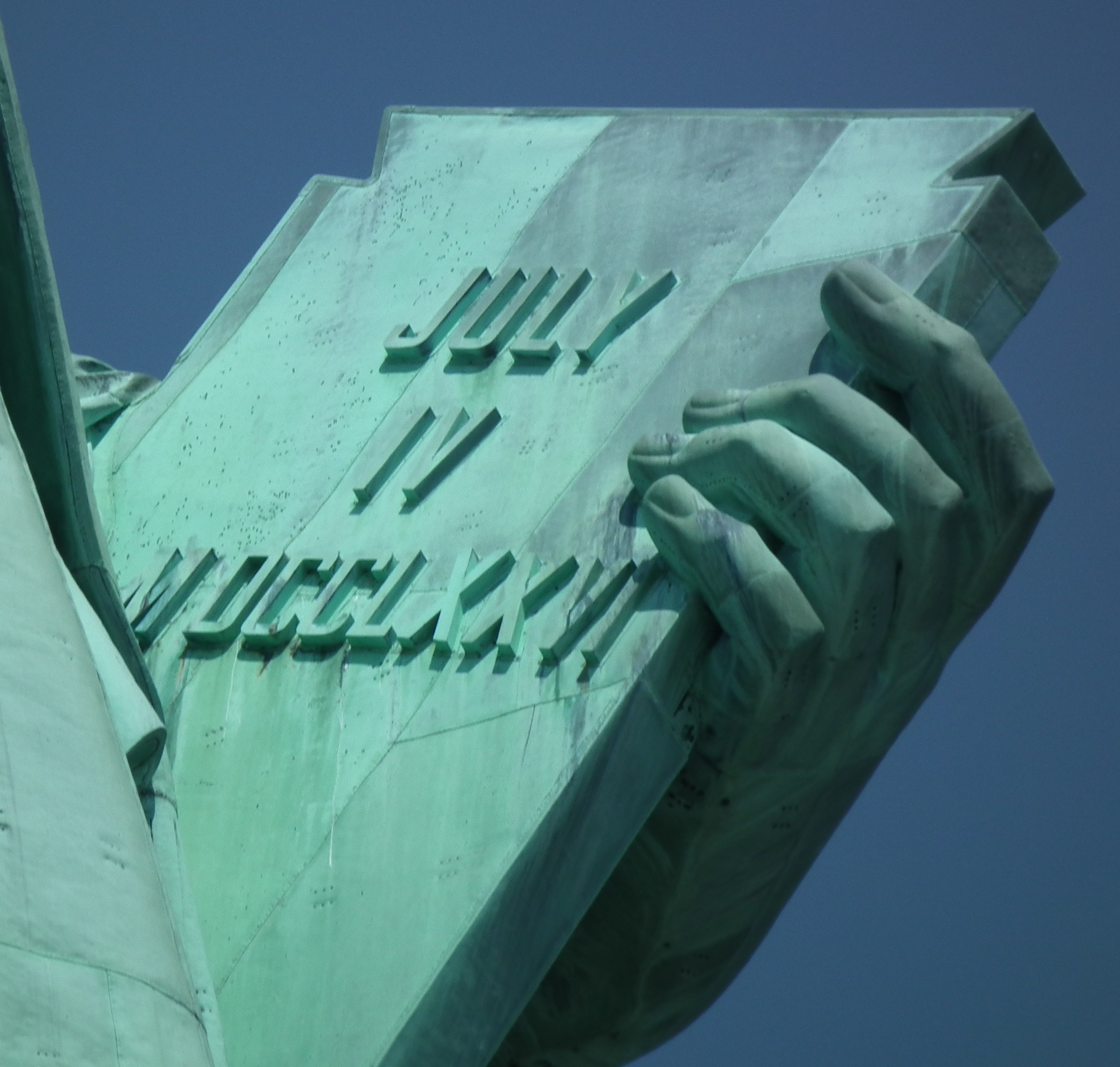
The original meaning of the Statue of Liberty is embedded in subtle details. The Declaration of Independence tablet is shaped like a keystone, the most important component in the structure of American government.
Laboulaye had the pleasure of seeing the finished statue assembled in Paris, but he died in 1883, before it was brought to America. He was mourned as a leading liberal of his generation and an eloquent advocate for the rights of men and women. Among the mourners was Susan B. Anthony, who respected Laboulaye’s views on the rights of women. She found the service more moving than all the museums and palaces in Europe.8
In a tribute to his friend, legislator Agénor Bordaux wrote that Laboulaye “never tired of demonstrating that freedom was an individual thing; that it was the right belonging to each person, in his capacity as a man, to exercise and develop his intelligence and his body without the State intervening other than for the maintenance of peace and justice. The form of government was therefore only the guarantee of freedom itself! As the idea of freedom presupposes the idea of perfectibility, Laboulaye, like thinkers of the late eighteenth century, saw the horizon receding and expanding, and a perpetual movement carrying society towards a purer beauty, a more certain truth, a more complete equity and tolerance.”9
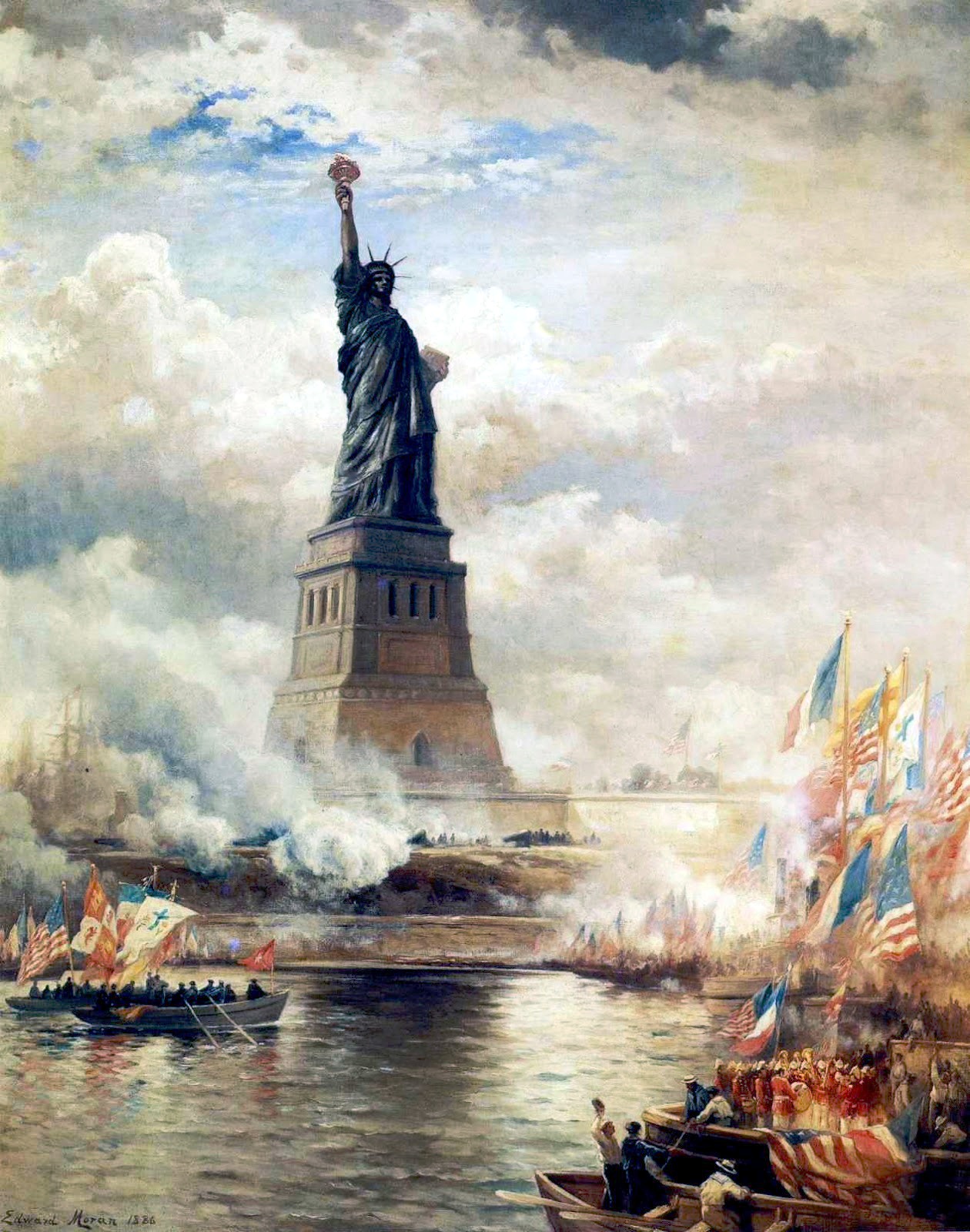
Unveiling the Statue of Liberty Enlightening the World, 1886, Edward Moran, 1886, Museum of the City of New York
If he had lived Laboulaye surely would have made his first trip to the United States in 1886 to attend the dedication. Since then the Statue of Liberty has been regarded as a symbol of many things — including French and American friendship, of which Laboulaye often spoke, and of the United States as a nation of immigrants, millions of whom passed the statue on their way to Ellis Island.
Éduoard Laboulaye’s idea of a monument to liberty as the guiding principle of limited governments based on natural rights is now almost forgotten. M. Glucksmann, who suggests we return the state to France, certainly does not share Laboulaye’s ideal, nor do many of modern Europe’s self-styled liberals, progressives, and socialists, nearly all of whom are committed to state power rather than limited government dedicated to maintaining peace and justice among free and autonomous individuals. The Statue of Liberty Laboulaye imagined still lifts her lamp and faces out to sea as if looking for an answering light from the Old World, but no light comes.
On a related theme — the distinction between American nationalism and American patriotism — see “My Country ‘Tis of Thee” in The American Crisis.
Notes
- Rachel Treisman, “Does the U.S. deserve the Statue of Liberty? Not anymore, one French politician says,” NPR, March 18, 2025. [↩]
- On Laboulaye, see Walter D. Gray, Interpreting American Democracy in France: The Career of Édouard Laboulaye, 1811-1883 (Newark: University of Delaware Press, 1994), esp. “Laboulaye, the Americanist,” pp. 55-72, and, on his role in the creation of the statue, pp. 128-33. Among contemporary assessments, John Bigelow, Some Recollection of the Late Eduoard Laboulaye (Privately printed, New York: G.P. Putnam’s Sons, 1889) is entertaining and instructive. Bigelow was an American diplomat in Paris in the 1860s and finally ambassador. He and Laboulaye were important Franklin scholars. [↩]
- The portrait was published as a woodburytype by Goupil & Cie in Galerie Contemporaine des Illustrations Françaises (8 vols., Paris: Paul de Lacroix, 1890). [↩]
- Mary L. Booth, “Translator’s Preface,” Laboulaye, Paris in America (New York: Charles Scribner, 1863), iii. Booth, a linguist, author, women’s rights champion, and first editor of Harper’s Bazaar, translated Laboulaye’s work for American audiences. [↩]
- Laboulaye, Histoire des Etats-Unis (3 vols., Paris: Charpentier, 1855-66). [↩]
- [Frédéric Bartholdi], The Statue of Liberty Enlightening the World described by the sculptor Frederic Auguste Bartholdi (New York: North American Review, 1885), 12-14; A National Park Service report asserts that this account of the origins of the statue is a “legend” invented by Bartholdi as a fundraising ploy, but the author does not explain what the fundraising effort had to gain by making this allegedly false claim. There is, in fact, no reason to doubt Bartholdi’s account of the dinner party, which Laboulaye’s scholarly biographer, Walter Gray, regards as reliable (see Gray, Interpreting American Democracy in France, 160, n. 61). The author of the NPS report correctly points out that Bartholdi’s account is the only source for the claim, but there is no competing claim, and if historians begin rejecting the veracity of every uncorroborated but uncontested detail for which there is sound documentary evidence much less good history will get written. It would be much more satisfying if someone else at the party had left a written account of Laboulaye’s suggestion and their account had somehow come to our attention, but it is perfectly understandable that we have no such corroboration. Bartholdi had no reason to lie and he seems to have been an honest and reliable man. Referring to his account as “legend” is hyperbole. See Rebecca Joseph, “The Black Statue of Liberty Rumor: An Inquiry into History and Meaning of Bartholdi’s Liberté éclairant le Monde — Final Report,” [↩]
- Laboulaye, “Union Franco-American,” [Speech at the Opera of Paris, April 25, 1875], Derniers Discours Populaires (Paris: G. Charpentiers et Cie, 1886), 167-82. The passage quoted is on p. 180: La statue était bien choisie: c’est bien la Liberté, mais la Liberté américaine. Ce n’est pas cette Liberté avec un bonnet rouge sur la tête et une pique à la main qui marche sur des cadavres. La nôtre tient d’une main une torche, non la torche qui incendie, mais le llambeau qui éclaire, de l’autre, les Tables de la Loi. Cette statue, symbole de liberté, nous dit en même temps que la liberté ne vit que par la vérité et la justice, la lumière et le droit. C’est cette liberté que nous vou lons, c’est elle qui restera éternellement l’emblème de l’alliance de l’Amérique et de la France. [↩]
- Elizabeth Cady Stanton, Eighty Years and More (New York: European Publishing Company, 1898), 177. [↩]
- Agénor Bardoux, “la mort de M. Laboulaye,” Journal des Débats Politiques et Littéraires, June 9, 1883. The passage quoted reads: “il ne s’est pas lassé de demontrer que la liberté était chose individuelle; qu’elle était le droit appatenant à chacun, en sa qualité d’homme, d’exercer et de developper son intelligence et son corps sans que l’Etat intervienne autrement que pour le maintien de la paix et de la justice. La forme de gouvernement n’était done que la garantie de la liberté même! Comme l’idee de liberté suppose l’idée d perfectibilité, Laboulaye, ainsi que penseurs de la fin dix-huitième siècle, voyait l’horizon reculer et s’agrandir, et un perpétuel mouvement emporter la societe vers une beauté plus pure, une vérité plis certaine, une équité et une tolérance plus completes.” [↩]