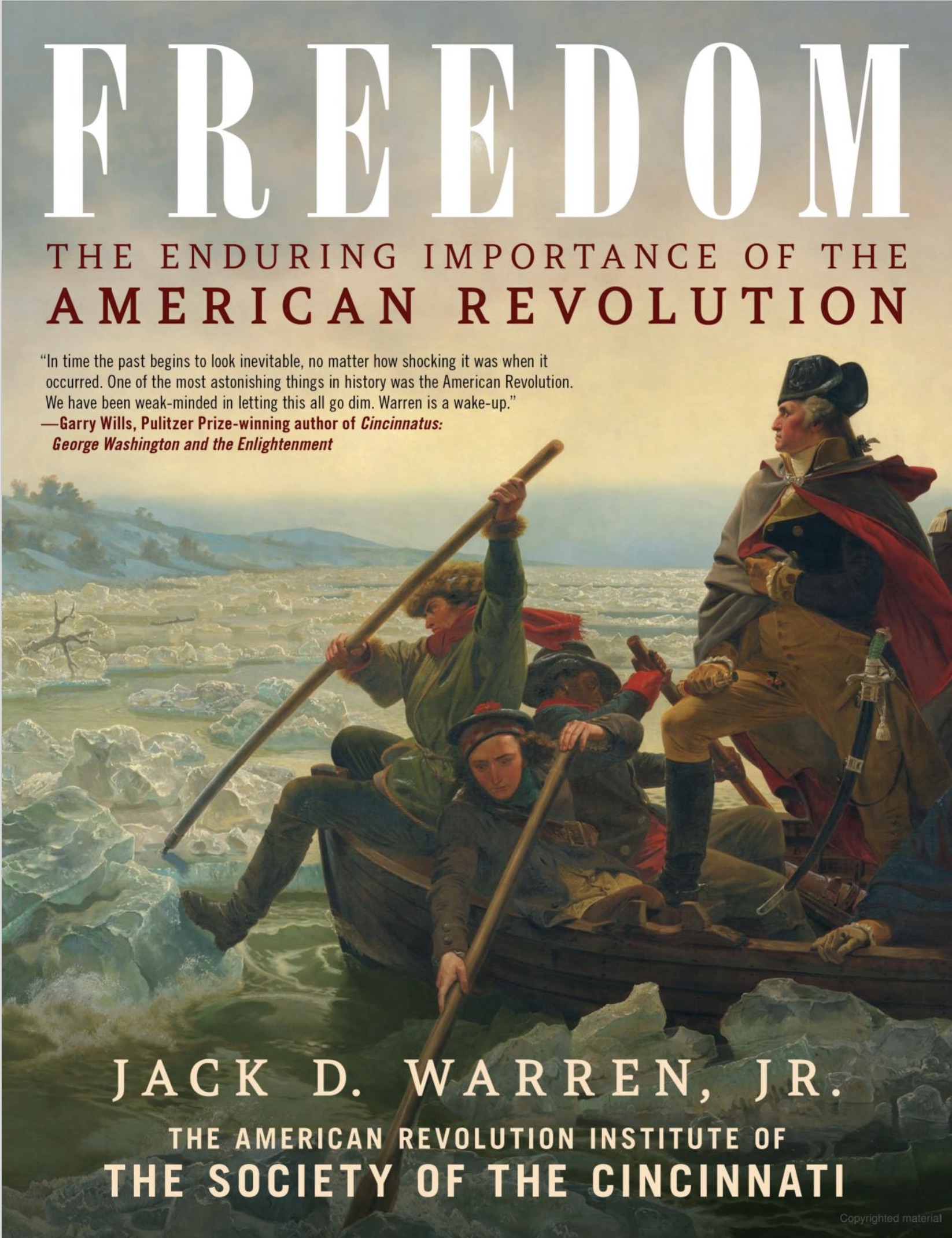
If you could have one book in your library on the American Revolution, here is the one I recommend: Jack Warren, Jr.’s, Freedom: The Enduring Importance of the American Revolution. The author begins his magisterial work with this observation: “America is free because nearly 250 years ago brave people fought a war to establish the independence of the United States and create a system of government to protect the freedom of its citizens.” By the end of Freedom, any careful reader will be entirely convinced of the statement, not as a matter of uncritical patriotism but in response to a history so well crafted as to illuminate for contemporary readers the origins and meaning of our life together in America.
The author, a seasoned historian, is currently editor of The American Crisis, an online journal dedicated to renewing an understanding of America’s past. Warren’s Freedom is at once a comprehensive course of study in the history of the Revolution and an exercise in what it means to live under history. The narrative is exhaustive, covering every imaginable detail, although one easily imagines that there is no end to the author’s knowledge of the era. John Lukacs says that humans remember a lot more of the past than is recorded. I’d nominate Jack Warren as the representative of that human factor.
He is a consummate narrative historian, working up the following into his detailed account:
Imagery, ranging from beautiful portraiture to historic cartoons and from historic maps to photographs of historic documents. To spend time on the pages of Freedom is akin to walking through the National Portrait Gallery in Washington, D.C. or visiting the National Art Gallery’s first floor lineup of paintings of some of our Founders. The imagery stands out, every chapter adorned with at least some full page replicas. The large 8×11 stock pages of the book provide a striking canvas for the beautiful, colorful portraits.
Individual narratives or eyewitness accounts add a lot of life to the drama of the story: threatening banter between Admiral Montagu and the rebels returning from the Boston Tea Party or the stirring and escalating speech by Patrick Henry before the Virginia House of Burgesses that famously ends in “give me liberty or give me death!” Banstre Tarleton, a British commander at the 1780 Siege of Charleston, is quoted regarding his own soldiers’ slaughter of Americans with “a vindictive asperity not easily restrained.” (231) Letters and speeches by figures like Adams and Franklin pepper the storytelling from early on to near the end. Franklin states of the Constitution: “I consent, Sir, to this Constitution because I expect no better, and because I am not sure, that is not the best.” (344)
Structures important to the American Revolution are carefully laid out with clear explanations. Warren introduces us to the crucial Founding Documents. Chapter 11 is worth the price of the book for the tutorial he gives on the Declaration of Independence. Every teacher in America should study it carefully before leading students through the document, tending to Warren’s exposition on the key terms: “one People”; the “Powers of the Earth” and their “separate and equal station”; and the triad, “Life, Liberty, and the Pursuit of Happiness.” Among other things, Warren makes an argument for why the “self-evident truths” were not so self-evident. As he explains it: “They were declared in darkness, in a world where equality was almost unknown and the rights we cherish were barely recognized.” (151) That insight of Warren’s, perhaps more than any other, helps his readers see just how revolutionary the Founders’ efforts were.
For all its exhaustive details, the narrative is not exhausting. The style is lively, and Warren’s history, a genuine narrative told in clear, beautiful prose. Above all, it is visionary. In its recollection of the ideals, sacrifice, and extraordinary victory of our Founding Fathers, Warren tells a reverent story, capable of providing meaning for any American. He puts flesh on the “idea of America” and frees us to see how the Founding ideals were not left as abstractions on the founding documents but lived by our forebears and now embraced as our own. In this sense, Freedom illuminates what it means to live under history — to live by the story of our past.
Humans are born free, but they must be educated to freedom; they must attain it and preserve it. Freedom comes from knowing the truth. To be free is to live for noble purposes. And to be truly free is to live generously for others, even sacrificially. As told compellingly by Jack Warren, the Founders exhibited all three qualities of freedom.
In typical mode, critics will object that since the Revolution did not eradicate slavery, liberate women, or elevate everyone to some measure of economic parity, it was a failure with respect to genuine freedom. Gordon S. Wood, who taught Warren at Brown University, counters that in 1776, there was no revolution in the world that could have achieved those goals.[1] The late historian Edmund S. Morgan, also one of our great scholars of the Founding, reportedly ended his final lecture at Yale in 1986 with a nod toward the Revolution: “No matter how we looked back on our Revolution, it was ‘as it always has been, good enough for us.’”
Then again, I came away from Freedom with an estimation of the Revolution as greater than “good enough.” I mean that as no criticism of Morgan, whose work I revere. Perhaps it has to do with the time that has elapsed since 1986. I remember that year. America was not so divided as it is today, particularly over our history. I think, then, that Jack Warren’s narrative is the nod toward the Revolution suited to our time:
It is objectively detailed and rises above any moralistic or anachronistic reduction of the Revolution. It is soaringly written and pointedly recollective, rising above the ugly sloganeering in which moralists and anachronists indulge. More than ever, we need to remember the origins of our freedom observationally and sympathetically. Having read the best book on the subject, a great book written through Jack Warren’s observant, sympathetic eye, any reader can rightly conclude for himself that our origins are more than good enough; they are truly good.
Andrew J. Zwerneman is co-founder and president of Cana Academy. He blogs weekly at www.canaacademy.org and is the author of History Forgotten and Remembered (2020) and The Life We Have Together: A Case for Humane Studies, A Vision for Renewal (2022). Andrew narrates the film series, HISTORY250™.