Many people who say they’re concerned about declining historical knowledge among young Americans say the answer is more civics education.
They’re very right to be concerned, but wrong to conflate civics and history and wrong to expect civics to do the work of history education. It can’t. And be assured it won’t.
History is an academic discipline that seeks understanding of the past. History education, properly understood, seeks to equip students with the skills to discern facts about the past by assessing evidence and relate those facts to one another to achieve understanding of how one past reality became another. Its great utility — far exceeding any set of facts it may involve or any sentiments it may nurture — is training people to understand how change happens.
Most Americans, once they leave school, will never be asked to trace the origins of the Civil War or the factors that led to American economic growth or the shaping of the women’s rights movement — the stuff of history class — but the skills of rational discernment and interpretation such exercises teach are essential for understanding the changing world in which we live. Historical understanding is an important attribute of a disciplined, orderly mind.
You can, of course, learn a great deal about American government by studying its history. I’ve spent many years studying the history of American government and public life and my own understanding of our government is based on it. But understanding the functions of modern American government — distinct from its development — was not my purpose. Focused civics education is far more effective at teaching about the functions of government, but it cannot substitute for history education.
Civics is a pedagogical discipline rather than an academic one. No one does original research or makes new discoveries in civics. We have political philosophers to explore the ethical and moral dimensions of public life and political scientists to discern and study patterns in it. Civics is a set of facts we teach to young people, like the names of colors or how to spell words.
Those facts aren’t trivial, and getting them right is critically important, especially for citizens of republics. For other governments, perhaps not so much. Civics is of little value in nations governed by force and fraud, because the formal mechanisms of their governments are disguises that hide, or pretend to hide, the naked deployment of power to serve private ends.
Civics, for the most part, has little need for history, when history is properly understood as the study of the past and not as a synonym for it. Governments function in certain ways. How they came to do so is not particularly important to civics education. It is enough, in American civics, for a student to understand the concept of separation of powers between legislative, executive, and judicial branches of government. It isn’t necessary, or even desirable in a civics context, for them to study Montesquieu, the eighteenth-century political thinker most closely associated with this concept. How particular aspects of government came to be is a subject civics is ill-equipped to address.
Civics doesn’t ask — or at least shouldn’t ask — students to question the validity of concepts like separation of powers. Those are philosophical and historical matters. Frankly there isn’t time to go down those rabbit holes. It is sufficient for students to understand that such concepts are basic to our system of government without straying into their historical development or philosophical basis.
Civics does not teach students how change happens — the aim of history education. It focuses, and should focus, on the present functioning of government.
American civics and history necessarily intersect at one important place — the use of precedent in judicial decisions. Precedent is central to Anglo-American jurisprudence and can only be understood through examples necessarily drawn from the past.
To grasp precedent and not mistake its use as nothing more than an exercise of political power or simply as an effort to correct errors, some understanding and appreciation of the contexts in which precedents were established is essential. Brown v. Board of Education of Topeka is only comprehensible in relation to Plessy v. Fergusson. Each is only comprehensible in the context of its moment.
Civics is hard pressed to provide that. Understanding Plessy requires some understanding of race relations and ideas about race in the nineteenth century, Reconstruction, and the Fourteenth Amendment and its early interpretation, among other things. This is too much to expect from a civics class. In the time available in civics, a student is more likely to learn a bare fact — Plessy codified separate but equal, which in practice was separate and unequal — make a judgment, or be told, that Plessy was a travesty, and move on.
What’s missing is what history education can supply: how we got there. History education, properly understood, should persuade students to suspend ethical judgments about the past in order to understand how change occurs. Of course too much modern history education is caught up in making ethical judgments about the past and encouraging students to view the past through the lens of their own ethical ideas and subjective preferences. This is a major problem of modern history education but the answer is to change the way we teach American history, not to expect civics to take its place.
There is another practical and powerful reason why civics is not the antidote to failed understanding and appreciation of American history: civics is susceptible to the same kind of corruption by politics that plagues history education.
Many civics teachers — and many of the administrators who oversee their work and shape expectations for civics education — have been persuaded that American government involves a great deal of force and fraud serving private ends and subverting the good of the many.
Many believe, and if they don’t believe they are compelled to teach as if they do, that the purpose of civics is not to teach students about the mechanisms of government but to encourage activist engagement to change public policy and even overturn mechanisms of government they judge to be unjust.
Such judgements are not always made by state legislatures and embedded in statewide standards of learning. They are made by activist teachers and administrators and imposed on students. They often disregard the aims evident in standards of learning.
Expecting civics to do the work of teaching students to understand and appreciate the principles, origins, development, and operation of our governments — expecting civics to do the work of American history education as well as the work of civics — is asking for disappointment.
Good civics is important. Young Americans need to understand how government functions and the responsibilities of citizenship. But civics is not a substitute for history. They both deserve our attention and we need to do a much, much better job at both of them.
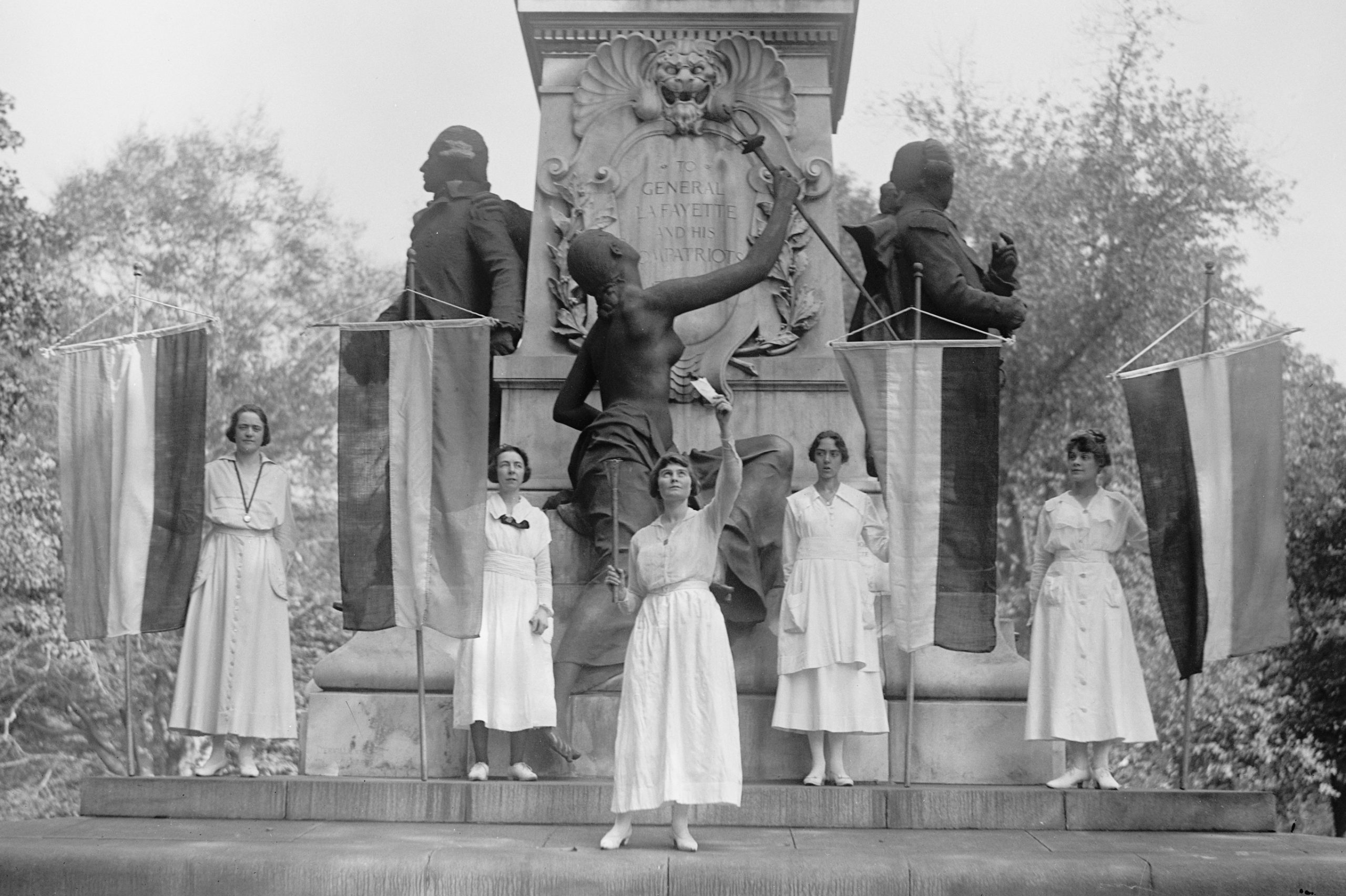
Above: A women’s suffrage protester burns a letter from President Wilson in a protest in Lafayette Park outside the White House in 1918. Library of Congress