Too many Americans think that the study of history is strictly a partisan matter. From that perspective, they expect history teachers to train students for fighting in the culture war. To one side of the political aisle or the other, they treat history, in other words, as a call to action, to march under a factional standard upon graduation.
To be sure, when teaching history, and when thinking about history, culture is in the mix. And culture wars are real, though they are very tricky conflicts to negotiate wisely.
A genuine education in history, however, is not a call to action, nor especially a call for young people to war with their political opponents. Genuine education is the transmission of culture: the inherited collection of humane letters, arts, customs, laws, beliefs, language, and traditions that free us to live together, not in opposition to each other. That is where history finds its place, as a field within the humanities: the subjects most suited to helping students answer questions about our humanity, our shared humanity, our good, common ground.
As for teachers, they are keepers of culture. They transmit our culture through the liberal disciplines, not by political agenda. Within those disciplines, teachers cultivate in their students the habits of interior freedom: to know and love what humans ought to know and love.
In that light, what are the habits history teachers ought to cultivate in their students? They won’t be habits of partisanship; they will be liberal habits of mind and heart, the strengths requisite to living under history as our shared story, as the story that frees society to hold together across generations and centuries of existence.
Nor will they be matters of narrow vision. The best education cultivates in students a vision of their humanity that transcends any one of them, even as it is a light to each of them. It transcends any political faction, even as it provides the noblest bearings by which any group orders itself. It is a vision that flows from our deepest origins, the foundations developed in our Western heritage, the cultural roots that free all of us, not just any one faction, to share a life together as one nation.
To help history teachers identify what habits they should cultivate in their students, I have created a chart organized around nine habits or sets of habits plus the objects most important to those habits in the study of history.
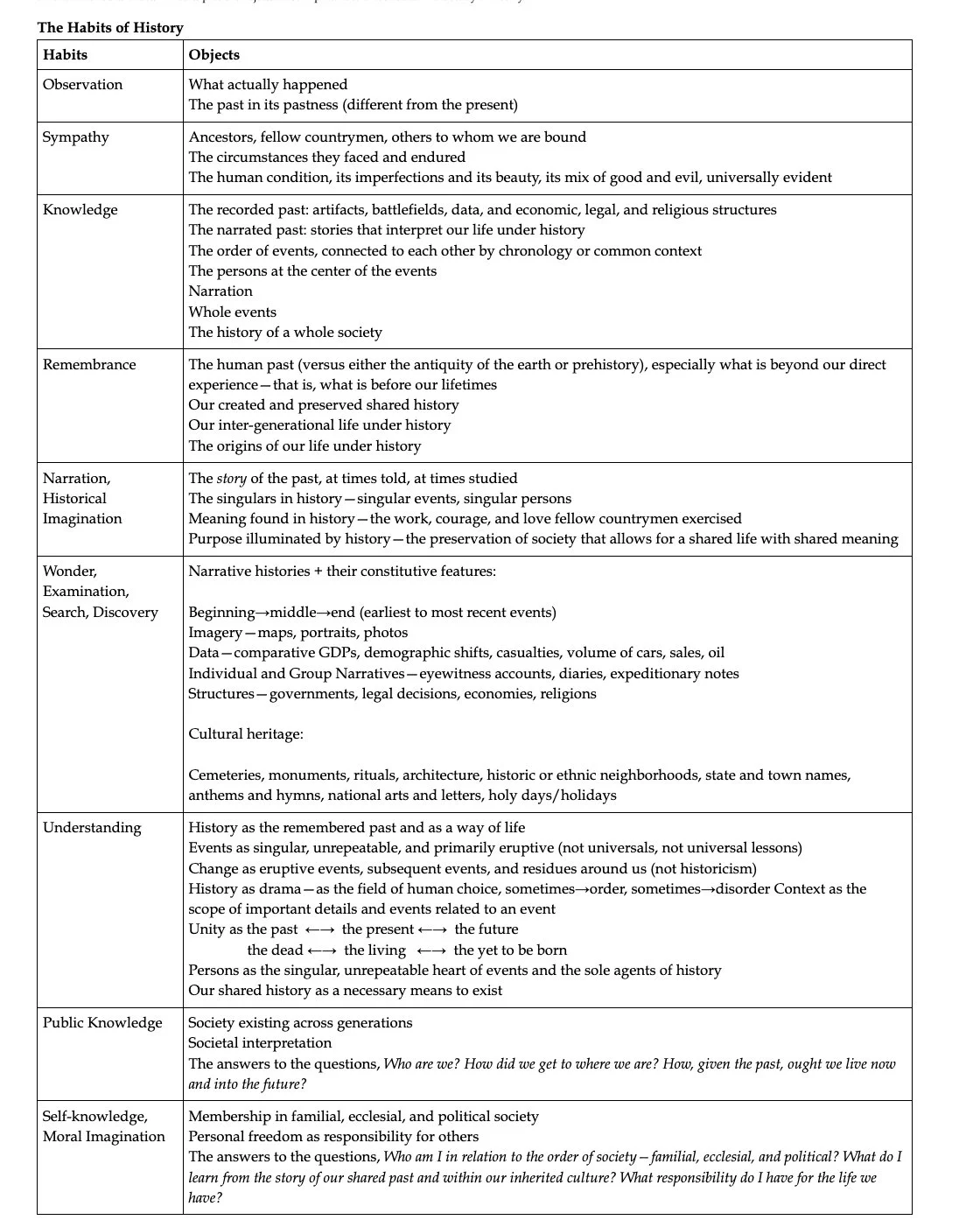
I recommend that you discuss the chart and the questions it raises. Set this reasonable goal for yourselves: Reach for clarity on the distinctions between the habits, then identify examples of the objects you intend for your students.
If you are leading a faculty discussion, form some helpful questions. Here are some examples:
Q: How are observation and knowledge different from each other?
You might begin by noting the more expanded field of objects for knowledge. It makes sense, as when we recognize a student who knows history well. He has mastered the material evidence (records, artifacts), grasped key interpretations (how narrative historians judge and relate their judgment of the past), and can narrate events, individually, or collectively as the history of an entire society.
Regarding the objects of observation, note the emphasis on how the past is distinct from alternative versions of the past—by inference, what we might want to have happened — or the imposition of the present on the past as if the past were the present writ small.
Q: What are some examples of what we want our students to know?
The recorded past: The Stamp Act, the Declaration of Independence, and Marbury v Madison, all written documents that played seminal roles in America’s early history.
The narrated past: Where Howard Zinn denies that there is a national society of meaning in America, and only classes, races, and genders, Wilfred McClay calls America a land of hope, evidenced from its beginning and across generations of Americans.
The order of events: Lincoln waited to declare emancipation until he could declare a significant victory—in this case, Antietam, which, while it ended inconclusively, halted Lee’s invasion of the north; and while the War did not begin as a war to end slavery, it became one.
Persons: How was Washington America’s Cincinnatus? Compare McClellan and Grant as strategists. Compare Wilson and Coolidge on the limits and possibilities of government. What roles did Presidents Eisenhower, Kennedy, Johnson, and Nixon play in involving America in Vietnam?
Narration: We don’t want our students to only be able to spit back dates and places—facts. We want them to narrate, to tell the story: to tell the story of an event — the Battle of Normandy, for example, or the Cuban Missile Crisis — and to tell either a societal history, or the history of one era — the Roman republic (five centuries), for example, or the rise and fall of Nazi Germany (three decades).
Q: Where do we see versions of the past that oppose observation?
One answer: the reduction of the past to a chronology of acts of oppression. The American Revolution, so this thinking goes, did not free the slaves, nor grant women the right to vote, nor eliminate income gaps between the rich and the poor. One counter to such a dismissal is to ask, Where in the world at the time were such matters resolved in ways that rise to the standards of the repudiators of the American Revolution? Nowhere, of course, and there is no evidence that anywhere in the world was ripe for a revolution that might have achieved those three objectives.
What did the Revolution achieve? One answer: no less than Frederick Douglass, a former slave, and Martin Luther King, Jr., who suffered from segregation, saw in the Revolution, solutions to the two respective problems. Douglass saw in the Constitution a “glorious liberty document” and King saw especially in the Declaration of Independence a “promissory note” for universal freedom.
Q: How is the past different from the present?
One could examine how Americans have educated their young, starting in the Colonial era. We could start with two observations: At the beginning, there were almost no schools. So, who taught the kids? Families did, and the churches. The first public schools, in fact, emerged from church life, which was highly integrated with family life. All three major forms of society, in other words—familial, ecclesial, and political—shared common purpose in educating the young.
Final thought
These are just a few tips on how to drive a discussion on the habits of history you and your school should cultivate in your students. Take some time to conduct that exchange. You will grow in your mastery of history. And that means you will lead your students better, and they will learn more.
Andrew J. Zwerneman is co-founder and president of Cana Academy. He blogs regularly at www.canaacademy.org and is the author of History Forgotten and Remembered (2020) and The Life We Have Together: A Case for Humane Studies, A Vision for Renewal (2022). Andrew writes and narrates the film series, HISTORY250®.