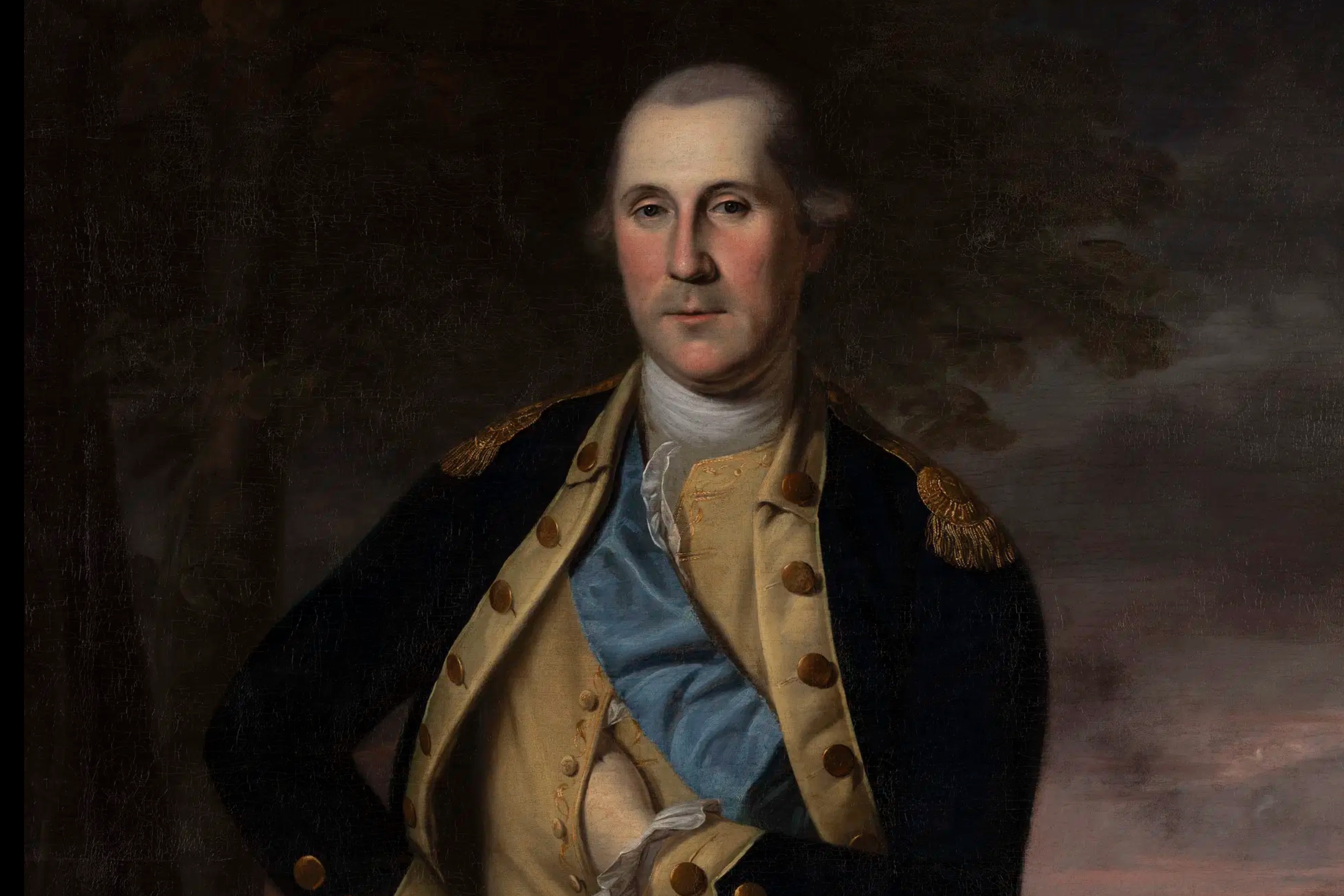
We know what Washington looked like, or think we know, because we have seen dozens of portraits of him. We carry his image in our pockets, on our dollar bills and our loose change. And though the most familiar portraits by Gilbert Stuart, Charles Willson Peale, and John Trumbull differ somewhat, most of us think we would recognize Washington if we met him in person — unexpected as that would be.
Washington is so famous that it is hard to imagine a time when Americans didn’t know what he looked like. But during the first years of the Revolutionary War, the only people who knew what Washington looked like were people who had seen him in person or had seen one of the very few painted portraits of him.
Printers tried to fill this void with imaginary portraits based on written descriptions — someone who had seen the general said he had a prominent nose, a broad forehead, a firm jaw, or simply a noble countenance — but these portraits no more resemble Washington than they resemble any other middle-aged man in a general’s uniform.
Charles Willson Peale, a young artist who had moved to Philadelphia from Maryland in 1775, set out to correct this. Peale had painted a portrait of Washington from life in 1772 and another in 1776 at the request of John Hancock. He also painted a miniature of the general for Martha Washington in 1776. Using these works as his source, Peale set out to create a mezzotint portrait of his famous subject — the first published portrait of George Washington by an artist who had painted him from life.1

Peale painted this miniature of the general for Martha Washington in 1776. It was based on the large portrait commissioned by John Hancock, but the treatment of the general’s attire is different. Peale based his 1778 mezzotint on this miniature. Mount Vernon Ladies Association
On October 16, 1778, Peale wrote in his diary that he “Began a Drawing in order to make a Medzo-tinto of Genl. Washington got a Plate of Mr. Brookes and in pay I am to give him 20 of the prints in the first 100 struck.”2 A mezzotint (from the Italian mezza tinta or half-tone) is a sophisticated form of intaglio (or inward cut) printing characterized by subtle gradations of tone from deep black to white produced with nothing more than black ink on paper. The shading is produced by burnishing the surface of a highly polished copper plate after cutting, which varies the depth of the cuts, which in turn varies the amount of ink conveyed to the paper. The mezzotint is the finest form of monochrome engraving ever devised. Peale had learned the art while studying with Benjamin West in London between 1767 and 1769, proceeding from what he called “some essays at Metzo tinto scraping” to an elaborate mezzotint based on his own painted portrait of William Pitt, Earl of Chatham, whom he depicted in Roman dress “speaking in Defence of the Claims of the American Colonies.”3
A month after starting work Peale finished the engraving and recorded that he “began to print off the small plate of Genl Washington” using a borrowed roller press. None of the printers in the city had any experience in striking mezzotints, a more demanding craft than printing a common line engraving. On November 20 Peale presented prints to several prominent people in the city, including Henry Laurens, president of the Continental Congress, Conrad Alexandre Gérard, the new minister from France, David Rittenhouse, a clockmaker and scientist, and Thomas Paine, the author of Common Sense. Peale continued giving the prints as gifts for months, including one to Pierre Eugene du Simitiere, a Swiss-born artist, who noted the gift in his private accession book. Peale also left prints on consignment at local shops, including two dozen at printer John Dunlap’s and a dozen each at two others. Dunlap ran an advertisement in the Pennsylvania Packet offering the print for five dollars.4

His Excellency Gen Washington, Charles Willson Peale, 1778, Robert Charles Lawrence Fergusson Collection, American Revolution Institute of the Society of the Cincinnati
Peale’s records account for about one hundred strikes from his mezzotint plate. Don Juan de Miralles, the unofficial agent of the Spanish government and a great admirer of Washington, took four dozen copies, which might have been as much as half of the print run. Miralles probably sent most of them to Spain.5 Ironically, Peale did not benefit from the Spaniard’s enthusiasm. Miralles died suddenly in April 1780 while visiting Washington’s headquarters in New Jersey, never having paid for the prints.
The prints offered for sale were probably seen by no more than a few hundred people. But some of those prints were acquired by engravers and printers who used Peale’s likeness of Washington as the basis of their prints of the general. Copied and recopied the image became the most familiar one for more than a decade. Versions of the Peale mezzotint — never credited as the source — appeared as etchings, line engravings, and wood cuts, some fairly sophisticated and faithful to the original, others simplified and crude by comparison. For more than a decade this was the face of George Washington to Americans who never saw the great man in person.
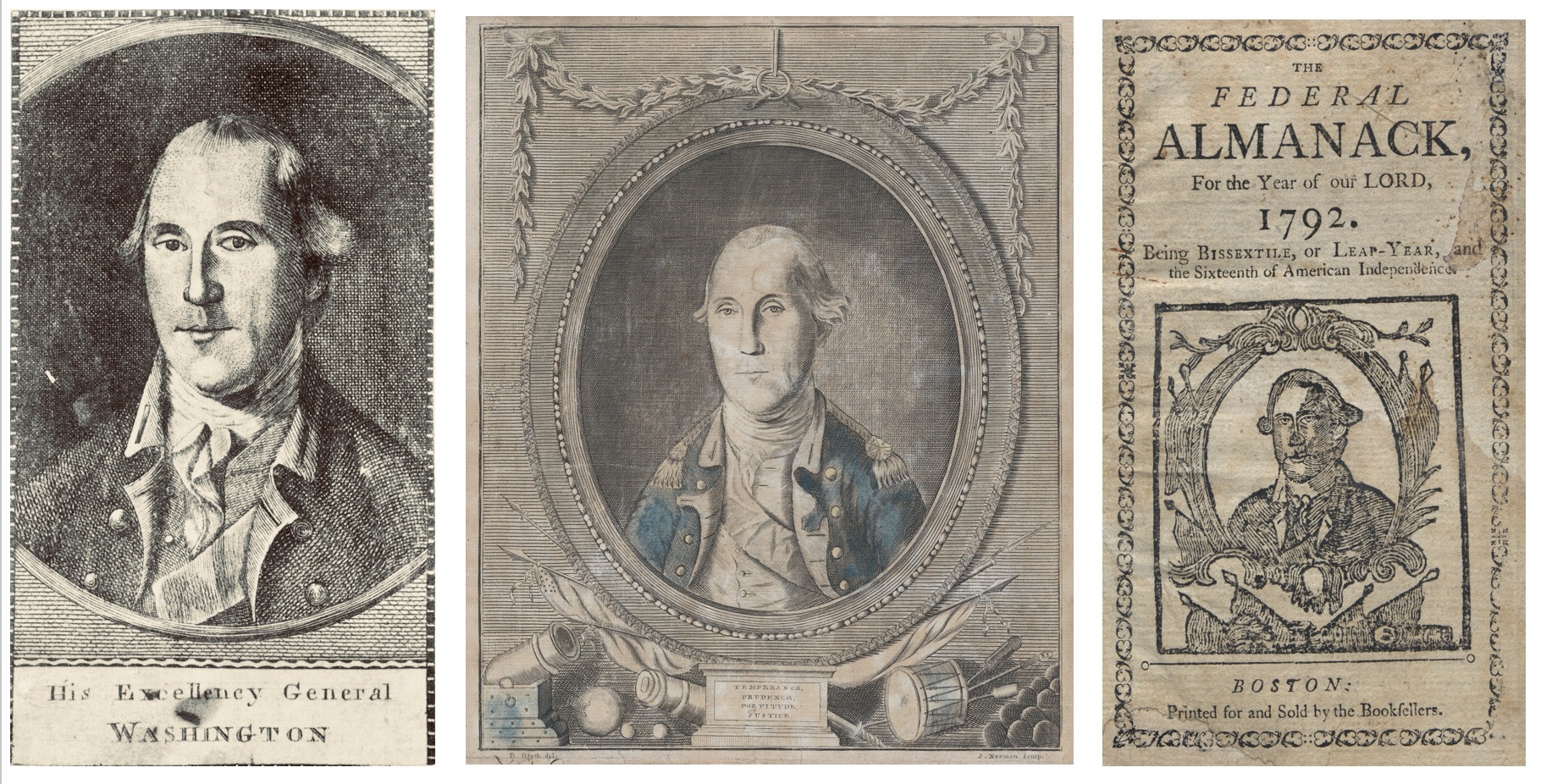
John Norman was the most important popularizer of Peale’s 1778 mezzotint. He was working as an engraver in Philadelphia in 1778 and copied Peale’s work for publications there. He subsequently moved to Boston and continued to use Peale’s mezzotint as the basis for his portraits of Washington. Other engravers, including Paul Revere, copied the image from Norman’s work. Left: John Norman copied the Peale mezzotint for the frontispiece of a 1779 school primer, which he advertised as “adorned with a beautiful head of general Washington.”6 Historical Society of Pennsylvania. Middle: Norman copied the portrait again in 1782 in this print designed by Benjamin Blyth of Salem, Massachusetts. Metropolitan Museum of Art. Right: An unknown artist created this woodcut, undoubtedly based on a print derived from Peale’s 1778 mezzotint, for a New England almanac published in late 1791. National Portrait Gallery
Despite its widespread influence, Peale’s 1778 mezzotint of George Washington is now one of the rarest of all printed portraits of the general. Until fairly recently no example was known to have survived. Scholars and print collectors knew from Peale’s diary and other records that he had created the mezzotint, but for most of the twentieth century it was assumed lost.7
Then in 1992 Wendy Wick Reaves, curator of prints and drawings at the National Portrait Gallery, discovered one of the mezzotints in a private collection in Boston. It had been misidentified as the work of John Norman. The National Portrait Gallery bought it.8 For several years it was the only one known. Then another example was identified in the Archives of the Indies in Seville — undoubtedly one of the four dozen prints acquired by Don Juan de Miralles. In 2014 the Society of the Cincinnati acquired one in remarkably good condition. It had been part of a private Canadian collection but not properly identified as the work of Charles Willson Peale.9 A fourth print has since been identified and there may be more to come.
What Washington looked like mattered to Americans and others at the end of the eighteenth century because they believed that a person’s appearance revealed their character. Some even thought they could predict character from appearance alone. Abigail Adams, who first saw Washington at camp in Cambridge in 1775, wrote to her husband that she was struck by his appearance: “Dignity with ease, complacency, the Gentleman and Soldier look agreeably blended in him.”10 Continental Army surgeon James Thacher, after observing Washington in October 1778, wrote: “The serenity of his countenance, and majestic gracefulness of his deportment, impart a strong impression of that dignity and grandeur which are his peculiar characteristics, and no one can stand in his presence without feeling the ascendancy of his mind, and associating with his countenance the idea of wisdom, philanthropy, magnanimity, and patriotism. There is a fine symmetry in the features of his face, indicative of a benign and dignified spirit.”11
French officers serving in America, more influenced than most Americans by the fashionable pseudoscience of physiognomy, were particularly struck by Washington’s appearance. Robert-Guillaume Dillon, an officer of Lauzun’s Legion, wrote that Washington’s “great character and his soul are apparent in his features; I recognized without difficulty the General out of a thousand officers of his army, he was one of the most handsome men that I’ve seen in my life.”12
The marquis de Chastellux, who served as liaison between Washington and Rochambeau, was equally certain that Washington’s appearance was a reflection of his character. He wrote that “the strongest characteristic of this respectable man is the perfect union which reigns between the physical and moral qualities which compose the individual, one alone will enable you to judge all the rest.” He found Washington “brave without temerity, laborious without ambition, generous without prodigality, noble without pride, virtuous without severity” and “his physiognomy mild and agreeable” — an appearance that inspired respect and confidence.13
The leading physiognomist, Johann Caspar Lavater, never saw Washington. He used a print much like Peale’s mezzotint to deduce the general’s character, finding in Washington’s face penetration and “the sentiment which results from a man being perfectly at peace with himself.” Washington’s face suggested valor, Lavater added, along with wisdom, modesty, and a “noble boldness” that “does not suffer itself to be carried down the stream of passion.”14 These were all characteristics Americans admired in Washington and found in his appearance.
Notes
- On the 1776 miniature by Charles Wilson Peale (hereafter CWP), see Charles C. Sellers, Portraits and Miniatures by Charles Willson Peale (Philadelphia: American Philosophical Society, 1952), 221, and Carol Borchert Cadou, The George Washington Collection: Fine and Decorative Arts at Mount Vernon (New York: Hudson Hills, 2006), 84. [↩]
- CWP diary, October 16, 1778, Lillian B. Miller, ed., The Selected Papers of Charles Willson Peale and His Family, vol. 1: Charles Willson Peale: Artist in Revolutionary America, 1735-1791 (New Haven: Yale University Press, 1983), 294-95. [↩]
- For CWP’s early mezzotint training, see Charles C. Sellers, Charles Willson Peale (New York: Charles Scribner’s Sons, 1969), 65, quoting CWP’s autobiography. The Pitt portrait, a colossal five by eight feet, was commissioned by Maryland-born Edmund Jenings, a lawyer in easy circumstances who lived in London, on behalf of a group of Westmoreland County, Virginia, gentlemen led by Richard Henry Lee. At Lee’s suggestion they had subscribed to a fund to commission a portrait of the earl of Camden for the county courthouse. They had American-born artist Benjamin West in mind to paint it, but Camden was uncooperative. Jenings proposed a portrait of Pitt instead, executed by West’s promising student CWP. CWP based the portrait on a statue of Pitt rather than sittings. See Charles Coleman Sellers, “Virginia’s Great Allegory of William Pitt,” William and Mary Quarterly, vol. 9, no. 1 (January 1952), 58-66; Broadside: Allegory of William Pitt, 1768, Lillian B. Miller, ed., The Selected Papers of Charles Willson Peale and His Family, vol. 1: 74-78. CWP was disappointed by the sales of his print of Pitt. See Peale to Paul Loyal, ca. 1773-74, ibid., 131, note 4. [↩]
- CWP diary, November 16 and 20, 1778, Lillian B. Miller, ed., The Selected Papers of Charles Willson Peale and His Family, vol. 1: 295, 297. For CWP’s gift to Pierre Eugene du Simitiere (who anglicized his name from Pierre-Eugène du Simitière after settling in Philadelphia), see Charles C. Sellers, Portraits and Miniatures by Charles Willson Peale, 225. For Dunlap’s advertisement, see Pennsylvania Packet, November 21, 1778. More generally, see Wendy Shadwell, “The Portrait Engravings of Charles Willson Peale,” in Joan D. Dolmetsch, ed., Eighteenth-Century Prints in Colonial America: To Educate and Decorate (Williamsburg, Virginia: The Colonial Williamsburg Foundation, 1979), 123-44. [↩]
- In the collections of the Society of the Cincinnati is a line engraving obviously derived from the 1778 Peale mezzotint, undoubtedly Spanish and bearing the simple legend El General Washington. This extraordinary little print does not include the name of the publisher or the engraver or even supply a date. It is an enigma. See “El General Washington” on the website of the American Revolution Institute of the Society of the Cincinnati. [↩]
- Pennsylvania Evening Post, June 15, 1779. Note that in this print, as in the other two here, Washington’s face is inclined slightly to his right, while in the Peale mezzotint his face is inclined slightly to his left. This kind of reversal was common in engraved copies, since the engraver typically copied the image as he saw it on to the plate, which produced a reversed image when struck. [↩]
- William S. Baker made no mention of the mezzotint in his pioneering study, The Engraved Portraits of George Washington (Philadelphia: Lindsay & Baker, 1880). That work was succeeded by Charles Henry Hart, Catalogue of the Engraved Portraits of George Washington (New York: The Grolier Club, 1904). Hart knew of the print but confused it with a mezzotint by Joseph Hiller based on the Peale portrait commissioned by Hancock. Hart believing he had properly identified the mezzotint alluded to in Peale’s diary for the first time (pp. 3-4). Hart’s error was recognized thereafter. [↩]
- Wendy Wick Reaves, “His Excellency Genl. Washington: Charles Willson Peale’s Long-Lost Mezzotint Discovered,” American Art Journal, vol. 24: 1–2 (1992): 44-59. Look at the print on the website of the National Portrait Gallery here. [↩]
- The Society of the Cincinnati print is in the Robert Charles Lawrence Fergusson Collection, a remarkable collection of printed and manuscript materials documenting the art of war in the age of the American Revolution. [↩]
- Abigail Adams to John Adams, July 16, 1775, Lyman H. Butterfield, ed., Adams Family Correspondence, vol. 1: December 1761 - May 1776 (Cambridge: Harvard University Press, 1963), 245-51. [↩]
- James Thacher, A Militaary Journal During the American Revolutionary War . . . (2nd ed., Boston: Cottons & Barnard, 1827), 150. [↩]
- MS Journal of Robert Guillaume Dillon, 1780-81, American Revolution Institute of the Society of the Society of the Cincinnati. In the original French: “son grand caractère et son âme se peignent dans ses traits; j’eus reconnu sans peine le Général entre mille officiers de son armée, c’est un des plus beaux hommes que j’ai vu de ma vie.” [↩]
- Marquis de Chastellux, Travels in North America, in the Years 1780, 1781, and 1782, vol. 1 (London: Printed for G. G. J. and J Robinson, 1787), 136-38. [↩]
- John Caspar Lavater, Essays on Physiognomy, Designed to Promote the Knowledge and the Love of Mankind (translated by H. Hunter), vol. 3 (London: Printed for Murray and Highley, H. Hunter, and T. Holloway, 1798), 435-37. [↩]