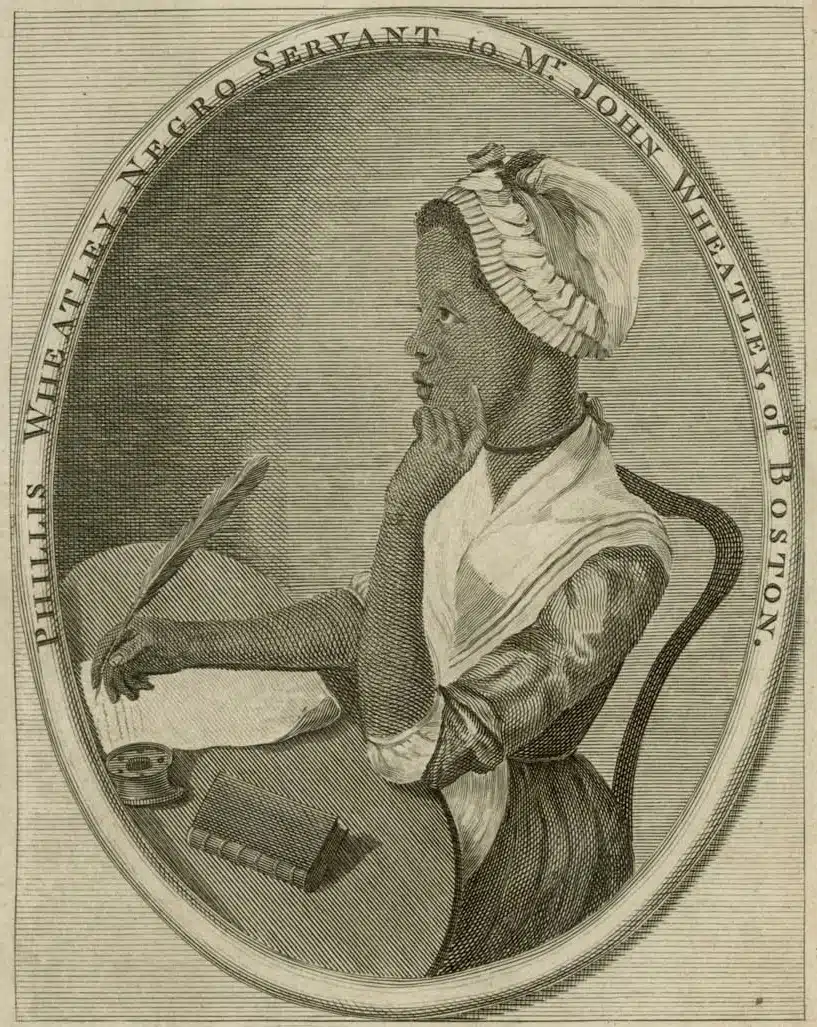
This is the third installment in our series commemorating the 250th anniversary of American independence, with thirteen of the most important images of people, events, and ideas involved in shaping our Declaration of Independence. Make sure to read the first installment — Independence Forever.
In 1762 Americans celebrated the coronation of George III, a young and vigorous king at the head of a triumphant empire. Americans soon learned to despise his ministers and ultimately concluded that the king was intent on stripping them of the rights of Englishmen. “The history of the present King of Great Britain,” says our Declaration of Independence, “is a history of repeated injuries and usurpations, all having in direct object the establishment of an absolute Tyranny over these States. To prove this, let Facts be submitted to a candid world.”

Allan Ramsay painted the king’s coronation portrait in 1761-62. The artist’s studio produced dozens of replicas of the portrait that were sent to colonial governments and British ambassadors. Together with thousands of engraved copies they made it the best known portrait of George III. This is Ramsay’s original and demonstrates his remarkable talent for depicting rich silk, velvet, and ermine. The king’s relaxed pose and the fact that his crown is barely visible in the background mark this as a casual royal portrait by eighteenth-century standards. The young king hated partisanship and longed to be respected as the common father of all his people at the head of a unified nation. Royal Collections Trust (for more on how contemporaries imagined George III, read A Portrait of George III).
What follows is a long bill of indictment of George III, a spectacular act of treason concluding that a king “whose character is thus marked by every act which may define a Tyrant, is unfit to be the ruler of a free people.” In our age of unfettered expression, when attacks on government officials are published every day, the boldness of these charges may be hard to grasp. Nothing quite like it had ever been published.
In his draft of the Declaration, Jefferson added: “Future ages will scarcely believe that the hardiness of one man adventured, within the short compass of twelve years only, to lay a foundation so broad & so undisguised for tyranny over a people fostered & fixed in principles of freedom.” Congress struck this sentence out of the final version.
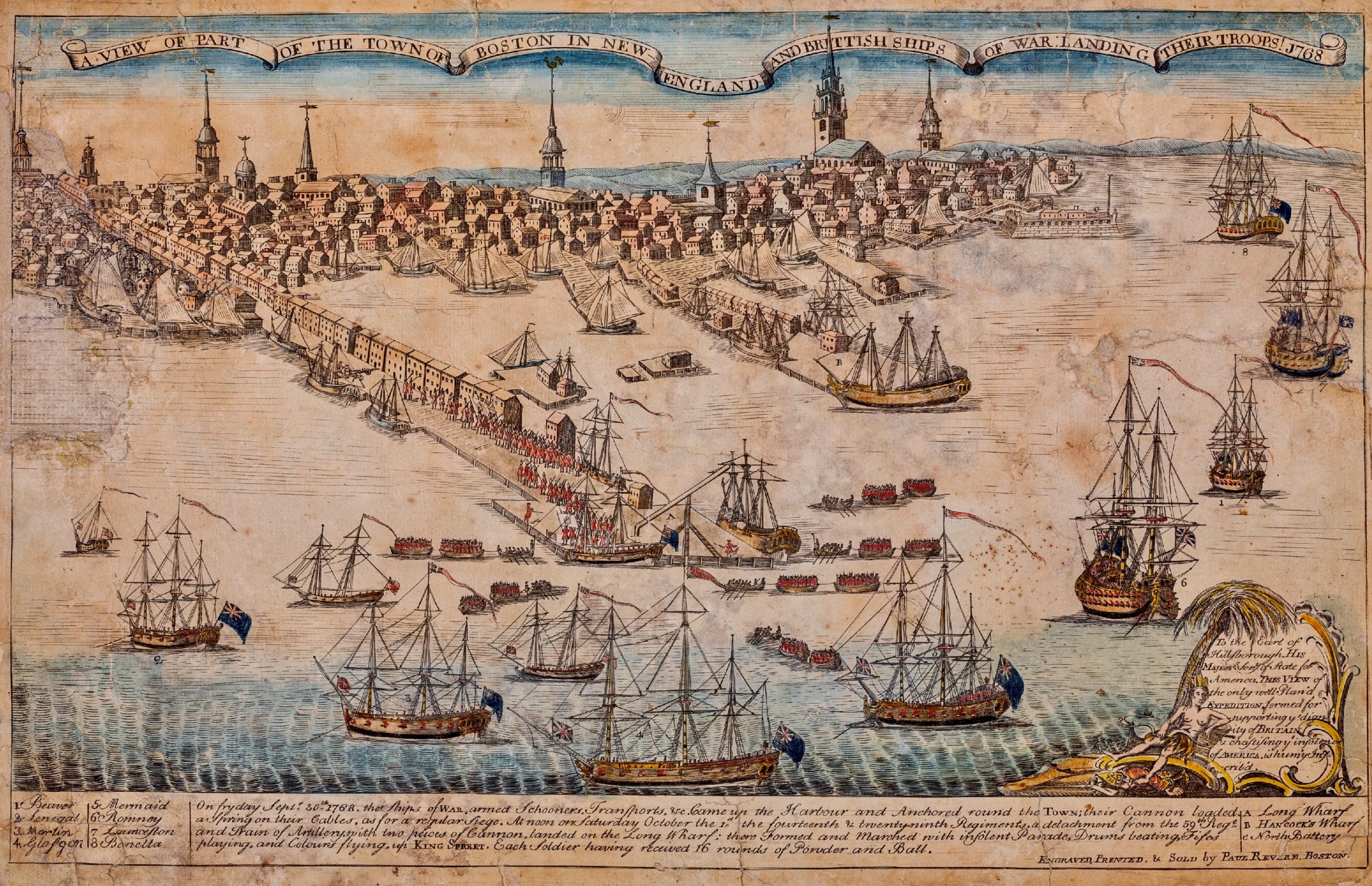
British warships entered Boston Harbor in 1768 with their gun ports open — a provocative gesture intended to intimidate the colonists and signal the British government’s intention to deal harshly with resistance. A View of Part of the Town of Boston in New-England and Brittish Ships of War Landing their Troops! 1768, Paul Revere, 1770, American Antiquarian Society
Among the most serious charges the Declaration made was that the king “has kept among us, in times of peace, Standing Armies without the Consent of our legislatures.” In 1768 the British had landed four regiments, each of some seven hundred men — that’s one soldier for every six civilians — to impose the government’s will on Boston. The warships that brought them entered the harbor with their gun ports open and the occupying army entered the city with bayonets fixed.
Silversmith Paul Revere engraved that appalling scene and the inevitable result of the occupation: a confrontation between the king’s troops and angry civilians in which five Bostonians were killed and six wounded in a tragedy known ever since as the Boston Massacre. We have seen this happen too many times since — in Europe under the Nazis, in Soviet Russia, and in the horrifying genocides of our own time, in massacres so appalling that what happened in Boston so long ago has lost the power it once had to disturb us as deeply as it should. Yet the scenes are often much the same. Revere’s King Street is Tiananmen Square in miniature.

Paul Revere copied — stole actually — this design from artist Henry Pelham, who published his version with the title The Fruits of Arbitrary Power. Both engravings symbolize the consequences of unchecked authority and military occupation. The little dog in the foreground symbolizes the betrayed loyalty of the colonists. The artists have renamed the customs house “Butcher’s Hall.” A gunman fires from a window — probably an allusion to a customs official who shot from a window of his house and killed a boy a few days before the massacre. The Bloody Massacre perpetrated in King Street Boston on March 5th 1770 by a party of the 29th Regt, Paul Revere, 1770, Massachusetts Historical Society. For more, read Lessons from the Boston Massacre.
A few minutes before dawn on April 19, 1775, British troops on an expedition to confiscate arms stored in Concord, Massachusetts, fired on armed militiamen on the Lexington Green. They killed eight men and wounded nine others. The rest dispersed.
Reports spread quickly and when the British reached Concord militia gathered there was prepared to resist. The two sides exchanged fire and several men — British Regulars as well as militia — were killed. The British ransacked the town but found few weapons. They returned to Boston the way they had come, fighting a running battle the whole way.
By the time the British troops reached Boston colonists had killed or wounded 272 of the king’s soldiers. The dead were scattered along the road. Colonists took their weapons, stripped the bodies, and buried many of them in shallow graves where they fell. The Regulars had killed over 100 colonists but had accomplished nothing of military importance. They had been sent to Boston to impose order and had started a war instead.
Two militiamen, Amos Doolittle and Ralph Earl, visited Lexington a few weeks after the encounter and spoke to eyewitnesses. Earl drew the scene and Doolittle, a silversmith, engraved it for sale. This is the first image of the first battle in our nation’s history.
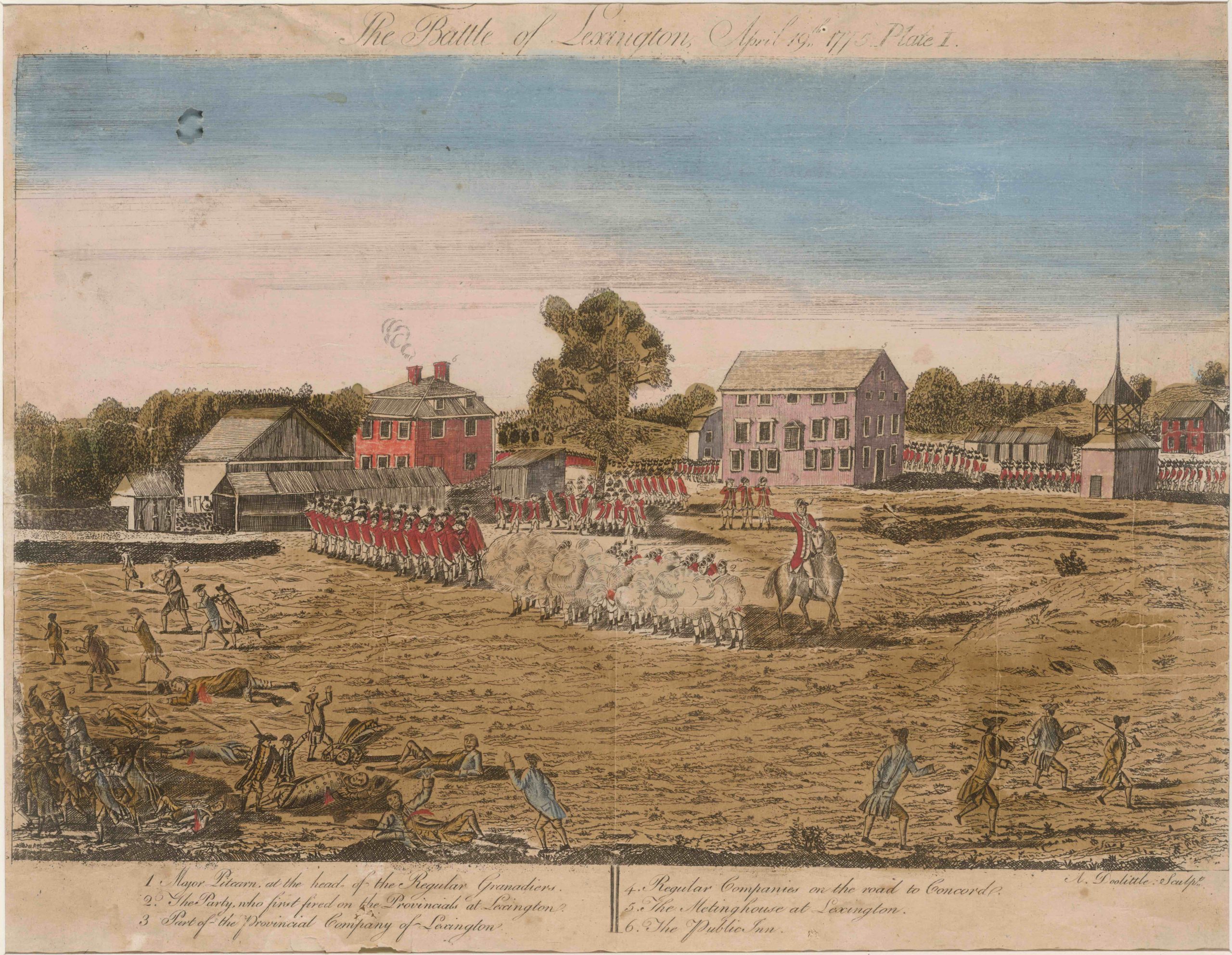
Joseph Warren, president of the Massachusetts Provincial Congress, charged that the British army had committed “barbarous Murders on our innocent Brethren” at Lexington. Amos Doolittle’s engraving of the scene reflected that view. The fighting looks entirely one sided. The British are delivering an organized volley and no American is returning fire. A few are looking toward the British but most are fleeing, leaving the green scattered with dead and wounded men. The Battle of Lexington, April 19th 1775, Ralph Earl and Amos Doolittle, 1775, Brown University Library. For more, read Imagining the Battle of Lexington and watch the Imagining the Battle of Lexington documentary video.
Two months later the British attacked Massachusetts militia at the Battle of Bunker Hill. When the war was over John Trumbull, who had witnessed the fight from afar, painted this imaginative version of the battle in the spirit of reconciliation. In the middle British Major John Pitcairn staggers, mortally wounded, while in the foreground a British officer stays the hand of a grenadier about to bayonet patriot leader Joseph Warren, who lies dying in the arms of a friend.
The painting is full of drama, but it didn’t happen this way. Warren — the president of the Massachusetts Provincial Congress who fought as a private — was shot in the head and bayoneted repeatedly. A British sailor later opened Warren’s shallow grave and desecrated his body. Our war for independence was marked from beginning to end by such brutality. Americans paid an awful price for freedom.
A year after Bunker Hill the Declaration of Independence condemned the king for presiding over these atrocities. “He has plundered our seas, ravaged our Coasts, burnt our towns, and destroyed the lives of our people,” it said, and he was “transporting large Armies of foreign Mercenaries to compleat the works of death, desolation and tyranny, already begun with circumstances of Cruelty & perfidy scarcely paralleled in the most barbarous ages, and totally unworthy the Head of a civilized nation.”
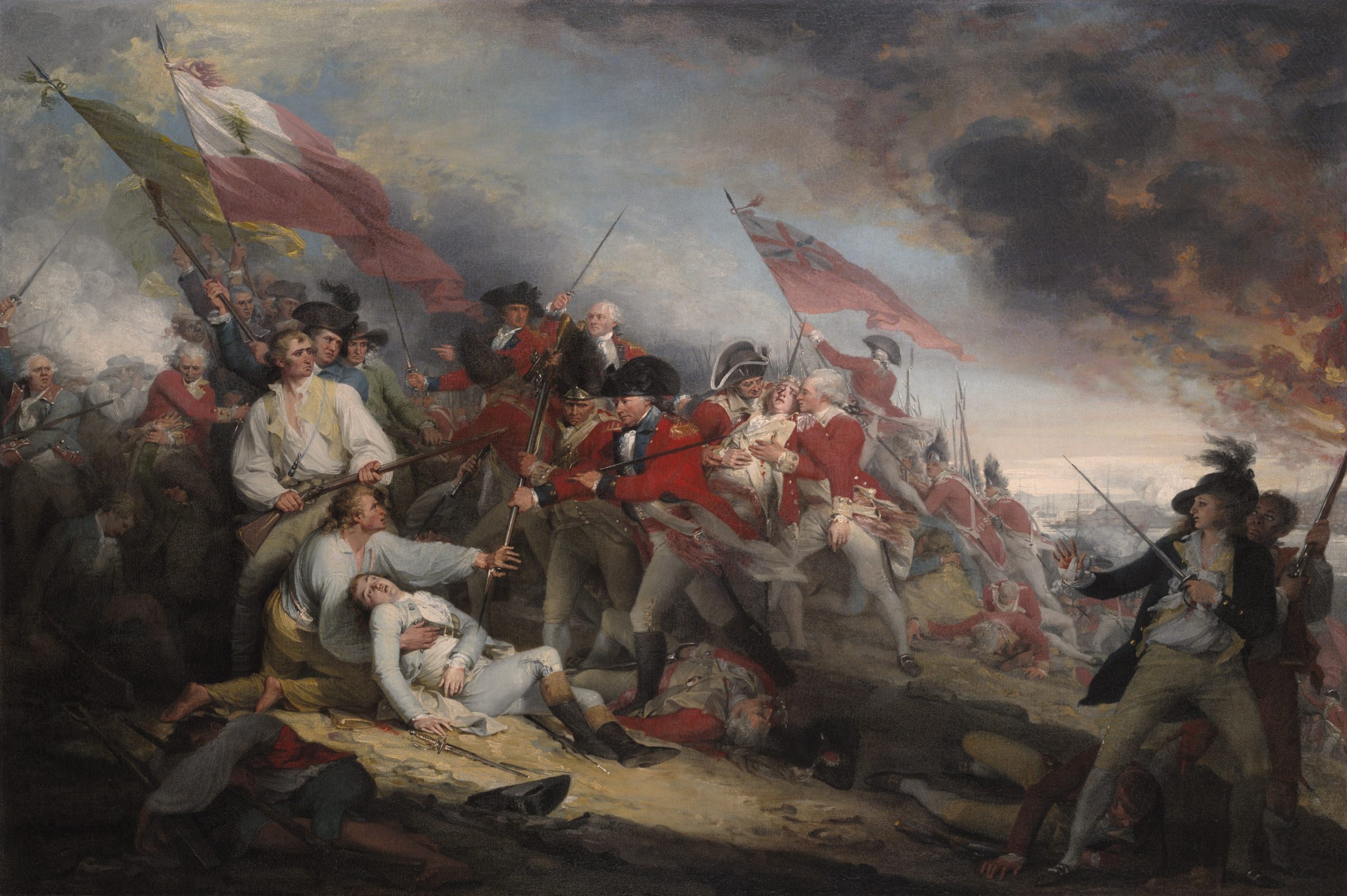
In his painting of the Battle of Bunker Hill, John Trumbull’s aim was to underscore the tragedy of a war between peoples joined by common traditions, customs, and history. The painting consists of pairs. The red New England flag mirrors the British red ensign. Israel Putnam at far left raises his sword to order his men to retreat while General Sir Henry Clinton raises his sword to order his men forward. At center Joseph Warren dies in the arms of a friend while British Major Pitcairn falls mortally wounded into the arms of his son. The Battle of Bunker’s Hill, June 17, 1775, John Trumbull, 1786, Yale University Art Gallery. For two other views of the Battle of Bunker Hill, including the first published depiction of an American battle, read Broken Officer: Two Views of Bunker Hill.
Many British observers thought the rebellion in America would be limited to New England, but in June 1775 the Continental Congress, representing all thirteen colonies, voted to create an American army and appointed a Virginia delegate, George Washington, to command it.
The choice was obvious. Washington had commanded troops in the French and Indian War and was committed to the American cause. He was tall and athletic, a graceful dancer and, according to Thomas Jefferson, “the best horseman of his age.”1 Washington stood out in a Congress full of stout, middle-aged men. He seemed younger than forty-two, yet his serious manner attracted the attention of much older members. He wore his militia uniform on the floor of Congress and listened intently. He said little in debate, but in private he asked: “Shall we supinely sit, and see one Provence after another fall a Sacrafice to despotism?”2
He accepted the appointment, insisting that he would serve without pay, and set off to take command outside Boston. Before he left he wrote home to his wife, Martha:
You may believe me my dear Patcy, when I assure you, in the most solemn manner, that, so far from seeking this appointment I have used every endeavor in my power to avoid it, not only from my unwillingness to part with you and the Family, but from a consciousness of its being a trust too great for my Capacity and that I should enjoy more real happiness and felicity in one month with you, at home, than I have the most distant prospect of reaping abroad, if my stay were to be Seven times Seven years.
He told her he hoped to be home by the fall. Except for a brief stop on his way to Yorktown in 1781 he would not return home for eight years.3
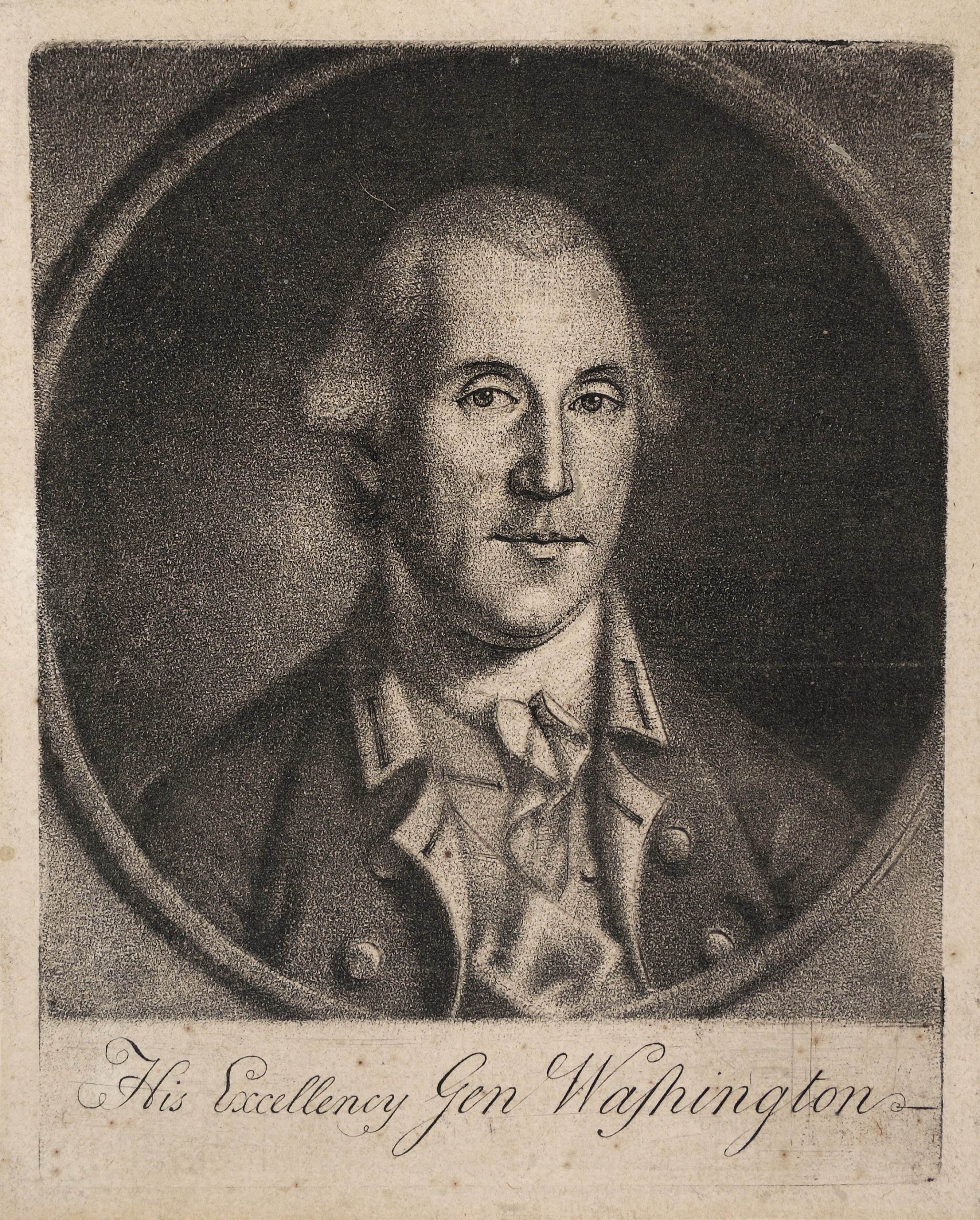
Despite his limited experience as a mezzotint artist, Peale portrayed Washington as his contemporaries described him. Abigail Adams, who first saw Washington at camp in Cambridge in 1775, wrote to her husband: “I was struck with General Washington. You had prepaired me to entertain a favorable opinion of him, but I thought the one half was not told me. Dignity with ease, and complacency, the Gentleman and Soldier look agreably blended in him. Modesty marks every line and feture of his face.”4 His Excellency Gen Washington, Charles Willson Peale, 1778, Society of the Cincinnati. For more on Peale’s engraved portrait read What Did George Washington Look Like?
Washington is so famous that it is hard to imagine a time when Americans didn’t know what he looked like. But during the first years of the Revolutionary War the only people who did had either seen him in person or had seen one of the very few painted portraits of him. Charles Willson Peale sought to remedy that with this engraving, the first published image of Washington based on a portrait done from life. Peale had about one hundred copies printed — only a few of the originals are known today — but the image was copied by scores of other engravers and became the most widely known portrait of Washington during Revolutionary War.
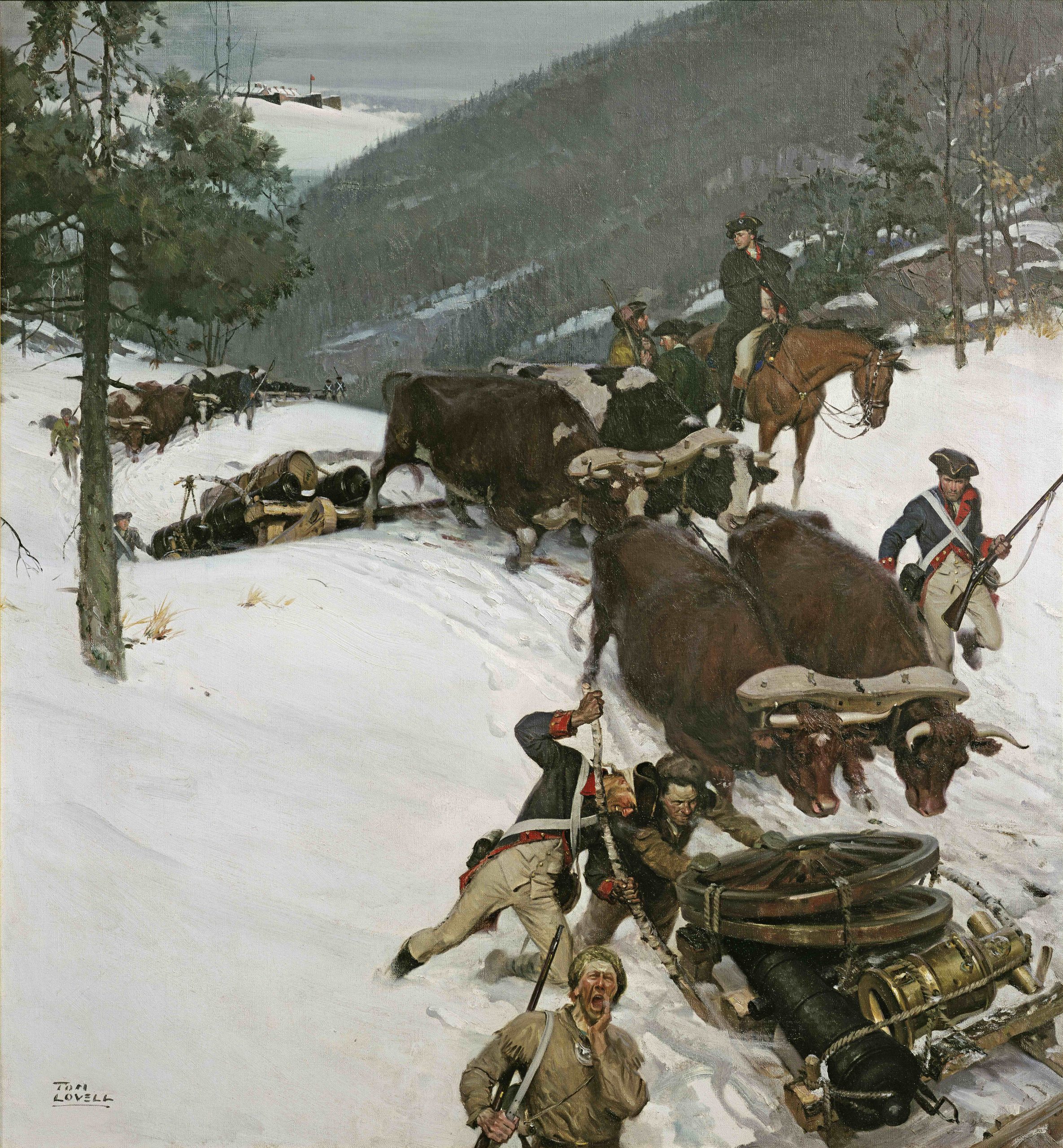
No contemporary depicted Henry Knox and his men hauling artillery from Fort Ticonderoga to Washington’s army outside Boston, but illustrator Tom Lovell captured the spirit of their heroic effort in this painting. The idea of hauling sixty tons of heavy artillery and ammunition overland seemed, in some respects, preposterous, but if it could be done at all it had to be done in winter, when the roads were frozen hard enough to bear the weight of the heavy guns, which they hauled most of the way on sleds. If they had waited until spring the task would have been impossible. The Noble Train of Artillery, Tom Lovell, 1946, Courtesy Dixon Ticonderoga Company
To drive the British out of Boston, Washington needed heavy artillery. He sent twenty-five-year-old Henry Knox to collect it from Fort Ticonderoga. Knox loaded fifty-nine guns weighing some sixty tons on sleds and hauled them three hundred miles through backcountry New York and across Massachusetts. The Continental Army then rolled the guns onto Dorchester Heights, within range the British warships in Boston Harbor. The British promptly evacuated Boston and sailed away. Congress voted to give Washington a gold medal to commemorate the victory. Washington knew celebration was premature. He expected the British army to return in greater force before the end of summer.

Although Congress voted in 1776 to present George Washington with a gold medal for compelling the British evacuation of Boston, the medal was not made until after the war. It was designed and struck in Paris under the direction of Thomas Jefferson, who brought it to the United States and presented it to Washington — by then our first president — in 1790. George Washington Comitia American Medal, Pierre Duvivier, 1789, Boston Public Library5
While John Adams worked to secure the votes to pass Richard Henry Lee’s resolution on independence, Congress assigned a committee of five — Benjamin Franklin, John Adams, Thomas Jefferson, Robert Livingston, and Roger Sherman — to write a declaration announcing the decision. The others delegated the work to Jefferson, who at thirty-three was the youngest member of the committee. He wrote the Declaration in a rented room during the last three weeks of June 1776.6 A bookish man, he had no books at hand to guide him. He needed none. His aim, he later explained, was “to place before mankind the common sense of the subject, in terms so plain and firm, as to command their assent, and to justify ourselves in the independent stand we were compelled to take. Neither aiming at originality of principle or sentiment, nor yet copied from any particular and previous writing, it was intended to be an expression of the American mind.”7
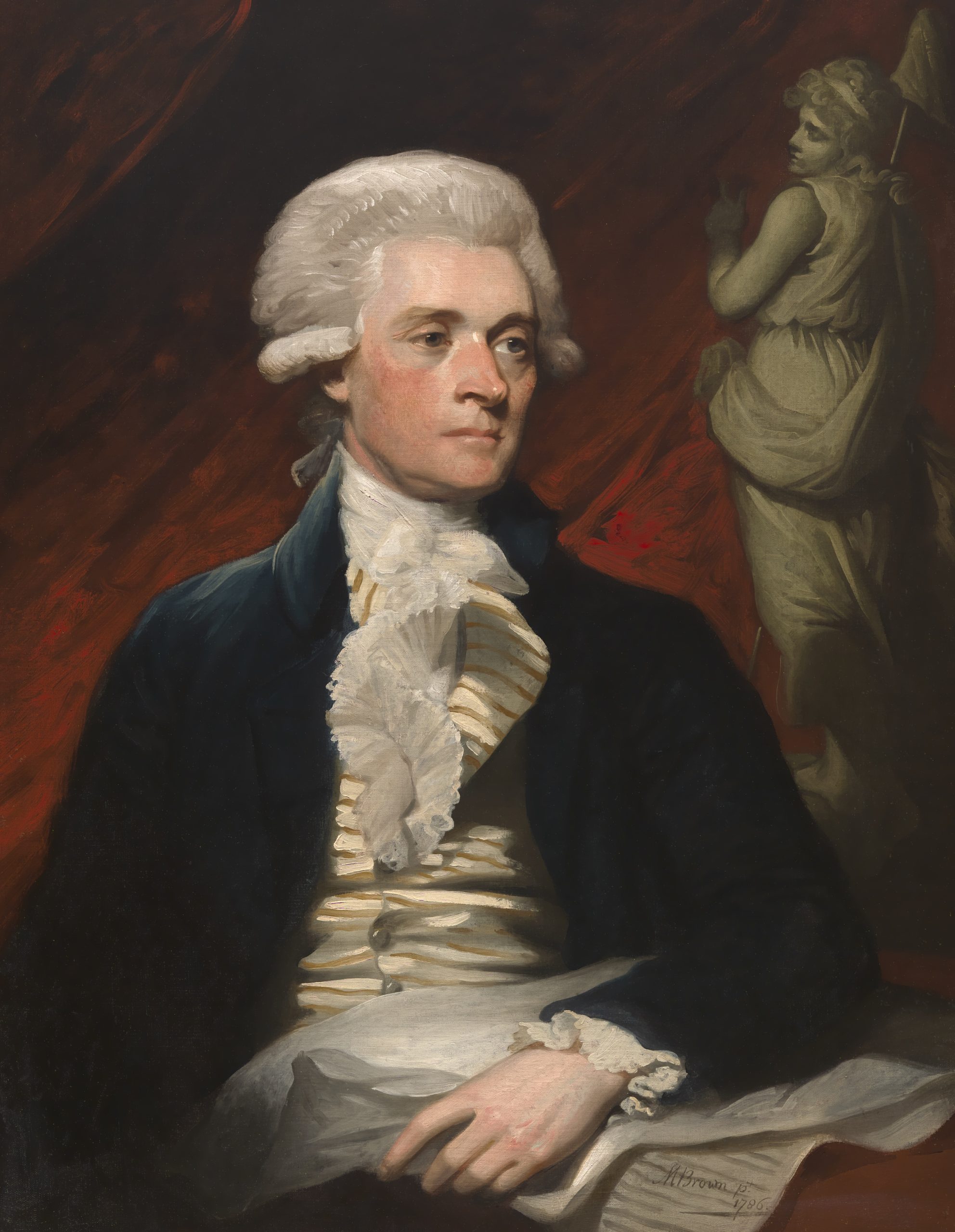
All carefully powdered and dressed in the latest fashions, this isn’t Thomas Jefferson as we usually imagine him. But this is the surviving portrait of Jefferson closest in time to his authorship of the Declaration of Independence. It was painted by Mather Brown in London in the spring of 1786, when Jefferson — then ambassador to France — traveled to London to meet with John Adams, then our first ambassador to Great Britain. Jefferson was forty-three and Brown, also an American, was all of twenty-four. Jefferson paid Brown ten pounds for the original, which was later lost. This is the replica Brown painted at the same time for John Adams, who also commissioned a portrait of himself from Brown. After returning to America Jefferson dressed more simply, in a manner he regarded as appropriate for a citizen of a republic of equals. Thomas Jefferson, Mather Brown, 1786, National Portrait Gallery
Jefferson was being modest when he wrote that the Declaration of Independence did not express any original ideas. The way he expressed and combined ideas was deeply original and has shaped our discussions and debates about the meaning of freedom for 250 years.
Congress took up Jefferson’s draft on July 2 and debated it clause by clause, changing and deleting for two days. Franklin and Jefferson said little. Franklin had no skill in debate, and Jefferson thought it was inappropriate for him to defend his own words. The task of defending Jefferson’s work fell mainly on Adams.8

The final engrossed version of the Declaration of Independence, now in the rotunda of our National Archives, is badly faded and nearly illegible. But Jefferson’s draft of the Declaration is perfectly clear and in many ways more interesting. It reflects the evolution of his thinking about the document and suggestions made by John Adams and Benjamin Franklin, identified by Jefferson in the margin at lower left. Library of Congress. For more on the central ideas of the Declaration, read Getting Right with the Declaration of Independence.
John Trumbull’s painting of the committee presenting Jefferson’s draft on June 28 is a tribute to the members who risked their lives, fortunes, and honor by declaring American independence. The scene could not have actually look like this. Trumbull included members who weren’t in Congress that day, but all of them played a role, large or small, in the drama.

John Trumbull’s depiction of the room where Congress met in the Pennsylvania State House — what we know as Independence Hall — is fanciful. Trumbull probably never saw the room. But he spent decades making sketches and life portraits of the signers of the Declaration and placed as many of them as he could fit in his painting of the five-member committee presenting the draft Declaration to John Hancock. The Declaration of Independence, John Trumbull, 1786-1820, Yale University Art Gallery
On July 4 all of the delegates present except for John Dickinson of Pennsylvania, who still hoped for reconciliation with Britain, voted to approve the revised Declaration of Independence. The text was given to printer John Dunlap, who printed the Declaration late that night. Dunlap probably printed about two hundred copies. Twenty-six are known today. On July 5 Charles Thompson, the secretary of Congress, dispatched copies to the governments of each of the newly independent states as well as to George Washington, who had gathered the Continental Army around New York City in anticipation of a British attack.

On July 4 Congress delivered a manuscript of the finished and approved Declaration of Independence to Philadelphia printer John Dunlap. By the next morning he had set it in type and printed it in as an elegant broadside. This first printing of the Declaration included the names of John Hancock, president of Congress, and Charles Thomson, the secretary. In 1777 Congress commissioned Baltimore printer Mary Katharine Goddard to print a new broadside of the Declaration with the names of all the signers. The Declaration of Independence, Dunlap Printing, 1776, Yale University Library
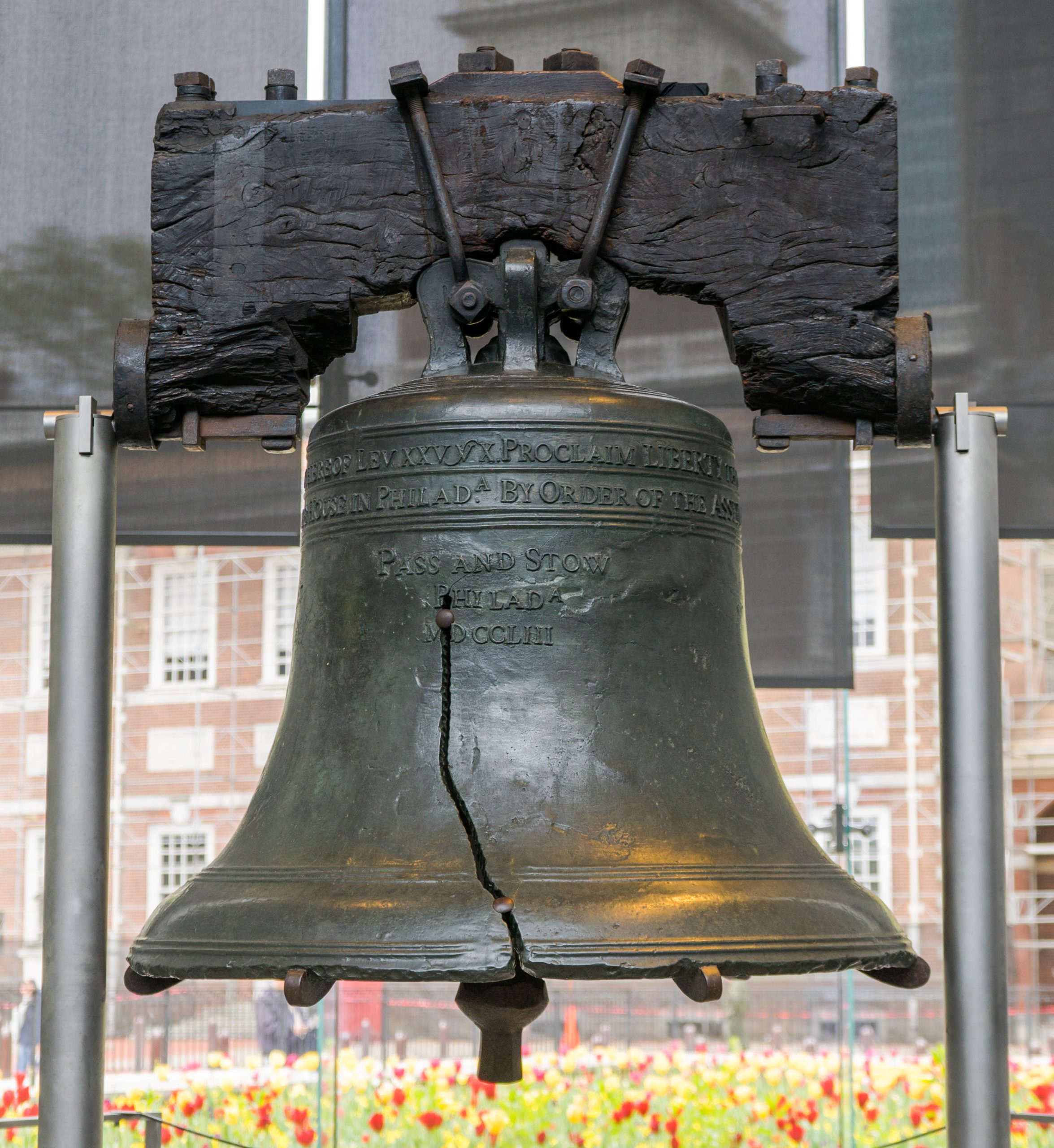
Colonel John Nixon, commander of Philadelphia’s defenses, read the Declaration to a crowd gathered in the State House yard on July 8. The bells in the city rang late into the night. Among them was undoubtedly the bell in steeple of the State House, on which was cast a command God gave to Moses recorded in the Book of Leviticus: “Proclaim LIBERTY Throughout all the Land unto all the Inhabitants Thereof.” Since the 1830s that bell has been known as the Liberty Bell.
The next day, at General Washington’s command, the Declaration was read to the troops gathered around New York City. The war they had been fighting for more than a year now had a clear purpose. What had started as armed resistance to the British army had become a war for independence.

After hearing the Declaration New Yorkers pulled down their gilded statue of George III. They scraped off the gold leaf, broke up the four thousand pounds of lead beneath, and carted it to Connecticut where the lead was cast into musket balls to shoot at the king’s soldiers. “The Emanations of the Leaden George,” a Massachusetts soldier wrote, “will make as deep an impression in the Bodies of read Coated and Torie Subjects” as the “Folly and pretended Goodness of the real George have made upon their Minds.”9 Pulling Down the Statue of George III at Bowling Green, William Walcutt, 1857, Lafayette College Art Collection
Notes
- Thomas Jefferson to Walter Jones, January 2, 1814, J. Jefferson Looney, ed., The Papers of Thomas Jefferson, Retirement Series, vol. 7: November 28, 1813-September 30, 1814 (Princeton: Princeton University Press, 2010), 100–104. This is sometimes misquoted as “the best horseman of the age,” which is unambiguous high praise, but Jefferson’s use of “his age” leaves open the possibility that he meant that Washington was a better rider than men of his chronological age, not the best of his time. [↩]
- George Washington to Bryan Fairfax, July 20, 1774, W.W. Abbot, et al., eds, The Papers of George Washington, Colonial Series, vol. 10: March 21, 1774-June 1775 (Charlottesville: University Press of Virginia, 1995), 128-31. [↩]
- George Washington to Martha Washington, June 18, 1775, Philander D. Chase, ed., The Papers of George Washington, Revolutionary War Series, vol. 1: June 1-September 15, 1775 (Charlottesville: University Press of Virginia, 1985), 3-6. [↩]
- Abigail Adams to John Adams, July 16, 1775, Lyman H. Butterfield, ed., Adams Family Correspondence, vol. 1: December 1761 - May 1776 (Cambridge: Harvard University Press, 1963), 245-51. [↩]
- The resolution to present the medal was introduced by John Adams, who wrote to Washington on April 1, 1776: I congratulate you, sir, as well as all the Friends of Mankind on the Reduction of Boston, an Event which appeared to me of so great and decisive Importance, that the next Morning after the Arrival of the News, I did myself the Honour to move, for the Thanks of Congress to your Excellency and that a Medal of Gold should be struck, in Commemoration of it.” John Adams to George Washington, April 1, 1776, Philander Chase, ed., The Papers of George Washington, Revolutionary War series, vol. 4: April 1 – June 15, 1776 (Charlottesville: University Press of Virginia, 1991), 1-4. David Humphreys was subsequently delegated to oversee the design and production of the medal. See David Humphreys to George Washington, May 10, 1785, W. W. Abbot, ed., The Papers of George Washington, Confederation Series, vol. 2: July 18, 1784 – May 18, 1785 (Charlottesville: University Press of Virginia, 1992), 545-47. “Notes on American Medals Struck in France,” Julian P. Boyd, ed., The Papers of Thomas Jefferson, vol. 16: November 30, 1789-July 4, 1790 (Princeton: Princeton University Press, 1961), 53-66. Citizens of Boston purchased the medal from a collateral descendant of George Washington in 1875 and presented it to the city in commemoration of the centennial of the event it commemorates. The city entrusted it to the library. [↩]
- On Jefferson’s service in Congress and the drafting of the Declaration, see Dumas Malone, Jefferson and His Time, vol. 1: Jefferson the Virginian (Boston: Little Brown and Company, 1948), 197-231, and Julian Boyd, The Declaration of Independence: the evolution of the text as shown in facsimiles of various drafts by its author, Thomas Jefferson (Princeton: Princeton University Press, 1945). [↩]
- Thomas Jefferson to Henry Lee, May 8, 1825, Paul L. Ford, ed., The Writings of Thomas Jefferson, vol. 10 (New York: G.P. Putnam’s Sons, 1899), 343 [↩]
- Pauline Maier, American Scripture: Making the Declaration of Independence (New York: Vintage, 1998), 97-153, reviews the revision of Jefferson’s draft by the committee and the other delegates. [↩]
- Edward Bangs, ed., Journal of Isaac Bangs, April 1 to July 29, 1776 (Cambridge, Massachusetts: University Press, 1890), 57 (July 10, 1776). [↩]